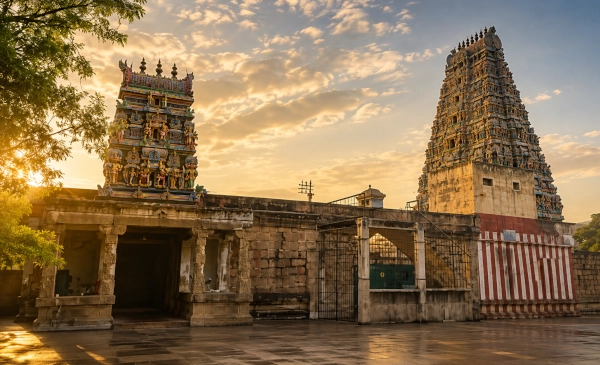
A newly discovered 13th-century Tamil inscription at the Thanthondreeswarar Temple in Anandur, near Pochampally in Tamil Nadu’s Krishnagiri district, has revealed evidence of Jewish merchants participating alongside other trading communities in the construction of a mandapam at the Shiva temple.
The inscription was noticed after villagers cleared vegetation around the temple and alerted local researchers. Scholars associated with the Krishnagiri District Government Museum and historical research organisations subsequently examined the stone and identified it as a medieval merchant-guild inscription.
According to the researchers, the inscription names four merchant groups — Soothakar, Mandala Vanigar, Tennilankai Valanjiyar and Ezhunootruvar — who jointly contributed to the construction of a hall at the Thanthondreeswarar temple.
Of particular importance is the reference to Soothakar, which researchers interpret as a Tamil rendering associated with Jewish merchants. If the interpretation is sustained through further epigraphic study, the inscription provides rare evidence that Jewish traders were not confined to coastal settlements but had become integrated into commercial networks extending into the interior of medieval Tamil Nadu.
The discovery is significant because Jewish epigraphic evidence from medieval Tamil Nadu remains extremely limited. Researchers associated with the find describe the Anandur record as only the second known Tamil inscription of this period to refer to a Jewish commercial presence in the state.
The earlier example came from the Periyapattinam-Valantharavai region of Ramanathapuram district, where a 13th-century Tamil inscription discovered in 2022 recorded land associated with a Suthapalli, interpreted by epigraphists as a Jewish place of worship. That inscription also reflected the presence of powerful merchant organisations such as the Ainnurruvar and showed how religious communities were embedded within South India’s wider commercial world.
The Anandur discovery adds an important inland dimension to that picture. The temple lay close to an old commercial route associated with Thagadur, the historic Dharmapuri region, and the Adhiyaman Peruvazhi, an ancient trade artery extending towards what researchers identify as Navalthavalam in the present-day Chittoor region of Andhra Pradesh.
Previous archaeological finds along this route include merchant inscriptions and distance-marker stones, indicating that the corridor once linked settlements, market centres and halting points across a much larger commercial landscape. Anandur appears to have formed part of this network rather than existing as an isolated temple settlement.
This context may explain why several merchant organisations jointly financed a temple structure there. Medieval South Indian temples frequently operated as more than purely religious institutions. They could function as centres of economic exchange, landholding, storage, employment and hospitality, while merchant guilds often made donations to temples situated along important routes.
A mandapam constructed with merchant support could therefore have served both ritual and practical functions, including accommodation, assembly or rest for travellers and trading groups moving through the region.
The presence of Tennilankai Valanjiyar is also notable. Historical records show that Valanjiyar merchant communities operated across South India and Sri Lanka and participated in long-distance commercial networks. Their appearance alongside other merchant groups at Anandur reinforces the picture of the region as part of an interconnected trading system extending beyond local boundaries.
The newly identified inscription therefore provides a glimpse into a commercial environment in which merchants of different geographic and cultural backgrounds could cooperate around common institutions. Rather than portraying religious communities as economically isolated, the record suggests participation within broader guild structures and shared commercial networks.
Researchers have also noted that the Thanthondreeswarar temple has yielded other historical material in the past, including a merchant-guild inscription associated with the Kulothunga Chola period and several memorial stones. The latest find consequently adds to an already substantial body of evidence indicating prolonged commercial and social activity around the site.
The wider significance of the inscription lies in what it reveals about medieval South India’s openness to international commerce. Tamil merchant organisations operated across the Indian Ocean, connecting inland production centres with ports and overseas markets stretching towards Sri Lanka, Southeast Asia, West Asia and beyond.
Foreign-origin merchant communities entering these networks did not necessarily remain confined to port cities. The Anandur inscription suggests that some participated in inland commerce and contributed to local institutions far from the coast.
The discovery also adds another layer to the history of Jewish communities in India. While Kerala’s Jewish settlements are far better known, archaeological and epigraphic evidence from Tamil Nadu increasingly suggests that Jewish traders also maintained connections with the eastern and southeastern coasts of the peninsula during the medieval period.
Further scholarly publication of the inscription, including a complete estampage, transcription and palaeographic analysis, will be important for establishing its precise date and confirming the interpretation of individual terms.
Even at this preliminary stage, however, the Anandur inscription is an important addition to the archaeology of medieval Tamil Nadu. It reveals a commercial landscape in which Jewish merchants, Tamil trading guilds, Sri Lanka-linked merchant groups and temple institutions intersected along inland trade routes more than seven centuries ago.
The find strengthens the view of medieval Tamil Nadu not as an isolated regional economy, but as a deeply connected part of the wider Indian Ocean trading world.
You may also like
-
India Begins National Push to Preserve Tribal Languages and Digitally Transform Tribal Museums
-
Malava in the Mahabharata: The Ancient Warrior People Behind the Malwa Region
-
Avanti in the Mahabharata: The Ancient Kingdom of Ujjain and the Malwa Region
-
Karusha in the Mahabharata: The Ancient Kingdom of Baghelkhand and the Vindhyan Heartland
-
Indian Woodblock Craft Helps Preserve Indigenous Australian Designs for Future Generations
