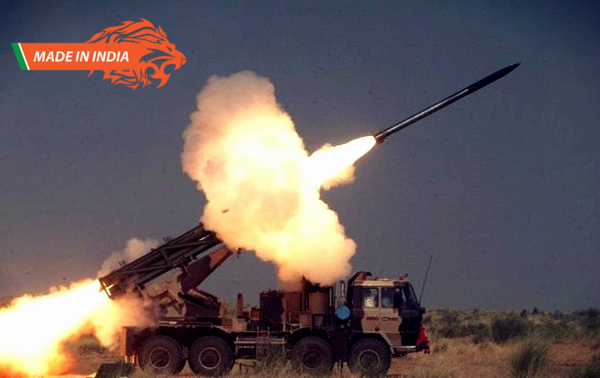
India’s indigenous rocket-artillery programme is moving towards a new class of long-range precision weapon, with the Defence Research and Development Organisation working on a 300-km-class guided rocket intended to give the Indian Army the ability to strike high-value targets far beyond the reach of conventional tube artillery.
The programme represents the next major step in the evolution of the Pinaka Multi-Barrel Rocket Launcher family, which began as a battlefield saturation system and is steadily being transformed into a networked precision-strike platform. Official Indian public-broadcast material has previously confirmed plans to progressively extend Pinaka’s reach from existing guided variants to around 120 km and ultimately 300 km.
Development responsibility for the longer-range Pinaka family centres on DRDO’s Armament Research and Development Establishment (ARDE), supported by laboratories specialising in propulsion, guidance and missile electronics. The broader programme brings together ARDE, the High Energy Materials Research Laboratory, Defence Research and Development Laboratory and Research Centre Imarat, creating an almost entirely Indian development chain for the weapon.
The technological foundation has already begun to mature. In July 2026, DRDO successfully flight-tested the Pinaka Long Range Guided Rocket at the Integrated Test Range in Chandipur. During that test, the rocket was fired at a user-defined minimum range of 60 km, executed its planned in-flight manoeuvres and struck the designated target with what the Ministry of Defence described as textbook precision. Significantly, the weapon was launched from an in-service Pinaka launcher, demonstrating DRDO’s objective of retaining a common launching architecture for rockets of different ranges.
That common-launcher philosophy could become one of the most important advantages of the programme. Instead of creating an entirely separate weapon system for every increase in range, India is attempting to develop a scalable family in which the same basic launcher architecture can support different classes of ammunition. This could simplify logistics, training, deployment and maintenance while allowing artillery units to select ammunition according to the depth and importance of the target.
The proposed 300-km Extended Long Range Guided Rocket, or ELRGR, would take this concept much further. At that distance, the weapon would move Pinaka beyond its traditional battlefield-support role and into the realm of deep precision fires. Such a system could potentially be used against command centres, logistics concentrations, ammunition storage sites, air-defence installations, communication nodes and other high-value fixed targets located well behind the immediate battlefield.
It would also create an important capability between conventional rocket artillery and more expensive tactical missiles. Guided rockets can potentially provide commanders with a weapon that combines substantial range and precision with lower unit costs than many dedicated ballistic or cruise missiles. This becomes particularly relevant when large numbers of precision weapons may be required during sustained operations.
The programme carries a strong Make in India dimension because Pinaka is already supported by one of India’s most developed indigenous artillery-production ecosystems. Indian public and private manufacturers have participated in launcher production, rocket manufacture, ammunition, fire-control equipment and associated vehicles, while DRDO continues to transfer mature technologies to domestic industry.
India’s approach is therefore increasingly moving beyond simply replacing imported weapons. The objective is to establish an indigenous family of long-range strike systems in which the launcher, rocket motor, energetic materials, navigation equipment, guidance electronics, warhead and manufacturing processes can progressively be sourced from within the country.
DRDO’s own technology roadmap for multi-barrel rockets identifies areas such as high-energy propellants, case-bonded rocket motors, hybrid navigation using inertial sensors and Indian satellite-navigation inputs, and lightweight launcher structures as important development areas. These technologies are directly relevant to extending range while retaining accuracy and payload performance.
The 300-km programme also reflects the Indian Army’s broader move toward longer-range precision artillery. Modern conflicts have demonstrated that artillery is increasingly being used not merely to saturate frontline positions but to attack targets deep inside an adversary’s operational rear using accurate, networked munitions. Extending Pinaka into the 300-km category would allow India to develop such capability around a system it already designs and manufactures domestically.
There remains an important distinction between development and operational induction. DRDO has publicly demonstrated the shorter-range LRGR, but it has not yet announced a flight trial of the 300-km ELRGR or disclosed its final configuration, warhead, guidance architecture or induction schedule. Until those milestones are officially announced, claims about specific performance characteristics beyond the intended 300-km-class range should be treated as developmental rather than established operational capability.
Nevertheless, the direction of the programme is clear. Pinaka is evolving from an indigenous replacement for conventional battlefield rocket systems into a much broader family of precision-strike weapons spanning tactical and deep-strike ranges.
References
1. Press Information Bureau — Ministry of Defence, 8 July 2026
DRDO conducts successful flight-test of Pinaka Long Range Guided Rocket
Official confirmation that DRDO successfully tested the Pinaka Long Range Guided Rocket at ITR Chandipur. The rocket was tested at a user-defined minimum range of 60 km, performed planned manoeuvres and struck the target with precision. The release also confirms that the LRGR was launched from an in-service Pinaka launcher.
https://www.pib.gov.in/PressReleasePage.aspx?PRID=2282572&lang=1®=6
2. DRDO — Multi-Barrel Rockets Technology Foresight
Official DRDO technology roadmap covering the technologies being developed for future multi-barrel rocket systems. It lists high-energy propellants, case-bonded rocket motors, hybrid navigation using MEMS IMU with IRNSS/GPS/GAGAN, improved launcher tubes and pod technologies relevant to longer-range precision rockets.
https://drdo.gov.in/drdo/en/offerings/technology-foresight/multi-barrel-rockets
3. DRDO — Guided Pinaka Rocket System
Official DRDO page detailing development and qualification of the Guided Pinaka Rocket System, including successful range, accuracy, consistency, multiple-target engagement and rate-of-fire trials.
https://drdo.gov.in/drdo/en/offerings/products/guided-pinaka-rocket-system
You may also like
-
ICAR Scientists Develop Indigenous Protective Gloves for Cotton Farmers, Sign Commercial Manufacturing Agreement
-
India Moves Towards Five-Year Assured Orders for Defence Startups Under New Procurement Reforms
-
BHEL–Coal India Joint Venture Begins Construction of ₹25,016 Crore Indigenous Coal Gasification Project in Odisha
-
Zen Technologies Introduces Indigenous Hyper-Strike Falcon AI-Guided Counter-Drone Interceptor
-
L&T and Germany’s SCHOTTEL Expand Partnership for Controllable Pitch Propeller Systems in Indian Shipbuilding
