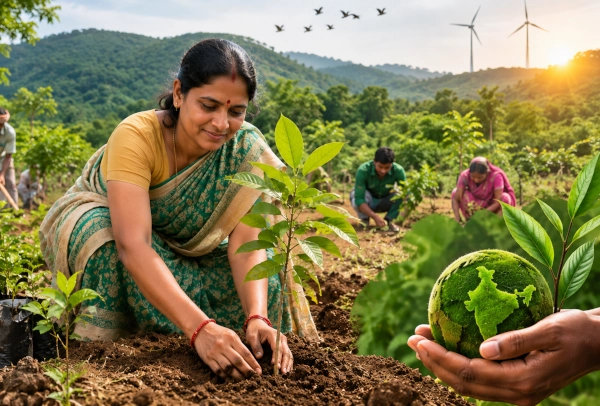
India restored 21.76 million hectares of degraded land between 2011 and 2020, while the associated restoration activities generated around 1.22 billion person-days of employment, highlighting the growing economic and livelihood dimensions of the country’s environmental restoration programmes.
Union Environment, Forest and Climate Change Minister Bhupender Yadav presented the figures at a side event during the 17th Conference of the Parties to the United Nations Convention to Combat Desertification (UNCCD COP17) in Ulaanbaatar, Mongolia, on August 24, 2026.
India has committed to restoring 26 million hectares of degraded and deforested land by 2030 under the Bonn Challenge. The target was expanded from an earlier commitment made in 2015 and forms part of the country’s broader strategy linking land restoration with biodiversity protection, climate resilience and rural development.
The latest figures come from India’s Second Progress Report on the Bonn Challenge, which assessed restoration efforts undertaken between 2011 and 2020. The evaluation covered interventions across forests, agricultural land, soil and water conservation systems and other landscapes rather than measuring restoration solely through increases in forest cover.
The employment generated through these programmes demonstrates how ecological restoration can simultaneously support rural livelihoods. Restoration initiatives can create work through activities such as afforestation, watershed development, soil conservation, agroforestry and the rehabilitation of degraded ecosystems.
India is now preparing its next assessment covering 2021–2025 in collaboration with the ICFRE Centre of Excellence on Sustainable Land Management and the International Union for Conservation of Nature. The new reporting cycle will examine three major indicators — the area restored, financial resources mobilised and employment generated — while strengthening systems for monitoring long-term restoration outcomes.
Several national programmes contribute to India’s land-restoration effort. The Green India Mission focuses on increasing forest and tree cover and improving ecosystem services, while funds channelled through the Compensatory Afforestation Fund Management and Planning Authority support afforestation and related restoration activities.
Urban and peri-urban restoration is being pursued through the Nagar Van Yojana, while watershed development, agroforestry and soil and water conservation programmes extend restoration activity across agricultural and rural landscapes.
The government is increasingly pursuing a landscape-based model that combines programmes implemented by the Centre, states and local communities rather than relying on a single restoration scheme. Such convergence is intended to address the different ecological and livelihood requirements of individual regions.
Looking beyond the 2030 target, India is also seeking stronger financing mechanisms, greater private and public investment, improved monitoring and expanded international cooperation in restoration technologies and practices. Community participation is expected to remain central because many restored landscapes are directly linked to agriculture, forestry and rural livelihoods.
India’s progress indicates that large-scale land restoration can deliver environmental benefits while simultaneously supporting employment and local economies. The next phase will focus not only on expanding the area restored but also on improving the ecological quality, financing and measurable long-term impact of restoration efforts.
Source: PIB: https://www.pib.gov.in/PressReleaseDetail.aspx?PRID=2302676®=48&lang=1
You may also like
-
India’s Livestock Disease-Control Drive Cuts FMD and Brucellosis Outbreaks
-
Trump Points to India’s Voter ID System as He Renews Push for SAVE America Act
-
CERT-In Warns Chrome Users of High-Risk Security Flaws, Urges Immediate Browser Update
-
From Transformation to Viksit Bharat: PM Modi Sets Out India’s Next Development Leap on 80th Independence Day
-
PM Modi Greets Nation on 80th Independence Day, Calls for Renewed Push Towards Viksit Bharat
