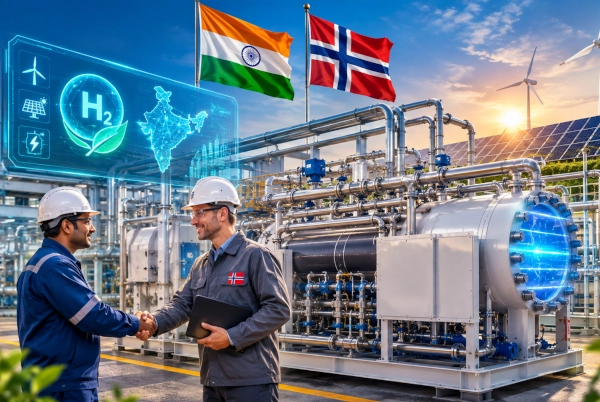
Bharat Heavy Electricals Limited (BHEL) has entered into a strategic partnership with Norwegian hydrogen-technology company Hystar AS to establish phased local manufacturing of proton-exchange-membrane (PEM) electrolyser systems in India, strengthening the country’s domestic green-hydrogen equipment ecosystem.
The agreement, announced on August 13, 2026, combines Hystar’s PEM electrolyser technology with BHEL’s engineering, manufacturing and large-project execution capabilities. The two companies intend to progressively indigenise the technology and develop locally manufactured systems for green-hydrogen projects in the Indian market.
Electrolysers form the technological core of green-hydrogen production. They use electricity to split water into hydrogen and oxygen, and when renewable electricity powers the process, the resulting hydrogen can provide a low-carbon alternative to hydrogen currently produced largely from fossil fuels. PEM electrolysers are particularly suited to renewable-energy applications because they can respond rapidly to changes in power availability from sources such as solar and wind.
For BHEL, the Hystar agreement is part of a broader effort to build domestic capabilities across more than one electrolyser technology. In July 2026, the state-owned engineering company entered into a separate partnership with thyssenkrupp nucera India for phased indigenisation and manufacturing of alkaline electrolyser systems. With the addition of Hystar’s PEM technology, BHEL says it is positioning itself among the relatively small number of Indian companies capable of offering both alkaline and PEM electrolyser solutions.
The two technologies have different strengths. Alkaline electrolysers represent a mature technology widely used for large industrial hydrogen projects, while PEM systems can offer compact designs and flexible operation that works well with fluctuating renewable-electricity generation. Building domestic capabilities in both could allow BHEL to address a wider range of future green-hydrogen projects rather than depending on a single technology platform.
Hystar said the partnership aims to create a pathway towards cost-competitive, locally manufactured PEM electrolyser systems for India. The Norwegian company will contribute its technology, while BHEL will bring its extensive manufacturing infrastructure, engineering expertise and experience in executing large energy and industrial projects.
Local manufacturing is particularly important because electrolysers remain one of the major cost components in producing green hydrogen. India’s National Green Hydrogen Mission specifically seeks to build domestic electrolyser manufacturing capabilities alongside large-scale hydrogen production, reducing dependence on imported equipment and strengthening the country’s clean-energy supply chain.
The National Green Hydrogen Mission targets at least 5 million metric tonnes of annual green-hydrogen production capacity by 2030. The government expects green hydrogen to support decarbonisation in sectors such as petroleum refining, fertilisers, steel, shipping and other industries where direct electrification can be difficult.
India has also begun building an indigenous electrolyser manufacturing base under the mission. By December 2025, incentives had been awarded to 15 companies covering 3,000 MW of annual electrolyser manufacturing capacity, while incentives for 862,000 tonnes of annual green-hydrogen production capacity had also been allocated.
BHEL’s entry into both PEM and alkaline electrolyser technologies could therefore give the public-sector engineering giant an important role as India’s green-hydrogen industry moves from pilot projects towards larger commercial installations. The company already possesses substantial manufacturing and project-execution experience across power generation, transmission, renewables, oil and gas, transportation, defence and aerospace, providing an industrial base that can be adapted for emerging hydrogen projects.
The Hystar partnership represents another step towards moving a critical clean-energy technology into domestic production. If the planned indigenisation progresses to commercial manufacturing, India could gain greater control over a key component of the green-hydrogen value chain while BHEL develops a new industrial business alongside its traditional power and heavy-engineering operations.
For BHEL, the strategy is becoming increasingly clear: rather than entering India’s hydrogen sector through a single technology route, the company is building capabilities across both major water-electrolysis platforms. That could position it to participate in a broad range of future green-hydrogen projects as India works towards domestic manufacturing, energy security and large-scale industrial decarbonisation.
You may also like
-
BHEL–Coal India Joint Venture Begins Construction of ₹25,016 Crore Indigenous Coal Gasification Project in Odisha
-
Zen Technologies Introduces Indigenous Hyper-Strike Falcon AI-Guided Counter-Drone Interceptor
-
L&T and Germany’s SCHOTTEL Expand Partnership for Controllable Pitch Propeller Systems in Indian Shipbuilding
-
PM Modi to Inaugurate RBI’s Tier IV Data Centre and Cybersecurity Training Institute in Bhubaneswar
-
India Creates 11 Crore Digital Farmer IDs Five Months Ahead of Target, Strengthening AgriStack Infrastructure
