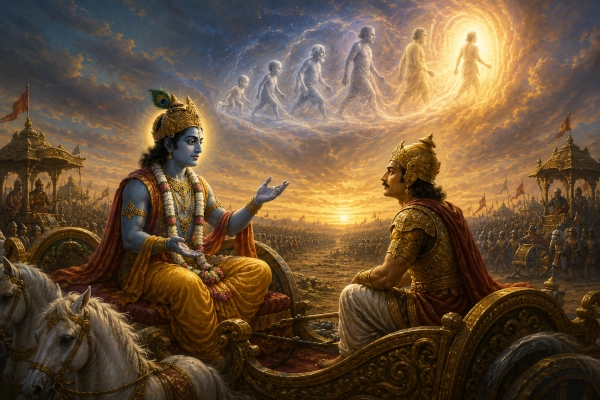
The armies of the Pandavas and Kauravas stood facing one another across the field of Kurukshetra. Conches had sounded, warriors had taken their positions and the greatest battle of the age was about to begin. Yet at the very moment when Arjuna was expected to raise his bow and fight, the renowned warrior found himself unable to move.
Arjuna had asked Krishna, his charioteer, to place their chariot between the two armies so that he could see those who had assembled for battle. What he saw shattered his resolve. On both sides stood men he had known throughout his life—teachers, elders, cousins, friends and relatives. Among them were Bhishma, whom he revered like a grandfather, and Drona, the teacher who had trained him in the use of weapons.
The battlefield no longer looked to Arjuna like a contest between two armies. It looked like the destruction of his own family.
His body trembled. His mouth became dry. The Gandiva bow began slipping from his hands. Victory suddenly seemed meaningless if it could be obtained only by killing the people with whom that victory might otherwise have been shared.
Arjuna told Krishna that he could see no good in the coming war. Kingdom, pleasure and prosperity held little attraction for him if they required the deaths of those standing before him. He began to believe that refusing to fight might be better than participating in such destruction.
Finally, overwhelmed by grief, Arjuna lowered his weapons.
It was at this moment that Krishna began the teaching that would become the Bhagavad Gita.
Krishna Challenges Arjuna’s Understanding of Death
Krishna did not begin by discussing battlefield tactics, politics or even the justice of the Pandava cause. He went directly to the source of Arjuna’s despair: his understanding of life and death.
Arjuna believed that the battle would destroy the people before him completely.
Krishna told him that this belief arose from confusing the temporary body with the eternal Self.
Bodies are born, grow, change, weaken and eventually die. The Atman, however, does not pass through these changes in the same way. It is not created when the body is born, nor does it cease to exist when the body dies.
Krishna therefore tells Arjuna that the wise do not grieve in the same way for the living or the dead, because they understand that the deepest reality of a being is not destroyed when the physical form disappears.
This did not mean that Krishna was dismissing Arjuna’s sorrow. Instead, he was asking him to look beyond what his senses could immediately perceive.
Arjuna saw bodies that could be wounded and killed.
Krishna asked him to recognise the consciousness that could not be destroyed by weapons.
The Self Was Never Born
Krishna then describes the Atman in some of the most profound verses of the Gita.
The Self is unborn, eternal, everlasting and ancient. It does not come into existence at one moment and disappear at another. When the body is destroyed, the Self is not destroyed with it.
This completely changes the meaning of death.
From the ordinary human perspective, birth appears to be a beginning and death appears to be an ending. Krishna presents them instead as changes in the condition through which the eternal Self experiences existence.
The body has a beginning.
The Self does not.
The body has an end.
The Self does not.
Therefore, the deepest identity of Bhishma, Drona, Arjuna and every other person standing on Kurukshetra could not ultimately be destroyed by the weapons of the battlefield.
The Clothes That Are Left Behind
Krishna then gives Arjuna one of the most memorable comparisons in the entire Bhagavad Gita.
A person wears clothes for a time. Eventually those clothes become old, torn or unsuitable. They are discarded and replaced with new garments.
Krishna says that embodied existence can be understood in a similar way.
The Self inhabits a body for a period of time. When that body becomes exhausted and reaches its end, the Self leaves it and takes another.
The old garment is not the person wearing it.
In the same way, the body is not the entirety of the being who experiences life through it.
This simple image allows Krishna to explain an enormous philosophical idea without complicated language. Everyone understands that throwing away a damaged garment does not destroy the person who wore it.
Likewise, death destroys the body but not the Atman.
Weapons Cannot Cut It
Krishna strengthens the teaching by describing everything that cannot happen to the Self.
Weapons cannot cut it.
Fire cannot burn it.
Water cannot wet it.
Wind cannot dry it.
Everything capable of destroying physical objects is powerless against the Atman.
A sword may divide a body.
Fire may consume it.
Water may dissolve matter.
Wind may dry what was once living.
But none of these forces can touch the eternal Self.
Krishna describes it as unchanging, immovable and everlasting. The physical world is constantly transforming, yet the spiritual principle within the individual remains beyond those transformations.
Arjuna’s error therefore lies in believing that the coming battle gives him the power to annihilate another being completely.
Krishna tells him that no human being possesses such power.
The Child, the Adult and the Old Man
Krishna also points to something Arjuna has already experienced throughout his own life.
The body of a child disappears as that child becomes an adult. The youthful body changes again with age. Yet through all these transformations, a person continues to experience a sense of being the same underlying self.
Arjuna was once a child.
That childhood body no longer existed.
He later became a young prince, then a warrior and eventually one of the greatest archers of his generation.
His body had changed continuously.
Yet Arjuna still regarded himself as Arjuna.
Krishna extends this familiar observation beyond death. If consciousness can remain connected with identity through the dramatic transformations of childhood, adulthood and old age, then the death of the body can also be understood as another transition rather than absolute annihilation.
The wise person, Krishna says, is not bewildered by this change.
Why the Teaching Does Not Mean That Life Is Unimportant
Krishna’s teaching about the immortality of the Self can easily be misunderstood if separated from the rest of the Gita.
He is not telling Arjuna that killing is insignificant because nobody truly dies. Nor is he teaching that physical suffering should simply be ignored.
The entire conversation occurs within the larger question of dharma.
Arjuna is a warrior facing a conflict that has emerged after repeated attempts at reconciliation have failed. His responsibility cannot be decided solely by fear, attachment or personal grief. Krishna is preparing him to examine action from a deeper perspective in which duty, intention and attachment must all be considered.
Understanding the immortality of the Self removes one source of Arjuna’s paralysis—the belief that he personally possesses the power to destroy the eternal existence of another being.
It does not remove his responsibility to act according to dharma.
This distinction becomes essential to everything Krishna teaches afterward.
Arjuna’s Fear Was About More Than Death
Arjuna’s crisis is powerful because it is not simply fear of dying.
He is prepared to risk his own life.
What he cannot accept is the possibility that doing his duty may require actions that cause enormous personal pain.
This is why Krishna does not respond merely by telling him to be brave.
Arjuna is already brave.
His problem is deeper.
He has confused emotional attachment with moral certainty.
Because fighting causes him grief, he begins to assume that refusing to fight must therefore be righteous.
Krishna gradually teaches him that painful action can sometimes be necessary, while apparently compassionate inaction can sometimes allow injustice to continue.
Before Arjuna can understand that lesson, however, he must first understand who he truly is.
He is not merely the body standing on the chariot.
Neither are the people before him merely the bodies he sees.
The Deeper Meaning of Krishna’s Teaching
The teaching of the immortal Self reaches far beyond the battlefield of Kurukshetra.
Human beings naturally build identity around things that constantly change—appearance, age, possessions, status, strength and social roles. Yet none of these remain permanent.
The child becomes an adult.
The powerful become weak.
Wealth appears and disappears.
Relationships change.
The body itself changes from moment to moment.
Krishna asks Arjuna to discover something deeper than all of these temporary conditions.
If a person believes that the changing body is the whole of existence, then every physical loss appears absolute. Ageing becomes frightening, death becomes total destruction and attachment becomes almost impossible to escape.
But if the Self is understood as something deeper than the body, then change acquires a different meaning.
Loss remains painful.
Death remains significant.
Yet neither represents the destruction of the deepest reality within a living being.
This understanding is meant to produce neither indifference nor coldness, but steadiness.
The person who understands what is permanent is less easily destroyed by what is temporary.
Moral
Death changes the body, but it does not destroy the eternal Self.
Krishna’s teaching asks Arjuna to distinguish between what changes and what remains. Bodies are born, grow old and disappear, just as worn garments are eventually discarded. The Atman, however, is neither born nor destroyed.
The lesson is not that life should be valued less.
It is that life should be understood more deeply.
When a person recognises that identity is greater than the temporary body, fear loses some of its power, attachment becomes easier to examine and difficult duties can be faced with greater clarity.
Before Krishna teaches Arjuna how to act, he first teaches him who he truly is.
You may also like
-
Aranmula Parthasarathy Temple: The Krishna Shrine Where Mahabharata, Pamba and Kerala’s Temple Culture Meet
-
Procrastination and the Bhagavad Gita: Why We Delay the Life We Are Meant to Live
-
Overcoming Depression Through the Wisdom of the Bhagavad Gita
-
Steadfast in the Storm: The Wisdom of Patience in the Bhagavad Gita
-
Fear, Duty, and Courage: Real-World Lessons from the Bhagavad Gita
