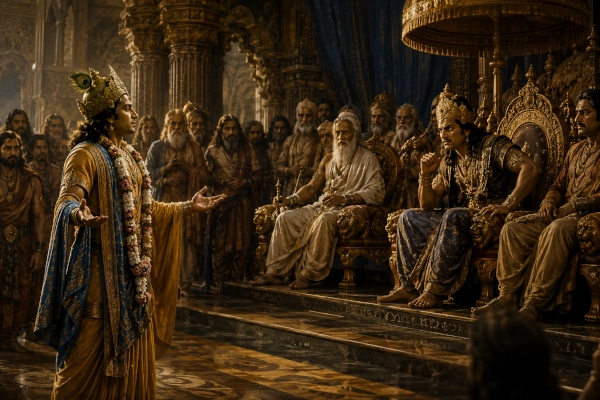
Before the conches sounded at Kurukshetra and before eighteen armies marched into one of the most devastating wars described in the Mahabharata, there remained one final opportunity for peace. Krishna travelled personally to Hastinapura as the envoy of the Pandavas, carrying with him a proposal that required enormous compromise from Yudhishthira but could still have preserved the Kuru dynasty from destruction.
By this stage, almost every cause for war already existed. The Pandavas had lost their kingdom through the dice game, Draupadi had been humiliated in the Kuru assembly, and the brothers had completed the years of exile imposed upon them. Duryodhana nevertheless refused to restore their political rights, while rulers throughout Bharat were already choosing sides and preparing their armies.
Despite everything that had happened, Yudhishthira continued to seek a peaceful settlement. The Pandavas had once ruled the prosperous kingdom of Indraprastha, yet they were now willing to reduce their demand to only five villages if that concession could prevent a war among relatives.
Krishna therefore entered Hastinapura carrying more than a territorial proposal. He carried the final opportunity for the Kauravas and Pandavas to resolve their conflict before political rivalry became irreversible bloodshed.
The Kingdom Was Already Preparing for War
The peace mission takes place in the Udyoga Parva, the section of the Mahabharata devoted largely to preparations for the coming struggle. Kings across Bharat were receiving envoys, choosing alliances, assembling troops and determining whether they would support the Pandavas or the Kauravas.
Chariots were being prepared, horses and elephants gathered, and military contingents began moving towards the two rival camps. The Pandavas understood that negotiations could fail, while Duryodhana believed the military strength of his coalition would allow him to resist pressure for compromise.
Diplomacy therefore proceeded alongside military preparation rather than replacing it. Yudhishthira wanted peace, but he was not willing to make the Pandavas helpless while waiting to discover whether Duryodhana would negotiate seriously.
Several efforts at mediation had already taken place. Drupada’s priest had travelled to Hastinapura and argued that the sons of Pandu had fulfilled the conditions imposed upon them and should receive their rightful share of the kingdom. Dhritarashtra later sent Sanjaya to meet the Pandavas and understand their position.
None of these missions produced a settlement. Each negotiation instead revealed more clearly that the central obstacle was Duryodhana’s unwillingness to recognise an independent political position for his cousins.
From Indraprastha to Five Villages
Yudhishthira’s willingness to compromise was extraordinary when measured against what the Pandavas believed had been taken from them. They had once ruled Indraprastha and had possessed enough influence for Yudhishthira to perform the Rajasuya sacrifice, yet he was now prepared to abandon any immediate attempt to recover an equal share of the Kuru realm.
Through Sanjaya, Yudhishthira communicated that the conflict could end if the five brothers were given only five villages. The request represented only a tiny fraction of the territory over which they believed they possessed a legitimate claim.
The proposal allowed Duryodhana to retain the overwhelming majority of the Kuru kingdom. At the same time, it would give the Pandavas enough territory to preserve their independence, dignity and political existence.
This was therefore not a demand for victory disguised as negotiation. It was a deliberately reduced settlement designed to give both sides something they could accept without complete humiliation.
Duryodhana rejected even this compromise. His refusal made clear that the dispute was no longer principally about the amount of territory involved, because five villages represented almost nothing compared with the kingdom he would retain.
The real issue had become whether the Pandavas would be permitted to possess any recognised political authority at all. Duryodhana’s position hardened to the point that he declared that he would not surrender even as much land as could be covered by the point of a needle.
Krishna Agrees to Become the Peace Envoy
When Yudhishthira asked Krishna to undertake the final peace mission, Krishna did not disguise the difficulty of the task. He understood Duryodhana’s temperament and knew that the likelihood of agreement was becoming increasingly small.
Krishna nevertheless believed that the attempt had to be made. When relatives approach a destructive conflict, he argued, those capable of mediating have an obligation to try to prevent the catastrophe before surrendering to war.
There was also a larger political purpose behind the mission. If Krishna made every reasonable effort and Duryodhana still rejected peace, the kings of Bharat would understand more clearly how the conflict had reached the battlefield.
Krishna therefore intended both to prevent war and to establish responsibility if war became unavoidable. Diplomacy could still save the Kuru house, but even unsuccessful diplomacy could demonstrate that peaceful alternatives had genuinely been exhausted.
Krishna also warned the Pandavas not to mistake his mission for evidence that war had become unlikely. While he travelled to Hastinapura seeking settlement, they were to remain prepared for the possibility that Duryodhana would refuse every proposal.
Draupadi Had Not Forgotten the Kuru Assembly
The willingness of Yudhishthira to compromise did not mean that everyone in the Pandava camp regarded peace in the same way. Draupadi had endured one of the most humiliating moments of her life in the Kuru assembly, and the memory remained vivid.
Before Krishna departed, she reminded him of what had happened. She had been dragged before the court while respected elders watched, and the Pandavas themselves had been subjected to repeated injustice.
Draupadi also knew how far Yudhishthira had already reduced his demands. The Pandavas were prepared to accept five villages, yet Duryodhana had shown no corresponding willingness to compromise.
Her position exposed an important tension within diplomacy. Peace was desirable, but a settlement could not simply require the injured side to surrender every claim while the stronger party retained everything obtained through injustice.
Krishna understood this distinction. He would negotiate seriously, but he would not seek peace by demanding complete submission from the Pandavas.
Krishna Arrives at Hastinapura
News of Krishna’s journey reached the Kuru capital before he arrived. His visit carried enormous political significance because Krishna was not simply another messenger; he was respected throughout Bharat, closely connected with the Pandavas and recognised as one of the most influential figures in the approaching confrontation.
Dhritarashtra discussed how he should be received, and preparations were made for an elaborate welcome. Hospitality in the ancient political world was more than courtesy because it could communicate respect, status and intention.
Vidura understood, however, that magnificent hospitality would accomplish nothing if the central political question remained unresolved. Krishna could not be separated from the Pandavas by gifts, wealth or ceremonial honour.
The real way to honour his embassy was to consider the settlement he had come to negotiate. Duryodhana understood that Krishna could not be bought, but he was no more willing to compromise because of that understanding.
Krishna Refuses Duryodhana’s Hospitality
Duryodhana offered Krishna lavish hospitality, but Krishna declined to place himself under such an obligation while negotiations were still taking place. Instead, he chose to stay with Vidura.
The decision carried diplomatic significance. An envoy entering a difficult negotiation must remain independent of the party whose conduct he has come to challenge, and Krishna would not allow elaborate hospitality to create even the appearance that his position had been softened through personal favour.
Krishna had come to Hastinapura to negotiate a political settlement, not to exchange courtesy for silence. Duryodhana could welcome him magnificently, but hospitality could not substitute for addressing the dispute itself.
Krishna also met Kunti, who had remained in Hastinapura while her sons experienced exile and displacement. Her grief emphasised that the approaching war would not be fought between distant strangers but between members of a family whose relationships had collapsed under the weight of ambition, resentment and accumulated injustice.
Vidura Warns Krishna About Duryodhana
Vidura spoke privately with Krishna and warned him that Duryodhana was unlikely to respond to reason. He had watched the prince for years and understood that Duryodhana increasingly interpreted compromise as weakness.
Duryodhana had also surrounded himself with men such as Karna, Shakuni and Dushasana, whose support strengthened his confidence that the Pandavas could be resisted militarily. Advice that contradicted this expectation was therefore easy for him to dismiss.
Vidura feared that Krishna’s mission would achieve nothing because the problem was no longer a lack of information. Duryodhana had heard the arguments for peace repeatedly and had rejected them each time.
Krishna nevertheless explained that the attempt remained necessary. A person who possesses the ability to prevent a catastrophe must try, even when success appears unlikely, because refusing to act would leave open the question of whether destruction could have been avoided.
Krishna Enters the Kuru Assembly
The next day Krishna entered the great assembly of the Kurus. Dhritarashtra was present, along with Bhishma, Drona, Kripa, Vidura and the assembled rulers and elders of the kingdom.
Krishna addressed Dhritarashtra first because the old king still represented the formal authority of the Kuru house. His argument combined morality with political realism rather than depending upon only one kind of appeal.
The Pandavas were the sons of Dhritarashtra’s brother and therefore belonged to the same family whose survival the king claimed to value. A war that destroyed one branch of that family could hardly be regarded as a successful defence of the Kuru dynasty.
Krishna also reminded the court that the Pandavas were not militarily insignificant. Bhima, Arjuna, Satyaki, Dhrishtadyumna and the kings allied with them represented formidable power.
Peace therefore offered the Kuru house something that victory in war could never guarantee. It could preserve both branches of the family while allowing the political dispute to end without an uncontrollable struggle.
Krishna Was Negotiating From Strength
Krishna’s appeal for peace was not the appeal of someone who believed the Pandavas were incapable of fighting. He made clear that their willingness to compromise should not be mistaken for weakness.
The distinction was essential to his diplomacy. A concession made because one has no alternative may be interpreted as surrender, while a concession made by someone possessing the power to resist demonstrates genuine restraint.
Yudhishthira wanted peace because he understood the human cost of war, not because Arjuna had lost his ability to fight or Bhima had lost his strength. The Pandava alliance was ready for conflict even while Krishna worked to prevent it.
The Kuru court therefore faced a genuine choice. It could accept a settlement that left Duryodhana in possession of most of the political power, or it could risk everything in a war against opponents who had already demonstrated that they would not accept permanent submission.
The Elders Urge Duryodhana to Accept Peace
Krishna was supported by several of the most respected figures in the Kuru court. Bhishma repeatedly warned Duryodhana that refusing reasonable settlement would bring ruin upon the dynasty.
Drona also understood the danger, while Vidura had spent years warning Dhritarashtra that his inability to control his son was pushing the family towards destruction. Gandhari herself was eventually called upon to reason with Duryodhana.
Even Dhritarashtra feared the consequences of the coming conflict. The old king wanted to avoid the destruction of his sons, but his authority over Duryodhana had become increasingly ineffective.
This created one of the great political tragedies of the Mahabharata. The wisest people in Hastinapura recognised the danger, yet their moral authority was not matched by enough political authority to compel a settlement.
Duryodhana could listen to Bhishma, Drona, Vidura, Gandhari and Krishna and still refuse them all.
Why Duryodhana Believed He Could Refuse
Duryodhana did not regard himself as a man standing alone against the world. He possessed reasons for believing that war could favour him.
Eleven akshauhinis would eventually stand on the Kaurava side. Bhishma would command his armies, Drona would fight for the Kuru throne, Kripa remained with Hastinapura, and Karna had pledged personal loyalty to Duryodhana.
Powerful rulers had also joined the Kaurava alliance. Duryodhana therefore believed that military strength allowed him to reject concessions that might otherwise have appeared prudent.
There was also a deeper psychological element to his refusal. The prosperity and status of the Pandavas had long disturbed him, and allowing them even a small independent territory meant acknowledging that their political claim had survived everything done to eliminate it.
Five villages were economically insignificant compared with the Kuru realm. Their political meaning, however, was enormous because they would confirm that the Pandavas remained legitimate rulers in their own right.
Duryodhana preferred the dangers of war to that recognition.
The Limits of Negotiation Become Clear
Krishna continued using different forms of persuasion. He appealed to family duty, political advantage, practical survival and the reputations of the men involved.
The Pandavas had already moved dramatically from their original position by reducing their claim to five villages. The elders of Hastinapura urged compromise, and Krishna explained that war would bring terrible consequences even to those who imagined themselves likely to win.
None of these arguments produced movement from Duryodhana. This revealed that negotiation had reached its structural limit.
Successful compromise requires movement from both sides. The Pandavas had reduced their demands substantially, while Duryodhana continued to insist that they receive nothing.
No further reduction was possible without requiring Yudhishthira and his brothers to abandon political independence entirely. At that point, the problem was no longer finding the correct middle ground because one side had rejected the existence of any middle ground.
Duryodhana Considers Seizing Krishna
Duryodhana then moved from refusing Krishna’s proposal to considering something far more dangerous. He contemplated capturing Krishna while the envoy was still inside Hastinapura.
From Duryodhana’s perspective, Krishna was one of the greatest strategic strengths of the Pandava cause. If he could be imprisoned, perhaps the Pandavas and their Yadava allies could be weakened or pressured.
The proposal horrified the elders because Krishna had entered Hastinapura as an envoy. Seizing a diplomatic messenger because his message was unwelcome threatened the very possibility of communication between hostile powers.
If envoys could be imprisoned during negotiations, then no rival ruler could safely send representatives to discuss peace, prisoners, boundaries or ceasefires. Duryodhana’s plan therefore attacked something larger than Krishna personally; it attacked the mechanism through which war might still be prevented.
The Plot Is Discovered
Satyaki became aware of the attempt to seize Krishna and ensured that his supporters were prepared. When Krishna learned of the scheme, he showed no fear because he understood that Duryodhana had profoundly misjudged the situation.
Dhritarashtra condemned the proposal, while Vidura recognised it as another example of Duryodhana’s inability to understand the consequences of his own actions. Even members of the Kuru establishment who supported Hastinapura militarily could see the madness of violating the safety of Krishna while he was acting as an envoy.
The negotiations had now moved beyond a disagreement over territory. Duryodhana was prepared to undermine the basic conventions that allowed adversaries to communicate.
Krishna Reveals His Divine Power
Duryodhana imagined that Krishna stood physically within the assembly and could therefore be surrounded and restrained. Krishna answered this assumption by revealing the extraordinary divine power concealed behind his human appearance.
The assembly witnessed a manifestation that demonstrated the impossibility of capturing him through ordinary force. Divine beings and overwhelming splendour became visible as Krishna revealed something of his cosmic nature.
Yet Krishna did not attack Duryodhana. This is important to the meaning of the episode because the revelation was not the beginning of battle.
Instead, Krishna demonstrated that coercion would not provide Duryodhana with the advantage he expected. The prince had attempted to convert diplomacy into an opportunity for capture and discovered that the person he intended to imprison was beyond his power.
The Final Door to Peace Closes
After this confrontation, little remained that diplomacy could accomplish. Bhishma had spoken, Vidura had spoken, Drona understood the danger, Gandhari had tried to restrain her son, and Dhritarashtra himself feared the consequences.
Krishna had personally entered the hostile capital and offered Duryodhana an arrangement that would allow him to retain most of the Kuru realm. The Pandavas had shown that they were willing to reduce their political ambitions dramatically to avoid war.
Duryodhana rejected every path offered to him. He would neither restore the Pandavas’ broader share nor give them the five villages that might have allowed both sides to withdraw from confrontation without complete humiliation.
Krishna therefore returned to the Pandavas with the conclusion that peaceful methods had been exhausted. The kings were already moving towards Kurukshetra, and the dispute would now be decided through war.
Why the Peace Mission Still Mattered
Krishna did not obtain the settlement he sought, but the mission was not meaningless. Diplomacy can accomplish important things even when it fails to produce an agreement.
Before Krishna’s embassy, both camps could argue about who was responsible for making war inevitable. After the mission, the political situation became much clearer.
The Pandavas had demonstrated willingness to accept a greatly reduced settlement. Krishna had personally attempted mediation, while some of the most respected figures in the Kuru court had supported peace.
Duryodhana had rejected the compromise and had even contemplated arresting the envoy sent to negotiate it. The diplomatic process therefore clarified where the final refusal had occurred.
Krishna had understood this possibility before leaving. If the mission succeeded, the Kuru dynasty would survive. If it failed despite every reasonable attempt, the rulers of Bharat would know that war had not been chosen without first exploring peace.
The Meaning of the Five Villages
The proposal for five villages remains one of the most memorable symbols of the entire diplomatic struggle. Its importance lies not in the economic value of the villages but in how far the Pandavas were prepared to move from their original position.
Yudhishthira had once ruled Indraprastha and performed the Rajasuya. He was now prepared to accept a tiny territorial settlement if it would prevent relatives, teachers, friends and soldiers from killing one another.
The offer created a possible face-saving arrangement for both sides. The Pandavas would retain enough territory to preserve their dignity and independence, while Duryodhana would remain ruler of the overwhelming majority of the Kuru realm.
The proposal failed because Duryodhana did not merely want more territory than the Pandavas. He wanted their political claim to disappear completely.
The Diplomatic Lesson: Know Whether the Other Side Wants an Agreement
Krishna’s mission contains an important lesson for any modern negotiation. Before continually improving an offer, negotiators must determine whether the other party actually wants a settlement.
When two sides disagree about territory, price, timing or procedure, compromise can often move them towards agreement. Each party makes concessions because each values settlement more than complete victory.
The Pandavas made that movement. Their demand was reduced from restoration of a kingdom to five villages, while Duryodhana made no comparable movement at all.
The problem therefore ceased to be the details of the proposal. It became the absence of a negotiating partner willing to recognise any acceptable outcome other than total submission.
Peace Requires More Than Silence
The episode also shows that peace cannot simply mean the absence of immediate fighting. A settlement that requires one side to accept permanent dispossession and humiliation may postpone conflict without resolving the underlying dispute.
Draupadi’s insistence upon remembering what had happened in the Kuru assembly reminds the reader that reconciliation must acknowledge justice as well as expediency. The injured party cannot always be expected to bear the entire cost of peace.
Krishna therefore sought a settlement that prevented war while still preserving the legitimate political existence of the Pandavas. The five villages represented the minimum space within which that dignity could survive.
Diplomacy Has More Than One Audience
Krishna was speaking to Duryodhana, but Duryodhana was not his only audience. Dhritarashtra needed to understand the danger facing his dynasty, while Bhishma and Drona had to confront the consequences of serving a policy they believed was leading towards catastrophe.
The assembled rulers also needed to judge which side had made a genuine effort to prevent war. Krishna’s words therefore operated simultaneously as negotiation, persuasion, warning and political record.
Modern diplomacy often functions in exactly this manner. An envoy may formally address an opposing government while also reassuring allies, strengthening moderates within the opponent’s camp and demonstrating seriousness to neutral observers.
Krishna’s embassy works on all these levels.
Hospitality Cannot Replace Compromise
Krishna’s refusal to allow Duryodhana’s hospitality to influence the negotiations offers another enduring lesson. Gifts, ceremonial honour and personal generosity can create subtle expectations of obligation.
A skilled negotiator must therefore preserve both actual independence and the appearance of independence. Krishna could respect the customs of Hastinapura without allowing Duryodhana to transform hospitality into political leverage.
The principle is simple. A ruler cannot refuse another party’s central concerns and expect magnificent entertainment of its representative to compensate for the absence of genuine negotiation.
Courtesy supports diplomacy, but it cannot substitute for substance.
Never Destroy the Channel of Communication
Duryodhana’s attempt to capture Krishna represents one of the clearest diplomatic warnings in the Mahabharata. Even hostile powers require safe channels through which they can communicate.
Envoys make it possible to discuss peace, ceasefires, prisoners, boundaries and withdrawals when direct relations have become dangerous. If messengers themselves become targets, the mechanism capable of controlling escalation disappears.
The safety traditionally extended to envoys therefore serves both sides, not simply the messenger. Duryodhana’s scheme was reckless because it treated diplomacy as an opportunity for tactical advantage rather than as protection against catastrophic misunderstanding.
Prepare for War While Working for Peace
Krishna’s behaviour also rejects the assumption that preparing for conflict and negotiating for peace are contradictory actions. Before his departure, he warned the Pandavas to remain militarily prepared because he believed the mission might fail.
At the same time, he sincerely attempted to obtain an agreement. Military preparation gave the Pandavas an alternative if negotiations collapsed, while diplomacy ensured that preparation did not become an excuse for rushing unnecessarily into war.
The Pandavas were therefore negotiating from a position in which they could choose peace rather than being forced to beg for it. This made their willingness to accept five villages even more significant.
Failed Diplomacy Can Still Reveal the Truth
One of the deepest lessons of Krishna’s mission is that negotiations can have value even when no agreement is signed. A sincere peace process can reveal which demands are negotiable, which leaders are preventing compromise and which side is willing to move towards settlement.
It can also reassure allies that military action is being considered only after reasonable alternatives have been explored. Neutral observers gain a clearer understanding of the dispute, while the parties themselves discover whether any common ground remains.
Krishna’s journey achieved exactly this. It demonstrated that the Pandavas were willing to compromise far beyond their original claim and that the Kuru elders themselves recognised the danger of Duryodhana’s position.
The mission could not create willingness where none existed, but it could reveal its absence.
The Tragedy of Hastinapura
The tragedy of Krishna’s embassy lies in how much remained possible even at that late stage. Duryodhana did not have to surrender Hastinapura, abandon the throne or accept the political supremacy of Yudhishthira.
He only had to recognise that the Pandavas could not be permanently excluded from political existence. Five villages were enough to preserve that principle.
Had he accepted, the immediate dispute might have ended without the slaughter that followed. Bhishma, Drona, Karna, Abhimanyu, Duryodhana’s brothers, Draupadi’s sons and countless ordinary soldiers were all still alive when Krishna entered the Kuru court.
For a brief period, their deaths remained possibilities rather than memories.
When Diplomacy Could Go No Further
Krishna’s peace mission stands as one of the Mahabharata’s greatest studies of diplomacy because it refuses to present negotiation as either weakness or magic. Diplomacy can reduce demands, expose misunderstandings, create face-saving compromises and warn opponents about the consequences of refusal, but it cannot force a person to value peace.
Yudhishthira was willing to abandon almost everything except the minimum dignity required for an independent existence. Krishna was willing to enter the opposing court and use every peaceful argument available to him. Bhishma, Vidura, Drona, Gandhari and Dhritarashtra all understood, to different degrees, what continued refusal might bring.
The final obstacle was therefore not the absence of a possible settlement. It was the refusal to accept any settlement in which the Pandavas survived as an independent political force.
Krishna opened a final path away from catastrophe, and the cost of taking it was only five villages. Duryodhana chose not to take that path, and soon the armies of Bharat marched towards Kurukshetra.
You may also like
-
The Frog King and the Serpent: The Enemy Invited Into the Well
-
The Serpent and the Meaning of Violence: When Grief Turned Ruru Against Every Snake
-
The Hawk and the Smaller Birds: Bhishma’s Lesson on Surviving Greater Powers
-
The Birds and the Destruction of Their Forest Home: A Mahabharata Lesson on Foresight, Leadership and the Duty to Protect
-
Chanakya’s Warning for Modern India: Why Internal Disorder Is the Cheapest Weapon Against a Rising Power
