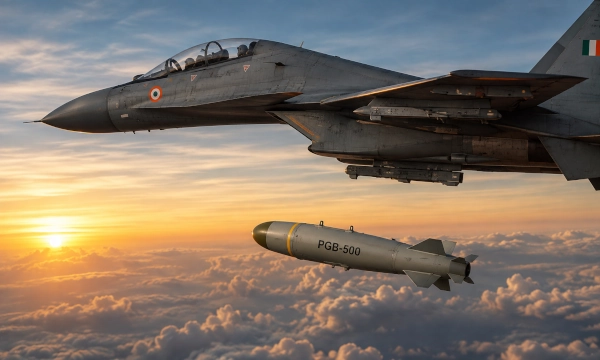
India’s indigenous precision-strike programme is set for another important milestone, with the Defence Research and Development Organisation and Indian Air Force preparing to conduct carriage and release flight trials of the PGB-500 precision-guided bomb from the Su-30MKI during September and October 2026.
The programme represents another step in India’s effort to build a broad family of indigenous precision-guided air-to-ground weapons for its combat aircraft. The Su-30MKI has increasingly become the principal test and integration platform for several of these weapons, ranging from precision bombs to anti-radiation missiles and long-range glide weapons.
Trials Planned at Jodhpur and the Rajasthan Range Complex
According to the ARDE trial-support specification, activities associated with the PGB-500 campaign are expected to involve Air Force Station Jodhpur and 3 AFRU at Chandan near Jaisalmer in Rajasthan.
The trial team is expected to include personnel from DRDO, the Directorate General of Aeronautical Quality Assurance and development-cum-production partners associated with the programme.
The use of Jodhpur is consistent with earlier Indian testing of heavy air-launched bombs from the Su-30MKI. ARDE previously used the same region for carriage and release testing of indigenous 500-kg-class weapons.
The coming tests should therefore be seen primarily as an aircraft-weapon integration and release-validation campaign, rather than evidence that the PGB-500 has already completed development and entered IAF service.
What Carriage Trials Actually Test
Before a new weapon can become operational on a fighter aircraft, engineers must demonstrate that the aircraft can safely carry it throughout the required flight envelope.
This involves considerably more than attaching the bomb to a pylon.
During carriage trials, engineers monitor how the weapon behaves while the aircraft flies at different speeds, altitudes and manoeuvre conditions. They evaluate structural loads, vibration, aerodynamic interaction, electrical interfaces and the behaviour of the weapon and its suspension equipment.
The purpose is to ensure that the bomb remains securely attached and does not create unacceptable aerodynamic or structural effects on the aircraft.
For a heavy 500-kg-class weapon carried by a high-performance fighter such as the Su-30MKI, these tests are especially important because the aircraft can experience substantial aerodynamic forces during high-speed flight and manoeuvring.
Release Trials Are an Even More Critical Step
Once carriage has been validated, engineers must prove that the bomb can leave the aircraft safely.
A weapon released from a fighter enters a complex airflow around the aircraft’s fuselage, wings, pylons and engines. If its separation behaviour is not properly understood, it could pitch, roll or move back towards the aircraft after release.
Release trials therefore examine the bomb’s initial trajectory immediately after separation.
High-speed cameras, telemetry equipment and onboard instrumentation can be used to measure the weapon’s motion and compare its actual behaviour with computer simulations and wind-tunnel predictions.
Only after safe separation has been demonstrated can progressively more demanding weapon trials move forward.
The September-October campaign is therefore an important certification step even though it should not be confused with final operational induction.
ARDE Has Already Built Experience With 500-kg Precision Weapons
The PGB-500 programme builds on years of Indian work in the 500-kg aircraft-bomb category.
ARDE conducted carriage and release trials of a 500-kg Precision Guided High Speed Low Drag aircraft bomb, or PGHSLD-500, at the Pokhran range between May 22 and May 30, 2017.
An official DRDO newsletter recorded that two weapons were used during those trials. One carried sensors, telemetry equipment and a data logger for carriage evaluation, while another incorporated GPS and telemetry equipment for the release trial.
The weapon was carried by a Su-30MKI operating from Jodhpur. During the release trial, it was dropped from approximately 5 km altitude at around 900 km/h to evaluate its separation and stability.
DRDO reported that high-speed imagery showed safe weapon separation without undesirable rolling, pitching or yawing near the aircraft.
This earlier work demonstrates that ARDE already possesses substantial experience integrating 500-kg-class precision weapons with the Su-30MKI.
However, an important distinction must be maintained. The current 2026 procurement document refers simply to “PGB 500 Bomb”. DRDO has not publicly explained whether the configuration entering the September-October trials is identical to the earlier PGHSLD-500, an evolved configuration, or a later production-oriented version.
It would therefore be premature to assume that every specification attributed to earlier PGHSLD demonstrators applies unchanged to the present weapon.
Ordnance Factory Khamaria Has Been Involved in the Programme
Evidence of continued industrial activity around the PGB-500 emerged in 2024.
Ordnance Factory Khamaria officials said the factory had been working on an indigenous 500-kg Precision Guided Bomb and had manufactured inert weapons for trials.
According to the factory’s then Chief General Manager, two inert PGB units had been developed for evaluation, while DRDO had supplied bomb shells for indigenous development work. The inert weapons were subsequently handed over for further testing.
The report also indicated that the programme envisaged DRDO supplying guidance kits as manufacturing progressed.
Bharat Electronics procurement records provide another indication of activity around the weapon. A February 2024 procurement-status document included an entry for an empty PGB-500 bomb assembly, showing that components associated with the programme were moving through India’s defence-industrial ecosystem well before the latest trial-support requirement.
Taken together, these developments suggest that the 2026 trials form part of a continuing development and productionisation effort rather than the beginning of an entirely new project.
Why the Su-30MKI Is Central to India’s Precision-Strike Programme
The Su-30MKI has become one of India’s most important indigenous weapon-integration platforms.
Its large payload capacity, long range and multiple heavy weapon stations make it particularly suitable for testing and carrying large air-to-ground weapons.
DRDO has already used the aircraft for several major indigenous programmes.
In April 2025, DRDO conducted release trials of the 1,000-kg-class Long-Range Glide Bomb Gaurav from the Su-30MKI. The weapon was integrated on multiple stations and tested in different warhead configurations, demonstrating a range close to 100 km with high accuracy.
The PGB-500 therefore joins a steadily expanding collection of Indian strike weapons being developed around the Su-30MKI.
This also strengthens the aircraft’s relevance as the IAF proceeds with the wider Super Sukhoi modernisation programme. Improved avionics, electronic warfare systems and indigenous weapons can extend the usefulness of the large Su-30MKI fleet far beyond the original Russian-supplied combat configuration.
India Is Building Several Different Precision-Bomb Categories
PGB-500 should also be viewed within a rapidly expanding indigenous guided-weapon ecosystem rather than as a standalone development.
At the lighter end is the Smart Anti-Airfield Weapon, developed to attack airfield infrastructure and other ground targets from stand-off distances. DRDO successfully demonstrated SAAW at ranges exceeding 70 km during earlier trials.
At the other end sits the 1,000-kg Gaurav long-range glide bomb, which gives the Su-30MKI a much heavier stand-off strike option.
More recently, DRDO and the IAF successfully conducted the maiden flight trial of the Tactical Advanced Range Augmentation, or TARA, weapon on May 7, 2026. TARA is a modular range-extension kit designed to convert conventional unguided warheads into precision-guided glide weapons.
These systems are not necessarily interchangeable.
Some are designed around long-range glide capability, while others prioritise accuracy, different warhead classes, cost or compatibility with existing bomb inventories.
The result is increasingly a layered indigenous precision-strike inventory rather than reliance on a single guided-bomb design.
PGB-500 Could Fill an Important Middle-Weight Role
A 500-kg guided bomb occupies a useful position in an air force’s strike inventory.
It is significantly heavier than weapons intended primarily for light infrastructure targets, but it does not impose the same aircraft payload and carriage penalties as a 1,000-kg-class weapon.
Such a weight category can potentially be used against hardened infrastructure, military installations and other targets requiring a substantial warhead while allowing a fighter to carry more than one weapon depending on configuration and mission requirements.
The exact target set, guidance system, range and warhead options of the current PGB-500 configuration have not yet been formally released by DRDO.
Those specifications should therefore not be inferred from unrelated Indian guided bombs or older prototypes until official documentation becomes available.
Precision Strike Has Become Increasingly Important for the IAF
Modern air campaigns increasingly emphasise the ability to strike a specific target while minimising the number of aircraft exposed to hostile air defences.
Unguided bombs remain useful, but accuracy depends heavily on release conditions and can require aircraft to approach closer to the target.
Precision-guided weapons allow the attacking aircraft to place ordnance much closer to the intended aim point and, depending on the weapon design, release it from safer distances.
This can reduce the number of weapons required to achieve a desired effect and improve the efficiency of each strike sortie.
The value becomes particularly clear when the target is a command facility, radar site, bridge, hardened shelter or other small but important military installation where simply delivering large quantities of explosives into the surrounding area is not sufficient.
Indigenous Weapons Reduce Dependence on Imported Stocks
India has historically used a mixture of domestic and imported precision-guided air weapons.
Developing indigenous alternatives has an important logistical advantage beyond acquisition cost.
Guided munitions can be expended rapidly during an intense conflict. Foreign weapons may then become difficult to replenish because of production queues, geopolitical restrictions or disruption to international supply chains.
A domestically designed bomb supported by Indian factories provides far greater control over production rates, maintenance, software changes and stock replenishment.
This is particularly important for ammunition because large wartime reserves may eventually require production quantities far greater than those needed during peacetime training.
The involvement of ARDE, Indian production partners and quality-assurance organisations in the PGB-500 programme therefore matters almost as much as the performance of the weapon itself.
Trials Will Not Mean Immediate Induction
The September-October schedule should nevertheless be interpreted carefully.
Carriage and release trials are an important milestone, but they are normally only part of the overall qualification process.
Depending on the stage of the programme, subsequent testing may need to validate guidance performance, accuracy, warhead effectiveness, environmental reliability, aircraft compatibility and performance under different release conditions.
The IAF may also conduct user evaluation before accepting the weapon for operational service.
DRDO followed a comparable progression with Gaurav. Its April 2025 release tests were described officially as trials “paving the way towards induction”, rather than as induction itself.
The same distinction should be maintained for PGB-500.
Successful tests in September and October would move the weapon closer to operational clearance, but would not automatically mean that production bombs had entered frontline IAF squadrons.
An Important Step in India’s Air-Launched Weapons Transition
The significance of PGB-500 lies in the larger transformation taking place within India’s air-launched weapons inventory.
The Su-30MKI was originally inducted with heavy dependence on Russian and other foreign-origin weapons. Today, it is increasingly becoming a carrier and test platform for Indian-developed systems.
BrahMos-A has already given it a powerful supersonic stand-off strike capability. Astra provides indigenous beyond-visual-range air-to-air combat capability. Rudram adds anti-radiation and strike options, while Gaurav and other guided bombs are expanding its conventional precision-attack inventory.
PGB-500 would add another domestically controlled option in the widely useful 500-kg category.
The coming campaign is therefore about more than proving that a bomb can fall safely from a Su-30MKI.
It forms part of a deliberate effort to ensure that India’s most important heavy fighter increasingly fights with weapons designed, integrated and eventually manufactured within the country.
After September-October 2026 carriage and release trials proceed successfully, PGB-500 will move another step closer to joining India’s growing family of indigenous precision-guided air-to-ground weapons.
References
Government e-Marketplace / DRDO-ARDE — Specification for Trial Support Services for Flight Trials of PGB 500, Ref. ARDE/ADM/PGB 500/TRIAL SUPPORT/2026/01 — Confirms Su-30MKI carriage and release trials planned for September-October 2026.
DRDO Newsletter — ARDE Conducts Successful Trials of Weapon Precision Guided High Speed Low Drag Aircraft Bomb, July 2017 — Records earlier Su-30MKI carriage and release trials of a 500-kg PGHSLD weapon.
Press Information Bureau — DRDO Conducts Successful Release Trials of Long-Range Glide Bomb Gaurav from Su-30MKI, April 11, 2025
Press Information Bureau — DRDO & IAF Successfully Conduct Maiden Flight Trial of Tactical Advanced Range Augmentation Weapon, May 8, 2026
The Hitavada — Ordnance Factory Khamaria’s Work on Indigenous 500-kg Precision Guided Bomb, July 31, 2024
You may also like
-
ICAR Scientists Develop Indigenous Protective Gloves for Cotton Farmers, Sign Commercial Manufacturing Agreement
-
India Moves Towards Five-Year Assured Orders for Defence Startups Under New Procurement Reforms
-
BHEL–Coal India Joint Venture Begins Construction of ₹25,016 Crore Indigenous Coal Gasification Project in Odisha
-
Zen Technologies Introduces Indigenous Hyper-Strike Falcon AI-Guided Counter-Drone Interceptor
-
L&T and Germany’s SCHOTTEL Expand Partnership for Controllable Pitch Propeller Systems in Indian Shipbuilding
