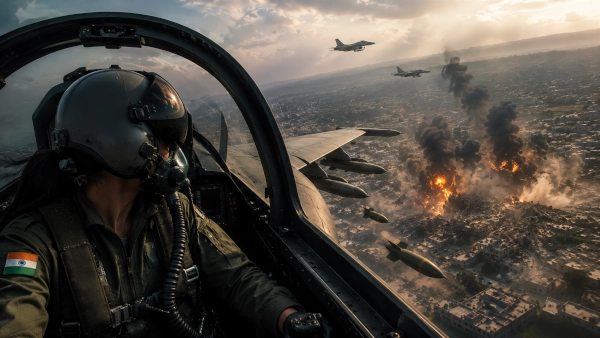
For many Indians, the word sindoor is inseparable from marriage, family and the bond between husband and wife. In the aftermath of the Pahalgam attack, images and accounts of women losing their husbands gave the name of India’s military response an emotional resonance far beyond the battlefield.
The operation was not merely about destroying buildings. It was meant to strike the infrastructure from which terrorist organisations had trained, organised and directed attacks against India.
That symbolism became even stronger with reports that a woman Indian Air Force fighter pilot flying a Su-30MKI participated in the mission against Markaz Taiba at Muridke, one of Lashkar-e-Taiba’s most important centres in Pakistan.
Her identity remains protected for operational reasons, and the Indian Air Force has not publicly disclosed the exact weapon used during the mission.
But the significance of her reported role is unmistakable.
A Woman Fighter Pilot Against a Centre Associated With Lashkar-e-Taiba
Markaz Taiba at Muridke was among the most significant targets struck during the opening phase of Operation Sindoor on May 7, 2025.
Indian government accounts identified Muridke as a major Lashkar-e-Taiba facility. The organisation has been linked to multiple terrorist attacks against India, including the 2008 Mumbai attacks.
During Operation Sindoor, India selected nine terrorist infrastructure sites across Pakistan and Pakistan-occupied Jammu and Kashmir for precision strikes.
Muridke and the Jaish-e-Mohammed complex at Bahawalpur stood out because they represented major institutional centres of two organisations that India has repeatedly held responsible for cross-border terrorism.
The attack on Muridke therefore carried significance well beyond the physical destruction of the facility.
It was a strike against infrastructure associated with the ideological, organisational and training apparatus behind terrorism directed at India.
The Meaning of “Sindoor”
The choice of the name Operation Sindoor became one of the most powerful aspects of the campaign.
Sindoor, traditionally worn by many married Hindu women, represents marriage and the presence of a husband in a woman’s life.
The Pahalgam attack left women widowed and families devastated.
Against that backdrop, the name conveyed a simple but powerful message: India would respond to those who had brought grief into innocent homes.
The reported participation of a woman fighter pilot in the Muridke strike gave that symbolism another layer.
A terror ecosystem accused of creating widows and destroying families was confronted by an Indian woman serving at the sharpest end of the nation’s military power.
She was not there as a ceremonial figure.
She was reportedly flying a frontline combat aircraft as part of a strike package directed against one of the most important Lashkar-e-Taiba facilities in Pakistan.
From Symbolism to Combat
Women officers had already become highly visible during Operation Sindoor.
Colonel Sofiya Qureshi and Wing Commander Vyomika Singh stood before the nation during official briefings and explained the military operation.
Their presence became an important symbol of women’s role in India’s Armed Forces.
The latest disclosures suggest that another group of women were playing a very different role away from the cameras.
According to defence reporting, more than one woman fighter pilot participated in Operation Sindoor. Women reportedly flew both Su-30MKI and Rafale aircraft, serving in pilot and weapon-system roles during operational missions.
The documentary is not simply that women were present during a military operation. It is that women were reportedly entrusted with some of the same high-risk combat missions assigned to their male colleagues.
The Muridke mission is perhaps the clearest example.
A Strike at the Heart of a Terror Infrastructure
Muridke was not selected randomly.
The complex had long been associated with Lashkar-e-Taiba and its network of training, indoctrination and organisational activity.
India’s objective during the opening phase of Operation Sindoor was to hit terrorist infrastructure while avoiding Pakistani military targets.
The government described the strikes as focused, measured and non-escalatory, with the chosen targets linked directly to terrorist organisations.
Operation Sindoor began as a counter-terror operation, not as an attempt to initiate a broader conventional war.
Muridke therefore represented exactly the type of target the operation was designed to neutralise: a major centre associated with an organisation India holds responsible for repeated terrorist violence.
The Weapon Remains Classified
The Su-30MKI can employ several long-range precision weapons.
During the wider Operation Sindoor confrontation, Indian aircraft used a variety of stand-off weapons against different targets.
However, the exact weapon used by the woman pilot during the Muridke mission has not been publicly identified.
Defence sources cited in reporting deliberately withheld that information, and any claim that she specifically fired a BrahMos or another named missile would therefore be speculative.
The confirmed significance lies in the mission itself: a woman fighter pilot reportedly formed part of the IAF strike package tasked with attacking the Muridke complex.
Women No Longer an Exception in the Fighter Stream
The episode also demonstrates how far the Indian Air Force has travelled since women were first allowed into the fighter stream.
The IAF began inducting women as fighter pilots in 2016 after the government approved the initiative the previous year.
Since then, women have flown frontline fighters, participated in major exercises and taken on increasingly demanding operational responsibilities.
The IAF has repeatedly emphasised that once pilots qualify for the fighter stream, operational employment is based on training and capability rather than gender.
Operation Sindoor appears to have put that principle into practice under actual combat conditions.
Women fighter pilots were no longer being tested to prove whether they belonged in combat aviation.
They were simply combat aviators.
From Pahalgam to Muridke
Operation Sindoor was launched following the Pahalgam terrorist attack of April 22, 2025.
The victims included tourists who had travelled to Kashmir with their families, turning what should have been a peaceful journey into tragedy.
India’s response came roughly two weeks later.
In the early hours of May 7, Indian forces struck nine terrorist facilities across Pakistan and Pakistan-occupied Jammu and Kashmir.
The targets included training camps, organisational headquarters and other infrastructure associated with Lashkar-e-Taiba and Jaish-e-Mohammed.
Muridke was among the most symbolically important because of its longstanding association with LeT.
The reported involvement of a woman fighter pilot in that attack therefore connects the emotional meaning of Operation Sindoor directly with one of its most important combat missions.
The Symbolism Runs Deeper
Military operations ultimately succeed or fail on planning, intelligence, weapons, training and execution and symbols matter because they explain what an operation represents to the society carrying it out.
Operation Sindoor came to embody the grief of families affected by terrorism and the determination of the Indian state to respond against the infrastructure supporting it.
The image of an unnamed woman fighter pilot taking a Su-30MKI into a mission against Muridke captures that symbolism with unusual force.
The terrorists responsible for violence had left women grieving.
India’s answer included women serving in the cockpit of frontline fighters.
The contrast is difficult to miss.
This was not about revenge against a population or a country. The declared targets were terrorist facilities associated with organisations India held responsible for attacks on civilians.
And among the personnel sent to strike those facilities were women who had earned their place in India’s fighter squadrons through the same training, discipline and operational standards as every other combat pilot.
A Defining Image of Operation Sindoor
The identity of the woman who reportedly flew the Muridke mission may remain classified for years.
That anonymity arguably strengthens the larger message.
She represents not one individual but a generation of Indian women who have entered military roles once considered beyond their reach.
During Operation Sindoor, that evolution reached the battlefield.
A woman fighter pilot reportedly flew as part of the force sent against a Lashkar-e-Taiba centre associated with the very ecosystem of terrorism that had brought grief to Indian families.
That gives the name Operation Sindoor a meaning that extends beyond the operation’s military objectives.
It became a story of loss answered by resolve, of women who had suffered because of terrorism and women in uniform who took part in confronting the infrastructure behind it.
The most powerful symbol of Operation Sindoor may therefore not be a missile launch or a destroyed building.
It may be the image of an Indian woman fighter pilot climbing into a Su-30MKI and flying towards Muridke — not as a symbol placed on the sidelines, but as a combat aviator entrusted with carrying out the mission.
You may also like
-
India Moves Towards Five-Year Assured Orders for Defence Startups Under New Procurement Reforms
-
Zen Technologies Introduces Indigenous Hyper-Strike Falcon AI-Guided Counter-Drone Interceptor
-
L&T and Germany’s SCHOTTEL Expand Partnership for Controllable Pitch Propeller Systems in Indian Shipbuilding
-
India to Train 60,000 Civil Defence Volunteers Across 12 States and UTs with Indian Army Support
-
Indian Army’s Northern Command Opens 75-Day Defence Technology Internship Programme for Young Innovators
