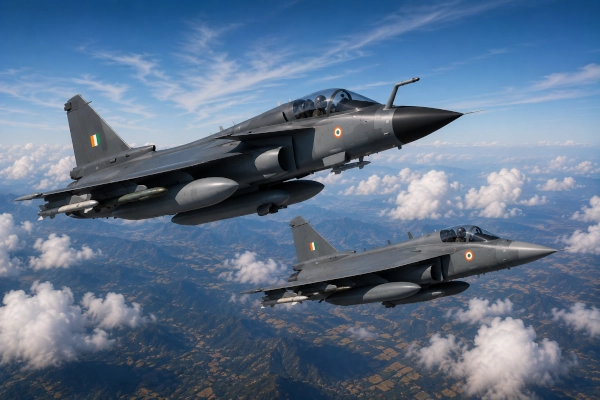
The Tejas Mk2 programme is approaching a crucial manufacturing phase as HAL continues structural assembly of the first prototype in coordination with the Aeronautical Development Agency.
During HAL’s official earnings conference call on May 15, 2026, Chairman and Managing Director Ravi Kota confirmed that assembly of Tejas Mk2 structures was underway. HAL currently expects the first aircraft to be rolled out by approximately March 2027.
The rollout will be followed by ground testing and preparations for the fighter’s maiden flight, beginning what is expected to be an extensive developmental flight-test and certification programme.
HAL Has Already Confirmed a Concurrent-Production Approach
The idea of beginning manufacture before the complete certification programme ends is not merely speculation.
During HAL’s official May 2025 investor conference call, then Chairman and Managing Director D.K. Sunil said the company expected certification to require roughly three years after the first flight and indicated that HAL normally follows a concurrent-production model.
He explained that once certification reaches sufficient maturity, manufacturing preparations can begin instead of waiting until every certification activity has been completed. HAL at the time expected initial production activity around 2030-31.
Such an approach could be particularly important for Tejas Mk2 because the Indian Air Force faces growing pressure on its fighter squadron strength as older aircraft retire.
Reports Point to Six to Eight Early Aircraft
More recent defence reporting has suggested that the IAF and HAL are considering an initial batch of around six to eight Tejas Mk2 aircraft before full-rate production.
These aircraft could potentially support operational evaluation, pilot conversion, tactical development and weapons integration while the wider certification programme continues.
HAL has officially acknowledged the concept of concurrent production, but the exact number and timing of any pre-series batch will depend on programme progress and IAF approval.
The Original Tejas Followed a Similar Model
India has considerable experience with Limited Series Production aircraft.
During development of the original Tejas, the government sanctioned the construction of eight LSP aircraft alongside prototypes and the establishment of a production line.
Those aircraft became an important part of the flight-test programme, supporting the gradual expansion of the flight envelope, sensor integration, weapons testing and development of the operational configuration.
The programme demonstrated how pre-series aircraft can bridge the gap between experimental prototypes and fighters intended for frontline squadrons.
Applying a similar concept to Tejas Mk2 could provide significantly more test capacity than relying solely on a small prototype fleet.
Why Early Production Could Save Time
Developing a modern fighter involves considerably more than proving that the aircraft can fly safely.
Tejas Mk2 will have to complete extensive trials involving its flight-control system, radar, electronic warfare suite, weapons, air-to-air refuelling capability, environmental performance and numerous operational configurations.
Certification changes discovered during testing can also require modifications to structures, software or onboard systems.
Traditionally, a manufacturer could wait until this process is substantially complete before establishing the production configuration.
Concurrent manufacturing changes that sequence.
HAL can begin preparing tooling, supply chains and production processes while ADA and the National Flight Test Centre continue development testing. A limited number of aircraft can then incorporate increasingly mature configurations as certification progresses.
The benefit is a shorter transition from development to operational induction.
The risk is that aircraft already under construction may require modifications if flight testing identifies significant design changes. For that reason, concurrent production normally begins only after the design reaches sufficient maturity.
Tejas Mk2 Structural Assembly Already Underway
HAL’s latest official comments show that the programme has moved beyond the purely digital-design stage.
Ravi Kota told investors in May 2026 that assembly of Tejas Mk2 structures was in progress, while noting that HAL and ADA still had technical issues to resolve jointly before rollout.
ADA remains the programme-management and design authority for the Tejas family, while HAL serves as the principal production partner. The Ministry of Defence has previously formally identified these respective roles.
The Mk2 is intended to be substantially larger and more capable than the current Tejas Mk1 and Mk1A.
It will use the more powerful GE F414 engine and is being developed as a medium-weight multirole fighter capable of carrying a significantly larger weapon load.
A Critical Future Fighter for the IAF
Tejas Mk2 occupies an important position in India’s long-term fighter force structure.
Unlike Tejas Mk1A, which primarily replaces the MiG-21 generation, Mk2 is intended to operate in the performance category occupied by aircraft such as the Mirage 2000, Jaguar and MiG-29 as those fleets eventually approach retirement.
The fighter is expected to incorporate an AESA radar, advanced electronic warfare systems, modern avionics, beyond-visual-range weapons and considerably greater fuel and payload capacity than the original Tejas.
The programme was formally sanctioned for development, flight testing and certification by the Cabinet Committee on Security in September 2022, providing the framework for construction of prototypes and subsequent trials. Contemporary reporting placed the sanctioned development package at approximately ₹6,500 crore in addition to earlier funding.
Production Planning Cannot Wait Until Certification Ends
One of the lessons from earlier Indian combat-aircraft programmes is that successful development does not automatically translate into rapid production.
Aircraft manufacturing depends on thousands of components arriving from hundreds of suppliers at precisely the required time. Long-lead items must often be ordered years before final assembly.
HAL consequently needs to prepare the Tejas Mk2 production ecosystem while the prototype programme is still underway.
The company already has an extensive domestic supplier network created for Tejas Mk1 and Mk1A. Major structures and subassemblies have increasingly been outsourced to Indian private companies as HAL expands production capacity.
That industrial base gives Mk2 a significant advantage compared with the early years of the original Tejas programme.
From Prototype to Squadron Service Faster
An early limited-series batch could also allow the IAF to begin preparing for Tejas Mk2 before full-rate production starts.
Test pilots and operational crews could develop tactics, maintenance procedures and training syllabi while engineers continue refining the aircraft.
Weapons and sensor configurations could undergo operational evaluation, while ground personnel gain experience maintaining the new platform.
These activities can otherwise consume considerable time after final certification.
For an Air Force that needs to introduce new fighters quickly, performing some of them in parallel offers an obvious advantage.
Sources
HAL / NSE, May 15, 2026: Official HAL earnings-call transcript confirming ongoing structural assembly and a targeted Tejas Mk2 rollout around March 2027.
HAL / NSE, May 16, 2025: HAL management discusses Tejas Mk2 certification timelines and the company’s concurrent-production strategy.
Ministry of Defence / PIB: Official description of ADA as the Tejas programme-management agency and HAL as production partner.
Ministry of Defence / PIB: Records of the original Tejas programme confirming government sanction for eight Limited Series Production aircraft during development.
You may also like
-
ICAR Scientists Develop Indigenous Protective Gloves for Cotton Farmers, Sign Commercial Manufacturing Agreement
-
India Moves Towards Five-Year Assured Orders for Defence Startups Under New Procurement Reforms
-
BHEL–Coal India Joint Venture Begins Construction of ₹25,016 Crore Indigenous Coal Gasification Project in Odisha
-
Zen Technologies Introduces Indigenous Hyper-Strike Falcon AI-Guided Counter-Drone Interceptor
-
L&T and Germany’s SCHOTTEL Expand Partnership for Controllable Pitch Propeller Systems in Indian Shipbuilding
