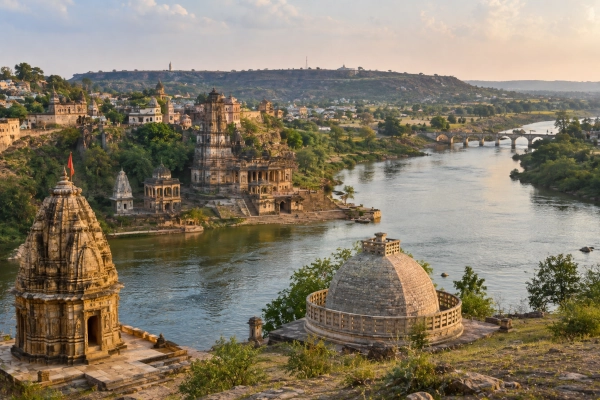
Among the many kingdoms that appear across the vast geographical world of the Mahabharata, Dasharna, or Daśārṇa, occupied an important position in central India. The kingdom appears repeatedly in the epic during the Pandavas’ campaigns, their search for a place of concealment, the story of Shikhandi and even the events surrounding the Kurukshetra War.
Historical geography generally associates the principal Dasharna region with Vidisha and eastern Malwa in present-day Madhya Pradesh. Scholarly studies of the ancient geography of central India place Daśārṇa among the historic regions south of the Yamuna, while archaeological studies identify Vidisha as an important centre of the wider Dasharna region.
The landscape would have occupied a strategically important position between the northern plains, Malwa, Bundelkhand and the routes leading south towards the Narmada region. Rivers, fertile valleys and overland routes made this part of central India valuable long before Vidisha became one of the celebrated cities of historical India.
Where Was Dasharna?
The core of ancient Dasharna is commonly placed around Vidisha and the eastern portion of the Malwa plateau, extending into territory associated with the Betwa and Dhasan river systems. The Indira Gandhi National Centre for the Arts also identifies ancient Vidisha and its surrounding region with the traditional Dasharna country.
In modern terms, its heartland can broadly be associated with areas around Vidisha, Raisen and adjoining parts of central Madhya Pradesh, although ancient political boundaries should not be imagined as matching modern district borders.
The Betwa, known in Sanskrit literature as the Vetravati, is one of the defining rivers of the region. Another important river is the Dhasan, whose ancient name has been connected with Dasharna. Historical geographical traditions therefore associate the name of the kingdom closely with the riverine landscape of central India.
This gave Dasharna access to routes connecting the Ganga-Yamuna plains with Malwa and central India. Vidisha later became an important commercial and political centre, reinforcing the strategic importance of the region.
Vidisha and the Heartland of Dasharna
Vidisha is the strongest modern geographical anchor for understanding Dasharna.
Archaeological scholarship identifies ancient Vidisha as the capital or principal urban centre of the Dasharna or Akara region of eastern Malwa. Later Sanskrit literature also associates Vidisha closely with Dasharna.
However, an important distinction must be made. The Mahabharata itself does not provide a modern-style map identifying Vidisha as the capital of every Dasharna mentioned in the epic. The association comes from combining the epic’s geographical references with later literature, archaeology and historical geography.
That distinction is important because the Mahabharata appears to know more than one group described as Dasharnas. One central Indian Dasharna corresponds well with the Vidisha–eastern Malwa region, while another reference during Nakula’s western campaign appears alongside western peoples such as the Shibis, Trigartas and Malavas.
For the major Dasharna kingdom encountered by Bhima and associated with the Panchala royal family, however, the central Indian identification remains the most convincing.
Dasharna Was Part of the Political Geography of the Mahabharata
Dasharna was not mentioned merely as a distant or obscure territory. The epic treats it as one of the recognised kingdoms of Bharatavarsha.
During the opening of the Virata Parva, when the Pandavas discuss where they might spend their thirteenth year of exile without being discovered, Arjuna lists several prosperous kingdoms surrounding the broader Kuru sphere.
Among them are Panchala, Chedi, Matsya, Surasena, Dasharna, Malla, Salva, Saurashtra and Avanti.
The passage describes these lands as fertile countries rich in food, suggesting that Dasharna was remembered as a settled and productive territory rather than an isolated frontier.
Its appearance alongside Chedi, Matsya, Avanti and Panchala also fits its likely geographical position in central India.
Bhima’s Conquest of Dasharna
One of the clearest references to Dasharna comes during the preparations for Yudhishthira’s Rajasuya sacrifice.
To establish Yudhishthira’s imperial authority and obtain tribute from surrounding kingdoms, the Pandava brothers undertook campaigns in different directions. Bhima marched towards the eastern regions with a large army.
After passing through Panchala and subduing several territories, Bhima reached the country of the Dasharnas.
There he encountered a ruler named Sudharman.
The Sabha Parva describes a remarkable confrontation between Sudharman and Bhimasena. Rather than focusing solely on chariots or archery, the episode describes the two warriors fighting with their bare arms.
Sudharman apparently fought with such courage and physical ability that even Bhima was impressed.
After defeating him, Bhima did something unusual. Instead of simply taking tribute and continuing his campaign, he appointed the Dasharna ruler as an important commander in his own force.
This brief episode gives Sudharman a surprisingly distinguished place among the kings encountered during the Pandava conquests.
Sudharman: The King Who Earned Bhima’s Respect
Bhima is one of the strongest warriors in the entire Mahabharata. For another king to impress him in direct physical combat is therefore significant within the narrative.
Sudharman’s defeat does not diminish him. Instead, the episode portrays him as a warrior whose courage earns the respect of his conqueror.
Bhima’s decision to place him in command suggests that the Pandava campaigns were not simply exercises in destruction. Kings who accepted Yudhishthira’s supremacy could be incorporated into a wider network of allies and subordinate rulers.
Dasharna therefore emerges as part of the political system being assembled around Indraprastha before the Rajasuya.
The episode also suggests that Dasharna possessed enough military strength for its ruler to be considered valuable to Bhima’s expedition.
Dasharna and the Story of Shikhandi
Dasharna plays an even more dramatic role in the story of Shikhandi, one of the most unusual and consequential characters in the Mahabharata.
Shikhandi was born into the royal house of Panchala and was ultimately destined to play a decisive role in the fall of Bhishma.
The Udyoga Parva introduces Hiranyavarman, king of the Dasharnakas, as a powerful monarch. His daughter was married to Shikhandi, whom King Drupada of Panchala had brought up as a son.
When Hiranyavarman learned that his daughter believed she had been deceived regarding Shikhandi, the matter escalated rapidly into an international crisis.
The Dasharna king gathered his forces and prepared for war against Panchala.
Drupada, despite being one of the most powerful kings of northern India, took the threat seriously. The episode shows that Hiranyavarman was not portrayed as a minor ruler whom Panchala could simply ignore.
Dasharna Nearly Goes to War With Panchala
Hiranyavarman sent messages demanding an explanation from Drupada.
The Dasharna king then consulted his ministers and mobilised a large army. The Mahabharata describes preparations for a possible invasion of Drupada’s kingdom.
Panchala consequently strengthened its defences.
For Shikhandi, the crisis became deeply personal. Believing that the dispute had placed Panchala and the royal family in danger, Shikhandi withdrew into the forest.
There Shikhandi encountered the Yaksha Sthunakarna, leading to the famous transformation episode that resolves the immediate crisis with Dasharna.
After representatives sent by Hiranyavarman became satisfied regarding Shikhandi, hostilities were avoided.
The story is important to the wider Mahabharata because Shikhandi would later stand before Bhishma on the battlefield of Kurukshetra. Bhishma refused to fight Shikhandi directly, allowing Arjuna to strike the grandsire down.
Thus, a royal marriage involving Dasharna becomes indirectly connected with one of the decisive moments of the entire epic.
Hiranyavarman Shows Dasharna’s Political Importance
The Shikhandi episode reveals much about how Dasharna is represented politically.
Hiranyavarman is described as powerful enough to threaten Panchala, a major kingdom ruled by Drupada. His response to the marriage dispute is not that of a dependent chief but of an independent monarch capable of gathering allies and preparing a substantial military expedition.
This indicates that the epic remembered Dasharna as a kingdom of real political weight.
Its geographical position may explain part of that importance. A kingdom centred in the Vidisha–eastern Malwa zone would have stood near routes linking northern India with central and western India.
Control of those routes could provide both commercial value and military importance.
Dasharna and the Pandavas’ Route Towards Matsya
Dasharna appears again when the Pandavas prepare to enter the kingdom of Matsya for their year of concealment.
The Virata Parva places Dasharna among the countries that lay in the broader zone through which the Pandavas could move while avoiding detection.
Other geographical reconstructions of the journey describe the Pandavas moving from the Yamuna region towards Matsya while keeping Panchala on one side and Dasharna on the other.
Although the epic’s route descriptions cannot always be converted into precise modern coordinates, they reinforce Dasharna’s place south of the main Kuru-Panchala zone and towards central India.
This fits reasonably well with the Vidisha and eastern Malwa identification.
Dasharna in the Kurukshetra War
Dasharna also appears in the military descriptions of the great Kurukshetra War.
A ruler of the Dasharnas is included among warriors deployed on the Pandava side. In one battle description, the king of the Dasharnas is grouped with other Pandava allies, and another passage places the Dasharna ruler among forces associated with Bhimasena.
This association is especially interesting in light of the earlier episode involving Bhima and Sudharman.
It is tempting to see continuity between Bhima’s Rajasuya-era relationship with Dasharna and the kingdom’s later support for the Pandavas. However, the epic does not clearly state that the Dasharna ruler at Kurukshetra was the same Sudharman encountered years earlier.
The distinction should therefore be maintained.
There are also passages that appear to associate Dasharna groups with forces on the Kaurava side. This may reflect different contingents bearing the same regional name, multiple Dasharna territories, or variations within the epic tradition. The Mahabharata itself elsewhere refers to Dasharnas in geographically different contexts.
Rather than forcing every reference into one kingdom, it is safer to recognise that Dasharna could refer to more than one political or ethnic grouping within the epic’s vast geography.
The Dasharna King Against Pragjyotisha
During the war, the Dasharna ruler is also described as confronting forces connected with Pragjyotisha, the powerful eastern kingdom ruled by Bhagadatta.
Bhagadatta was one of the formidable warriors fighting for Duryodhana and was famous for his elephant warfare.
The appearance of a Dasharna king opposing such forces reinforces the kingdom’s active participation in the Pandava coalition.
Dasharna was therefore not merely sending symbolic tribute. Its warriors appear within the epic’s battlefield narratives.
Dasharna After the Kurukshetra War
Dasharna appears yet again after the destruction of the Kaurava army.
Following the war, Yudhishthira eventually performed the Ashvamedha sacrifice. According to the traditional ritual, a consecrated horse travelled across different kingdoms, accompanied by an army. A ruler who stopped the horse effectively challenged the authority of the king performing the sacrifice.
Arjuna accompanied the Ashvamedha horse.
During this campaign, he entered the country of the Dasharnas, where he encountered a ruler named Chitrangada.
The Ashvamedha Parva states that Chitrangada was a powerful king and that a severe battle took place between him and Arjuna. Arjuna eventually brought the Dasharna ruler under Yudhishthira’s authority before continuing towards the territory ruled by the son of Ekalavya.
This is important because it shows Dasharna continuing as a functioning kingdom after Kurukshetra.
King Chitrangada of Dasharna
Chitrangada should not be confused with other Mahabharata figures who bear the same name, including Bhishma’s elder half-brother Chitrangada or the Manipura princess Chitrangada.
The Dasharna ruler belonged to a completely separate episode.
His resistance to Arjuna demonstrates that the post-war imperial authority of Yudhishthira was not automatically accepted everywhere.
Even after the devastation of Kurukshetra, regional kingdoms retained their own rulers, armies and political ambitions.
Dasharna was one such kingdom.
The battle with Arjuna also confirms that the region remained within the political world of the Pandavas long after the Rajasuya campaign of Bhima.
Dasharna, Chedi, Panchala and Avanti
Geographically, Dasharna occupied a fascinating position between several better-known Mahabharata regions.
To its north and northeast lay territories associated with Panchala and Chedi. To the west lay Avanti and the wider Malwa region, while routes to the south eventually connected with the Narmada valley.
This placed Dasharna near the meeting point of northern and central India.
Its location would help explain why it appears repeatedly when armies travelled between the Kuru-Panchala heartland and kingdoms further south or west.
The Mahabharata is often read primarily as a story centred on Hastinapura, Indraprastha and Kurukshetra. Yet kingdoms such as Dasharna reveal that the epic imagined a much wider political landscape connected through marriages, military expeditions, tribute networks and alliances.
The Rivers of Ancient Dasharna
The physical geography of the region helps explain the survival of important settlements.
The Betwa River flows through the Vidisha region before continuing northeast towards the Yamuna. Vidisha developed near this river system and became an important centre of travel and trade.
The Dhasan River, another tributary within the larger Betwa-Yamuna system, preserves a name historically associated with Daśārṇa.
Between these river valleys lie fertile plains, rocky uplands and routes towards the Vindhyan interior.
This landscape was well suited to agriculture while also providing access to central India’s mineral, forest and pastoral resources.
It is therefore understandable that the Virata Parva could include Dasharna among the prosperous and well-supplied kingdoms known to the Pandavas.
From Dasharna to Historical Vidisha
The historical significance of the region did not disappear after the period represented in epic tradition.
Vidisha became one of central India’s important ancient cities. Archaeological and textual evidence demonstrates considerable activity in and around Vidisha in subsequent centuries.
Nearby sites such as Besnagar, Udayagiri, Sanchi and Gyaraspur testify to the extraordinary religious and cultural development of the wider Vidisha landscape.
These remains belong to historical periods much later than the setting traditionally assigned to the Mahabharata. They cannot therefore be treated as archaeological proof of specific Mahabharata episodes.
They do, however, demonstrate that the geographical region associated with Dasharna developed into a major cultural and political zone of ancient India.
That continuity of regional importance is significant.
Was Vidisha Definitely the Mahabharata Capital of Dasharna?
Later literary and historical traditions strongly associate Vidisha with Dasharna, and archaeological scholarship regularly describes Vidisha as the principal city or capital of the ancient Dasharna region.
However, the Mahabharata passages involving Sudharman or Hiranyavarman do not explicitly say, in modern geographical terms, that their royal capital was Vidisha.
Therefore, the most accurate formulation is:
The Dasharna kingdom of the Mahabharata is generally associated with the Vidisha–eastern Malwa region of present-day Madhya Pradesh, while Vidisha is identified by later literary and historical traditions as the principal city of ancient Dasharna.
This preserves both the traditional identification and the limits of the evidence.
A Kingdom Connected to Major Mahabharata Events
Dasharna may not receive the narrative space given to Hastinapura, Panchala, Magadha or Dwaraka, but its appearances occur at important moments.
Bhima encounters King Sudharman during Yudhishthira’s rise towards imperial power. Hiranyavarman nearly takes Dasharna to war with Panchala during the extraordinary story of Shikhandi. Dasharna warriors later appear in the Kurukshetra conflict. After the war, King Chitrangada challenges Arjuna during the Ashvamedha campaign.
Few relatively small kingdoms are woven into so many stages of the epic.
Through these episodes, Dasharna connects the political world before the Rajasuya, the family history of one of Bhishma’s eventual opponents, the Kurukshetra War and the restoration of Pandava authority after the conflict.
Dasharna in Modern India
For a modern reader travelling through Madhya Pradesh, the geographical memory of Dasharna can best be approached through the Vidisha region and eastern Malwa.
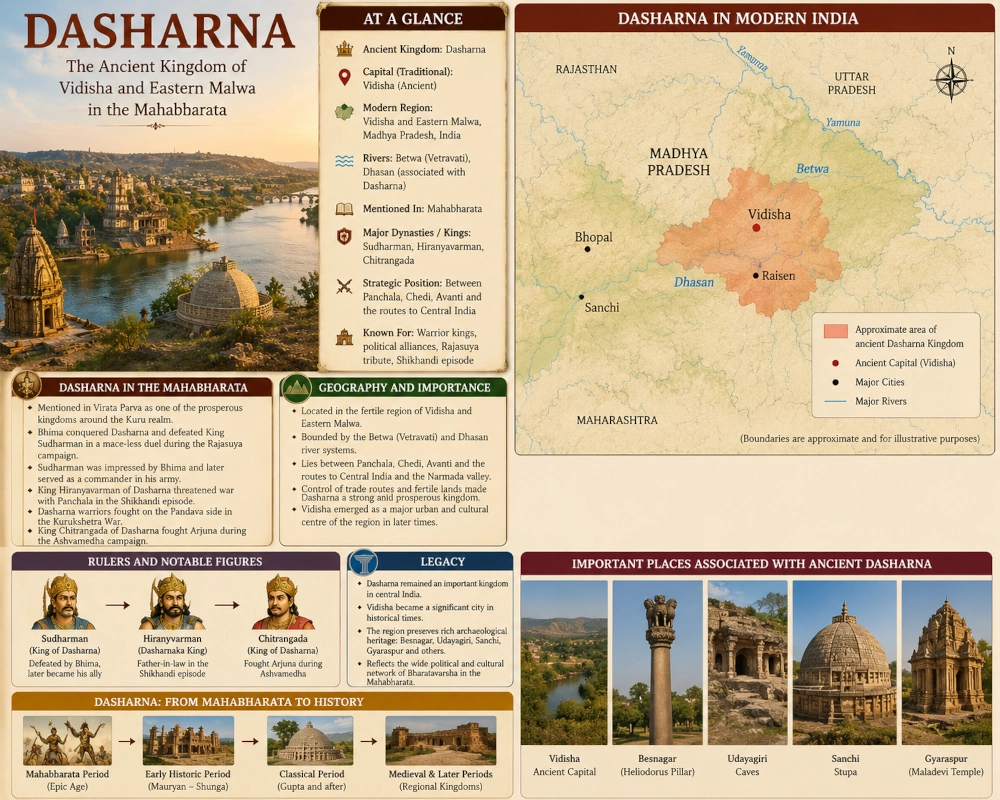
Vidisha lies northeast of Bhopal and close to Sanchi. The Betwa continues to define the landscape, while archaeological remains across Vidisha, Besnagar, Udayagiri and surrounding districts reveal the antiquity of settlement in this part of central India.
The ancient kingdom should not be reduced to the limits of modern Vidisha district. Political boundaries changed repeatedly over centuries, and terms such as Dasharna could describe wider regions rather than fixed administrative units.
A useful modern approximation is therefore:
Core region: Vidisha and the Betwa valley
Wider cultural zone: Eastern Malwa and adjoining central Madhya Pradesh
Modern state: Madhya Pradesh, India
Major geographical markers: Betwa River, Dhasan River, Vindhyan approaches
Principal ancient urban association: Vidisha
Dasharna’s Place in the Mahabharata World
Dasharna illustrates one of the most fascinating qualities of the Mahabharata: the epic does not describe an isolated conflict between two families. It presents a vast network of kingdoms spread across the Indian subcontinent.
Kings married across political borders. Armies travelled enormous distances. Regional rulers joined rival alliances. Tribute flowed towards powerful capitals, while defeated kings could later become commanders and allies.
Dasharna participated in this network at several levels.
Its King Sudharman encountered Bhima and earned his admiration. King Hiranyavarman negotiated and threatened war with Drupada of Panchala. Its warriors entered the great conflict at Kurukshetra. King Chitrangada later resisted Arjuna during the Ashvamedha.
Behind these stories stood the landscape of central India — river valleys, cultivated plains and routes connecting the northern heartland with Malwa and the Vindhyas.
Today, Vidisha and eastern Malwa preserve the strongest geographical memory of ancient Dasharna.
Mahabharata References
The principal references discussed in this article occur in the Sabha Parva, where Bhima subdues Dasharna and encounters Sudharman; the Virata Parva, where Dasharna appears among the prosperous kingdoms considered by the Pandavas; the Udyoga Parva, which tells of King Hiranyavarman and the marriage involving Shikhandi; the Bhishma and Drona Parvas, which contain references to Dasharna forces during Kurukshetra; and the Ashvamedha Parva, where Arjuna battles King Chitrangada of Dasharna.
Modern location: Vidisha and eastern Malwa, Madhya Pradesh, India.
You may also like
-
How a Rock Shelter in Nagaland Is Rewriting Northeast India’s Prehistory
-
13th-Century Tamil Inscription Reveals Jewish Merchants Helped Build Hall at Shiva Temple in Krishnagiri
-
India Begins National Push to Preserve Tribal Languages and Digitally Transform Tribal Museums
-
Malava in the Mahabharata: The Ancient Warrior People Behind the Malwa Region
-
Avanti in the Mahabharata: The Ancient Kingdom of Ujjain and the Malwa Region
