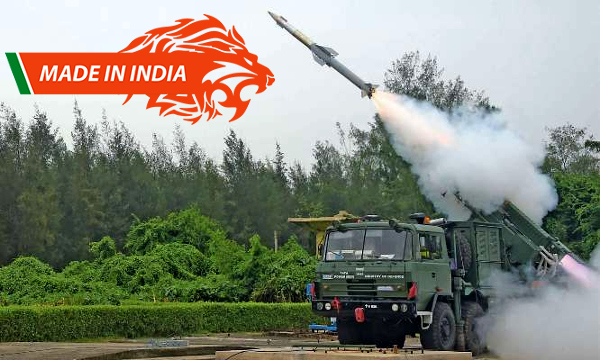
India is preparing for what could become one of its largest indigenous surface-to-air missile production cycles, with industry disclosures pointing to requirements of around 1,000 Quick Reaction Surface-to-Air Missiles (QRSAM) and a similar number of Akash-NG missiles. The two programmes would substantially expand the country’s inventory of mobile short- and medium-range air-defence weapons while creating years of production work for Bharat Electronics Limited (BEL), Bharat Dynamics Limited (BDL) and a large network of private-sector suppliers.
The more immediate programme is QRSAM, now formally identified by DRDO as Anant Shastra. The system has already received Acceptance of Necessity for induction, and BEL has indicated that the remaining major step before the expected order is approval from the Cabinet Committee on Security. During its July 2026 investor interaction, BEL said all activities and inputs required from its side had been completed and that it was awaiting CCS clearance. Management continued to guide for the order during the first half of the current financial year, with September mentioned as the expected outer timeline.
BEL has placed the expected overall programme at around ₹30,000 crore, covering requirements of both the Indian Army and Indian Air Force. BEL is expected to function as the lead system integrator, bringing together radars, command-and-control equipment, launchers, communications and associated subsystems. BDL would manufacture the missiles under a back-to-back arrangement with BEL. BEL had earlier indicated that the missile portion could account for roughly 30 per cent of the overall programme value.
Recent disclosures from Apollo Micro Systems, which participated in QRSAM development and supplies several missile subsystems, provide further indication of the anticipated scale. Its management has said the initial QRSAM production cycle could involve around 1,000 missiles, with the missile package flowing from BEL to BDL estimated at roughly ₹11,000-12,000 crore. The figure should presently be treated as an industry estimate associated with the expected procurement rather than as the quantity of an already signed Ministry of Defence contract.
QRSAM has been designed specifically to accompany mobile military formations and provide rapid protection against aircraft and other aerial threats. During evaluation trials, DRDO and the Indian Army tested the system against targets representing long-range, medium-altitude engagements, high-altitude manoeuvring threats, low-radar-signature targets and salvo attacks. Its deployment configuration incorporates an indigenous RF-seeker-equipped missile, mobile launcher, automated command-and-control system, surveillance radar and multifunction radar. One of the system’s defining features is its ability to search and track while moving before engaging targets after a short halt.
The first major production order will not immediately translate into hundreds of missiles leaving factories every year. BEL has said the initial QRSAM programme could be executed over seven to eight years because the production process includes First-Off Production Model stages, evaluation and subsequent transition into full-rate manufacturing. Once the production line, suppliers and quality-control processes have stabilised, BEL believes a subsequent order of comparable size could potentially be completed within three to four years.
Alongside QRSAM, the Akash-NG programme is moving towards the procurement phase following completion of its User Evaluation Trials in December 2025. DRDO said the system successfully intercepted targets across different ranges and altitudes, including demanding low-altitude near-boundary and long-range high-altitude scenarios. Successful completion of these trials cleared an important pathway towards induction into the Indian Air Force.
Akash-NG represents a substantial redesign rather than a simple incremental modification of the original Akash weapon system. The missile incorporates an indigenous RF seeker and solid-propellant propulsion, while the complete weapon system includes a multifunction radar, command-and-control unit and missile launch vehicle developed by DRDO laboratories with Indian industry. Earlier DRDO testing also demonstrated the system’s more compact deployment architecture and canisterised launcher, giving it a considerably smaller ground footprint and improving deployability compared with the earlier generation.
Industry guidance now points towards a potentially very large Akash-NG production requirement. Apollo Micro Systems management recently stated that the Ministry of Defence had cleared around 1,000 Akash-NG units while discussing the company’s expected opportunities from upcoming bulk-production programmes. However, this figure should not yet be interpreted as a signed contract for 1,000 missiles. BEL’s procurement roadmap has described Akash-NG as progressing through the approval and acquisition sequence before an RFP and production contract are concluded.
BEL is positioned to play the central industrial role in Akash-NG as well. In its January 2026 investor conference, the company confirmed that it was the lead bidder for the Indian Air Force’s Akash-NG requirement, while BDL would again handle the missile portion through a back-to-back arrangement. This division of responsibility differs from some existing Army Akash programmes, where BDL has acted as the lead contractor. BEL at that stage estimated the initial Akash-NG opportunity at approximately ₹2,500-3,000 crore, while cautioning that the final configuration and quantities could change during procurement approval.
The two programmes therefore create an unusually deep production relationship between India’s two principal defence public-sector electronics and missile manufacturers. BEL will anchor system integration, radars, command-and-control and associated electronics, while BDL will provide large-scale missile production. Beneath them will sit a much broader supply chain producing guidance electronics, onboard computers, actuators, launch equipment, seekers, power supplies, mechanical assemblies and other specialised components.
India has already begun expanding the infrastructure required for this wider missile-production push. In February 2026, the Defence Minister inaugurated a new Missile Integration Facility at BEL’s Bengaluru complex, while BEL continues to invest in facilities for radars, seekers, electronic warfare equipment and defence-system integration. The expansion reflects a broader transition from producing indigenous missile systems in relatively limited batches to sustaining several major weapon families simultaneously.
Strategically, QRSAM and Akash-NG address somewhat different parts of the air-defence requirement. QRSAM is optimised for highly mobile formations that require protection while manoeuvring and must rapidly detect, track and engage aerial threats. Akash-NG is intended to strengthen the Indian Air Force’s ground-based air-defence network with a more compact, responsive and modern successor to the existing Akash family. Together with VSHORADS, MRSAM, the indigenous Integrated Air Defence Weapon System and the longer-range Project Kusha family under development, they will contribute to an increasingly layered Indian air-defence architecture.
The growing requirement is also being shaped by changes in aerial warfare. Low-flying cruise missiles, unmanned aircraft, precision-guided weapons and increasingly sophisticated stand-off attacks place intense demands on short- and medium-range air-defence inventories. A missile system is therefore no longer judged only by the number of firing units deployed; forces require sufficiently deep interceptor stocks to sustain operations against repeated or saturation attacks.
Producing around 2,000 missiles across QRSAM and Akash-NG, if the currently indicated quantities ultimately translate into contracts, would consequently represent more than two major procurement programmes. It would establish long-duration manufacturing lines for two modern indigenous air-defence missile families, deepen the workload flowing from DRDO technologies into Indian industry and give the armed forces a much larger domestic interceptor reserve.
The crucial distinction at present is that the two programmes are at different procurement stages. QRSAM is considerably closer to a major production contract, with BEL awaiting final approval for an order valued at roughly ₹30,000 crore. Akash-NG has completed its user evaluation and is advancing towards acquisition. Even with that qualification, the scale being discussed points towards a major expansion of India’s indigenous air-defence manufacturing capacity over the coming decade.
You may also like
-
IndigoTex Raises ₹5 Crore to Scale Indigenous Advanced Textile Technologies
-
Sunfox Technologies Raises $7 Million to Take India-Built Spandan ECG Platform Global
-
DRDO Opens Actuators, Infrared Seeker, Lightweight Torpedo and Armour Technologies to Indian Industry
-
Indian Army to Add 225 Indigenous FPV Drones; Aerodrone Says Systems Were Tested Up to 17,500 Feet
-
India Helps Build a Machine Hotter Than the Sun: INOX India’s Cryogenic Role in ITER
