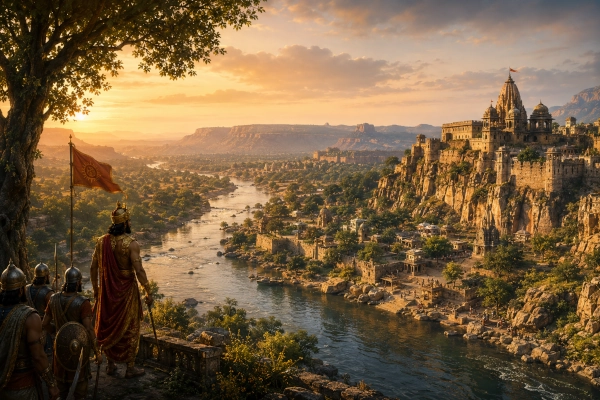
The Karusha Kingdom was one of the ancient realms remembered in the Mahabharata. It belonged to the vast political landscape that stretched beyond the better-known kingdoms of Kuru, Panchala, Magadha and Chedi.
Karusha appears several times in the epic as an established kingdom with its own rulers and warriors. Its kings attended major royal gatherings and participated in regional alliances. Karusha troops later fought in large numbers during the Kurukshetra War.
The kingdom is traditionally associated with the Baghelkhand and Vindhyan region of north-eastern Madhya Pradesh. For a modern geographical reconstruction, its broad setting can be visualised around Rewa, Satna, Sidhi and the adjoining Vindhyan country. Ancient boundaries remain uncertain, so any modern map must treat this identification as approximate.
Karusha’s importance came partly from geography. The region stood between the Gangetic plains and the forested plateaus of central India. It also lay near the political sphere of Chedi, while routes through the Vindhyas connected northern India with kingdoms farther south and east.
Karusha at a Glance
Ancient Kingdom: Karusha or Kārūṣa
Epic: Mahabharata
Modern Identification: Baghelkhand and adjoining north-eastern Madhya Pradesh
Modern Reference Region: Rewa-Satna-Sidhi and neighbouring Vindhyan districts
Country Today: India
Landscape: Vindhyan plateau, forests, river valleys and uplands
Important River Systems: Tons-Tamas and Son region
Important Mahabharata Ruler: Vaka, king of the Karushas
Major Political Association: Jarasandha of Magadha
Closely Associated Kingdom: Chedi
Kurukshetra Alliance: Pandava side
Capital: Not securely identified in the Mahabharata
Where Was the Karusha Kingdom?
The exact borders of Karusha cannot be drawn like those of a modern state. The Mahabharata gives political and geographical clues but does not provide surveyed frontiers.
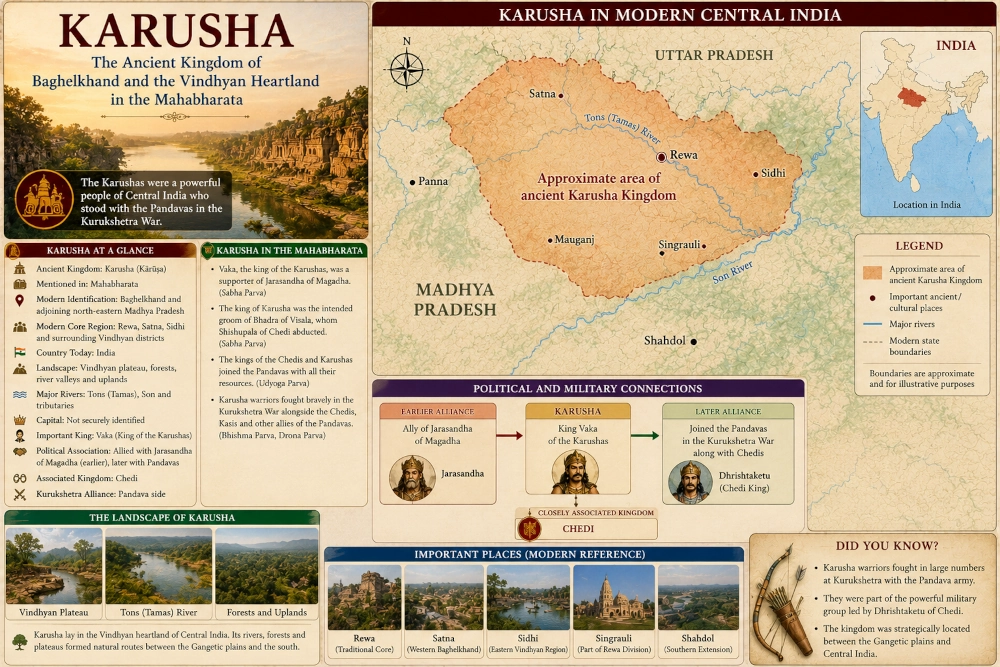
Traditional historical geography has associated Karusha with parts of the Vindhyan-Baghelkhand region of central India. For this article, the kingdom is placed broadly in north-eastern Madhya Pradesh, with the Rewa region providing the strongest modern point of orientation.
Modern Rewa Division lies in north-eastern Madhya Pradesh and forms part of the Baghelkhand region. It includes Rewa, Satna, Sidhi, Singrauli, Mauganj and adjoining districts.
Rewa itself lies on the Vindhyan plateau. The modern district administration describes the region as part of the Vindhya landscape and notes the importance of the Tons River and its tributaries.
This terrain provides a useful geographical setting for imagining ancient Karusha: a land of plateaus, forests, river valleys and natural routes linking northern and central India.
Karusha in the Ancient Geography of Bharat
Karusha was not an isolated forest territory. The Mahabharata presents the Karushas as one of the recognised peoples of ancient Bharat.
Their name appears beside other established kingdoms and tribes. More importantly, Karusha rulers interacted directly with some of the most powerful political figures in the epic.
These references reveal a kingdom integrated into the diplomatic system of the age. Its rulers attended royal gatherings, formed alliances and committed military forces to major conflicts.
Karusha’s location also placed it near the political world of Chedi, another important central Indian kingdom. The epic frequently mentions the Chedis and Karushas together, particularly during the Kurukshetra War.
Vaka, the King of the Karushas
One of the strongest direct references to Karusha appears in the Sabha Parva.
When Krishna explains the immense power of Jarasandha of Magadha to Yudhishthira, he describes the network of rulers who supported the Magadhan king.
Among them appears Vaka, explicitly identified as the king of the Karushas.
The text portrays Vaka as a powerful warrior capable of using extraordinary methods of warfare. He had placed himself within Jarasandha’s political sphere and served the Magadhan ruler.
This reference provides valuable information about Karusha before the rise of Pandava power.
Jarasandha had created one of the largest political alliances described in the early Mahabharata. His influence stretched far beyond Magadha. Karusha formed part of this wider coalition.
Karusha and the Power of Jarasandha
Jarasandha dominated much of the political world before Yudhishthira’s Rajasuya sacrifice.
His power threatened Krishna and the Yadavas. It also prevented Yudhishthira from claiming unquestioned imperial status.
The Sabha Parva lists several kings who had aligned themselves with Jarasandha. Vaka of Karusha stood among them, while Dantavakra and other rulers also appear within this wider political network.
Karusha’s connection with Jarasandha makes sense geographically. A central Indian kingdom could form part of the political corridor linking Magadha with Chedi and territories farther west.
The destruction of Jarasandha by Bhima fundamentally changed this balance.
Once Jarasandha disappeared, many kingdoms that had operated within his sphere gained greater political freedom. The alliances of the epic subsequently shifted.
Karusha itself would later stand with the Pandavas.
Karusha and Shishupala of Chedi
Another fascinating reference connects Karusha with Shishupala, the powerful king of Chedi.
During the Rajasuya episode, Krishna lists the offences committed by Shishupala. One involved a princess named Bhadra of Visala.
Bhadra had been intended as the bride of the king of Karusha. According to the Sabha Parva, Shishupala disguised himself as the Karusha ruler and carried her away.
The incident reveals something important about Karusha’s status.
Its royal family participated in the wider marriage diplomacy of ancient India. Marriage alliances linked kingdoms, established political relationships and sometimes produced serious conflict.
Karusha was therefore deeply connected to the royal network surrounding Chedi and other central Indian powers.
Karusha and Chedi: A Close Political Relationship
Karusha and Chedi appear together repeatedly in the Mahabharata.
This close association becomes especially visible during the preparations for the Kurukshetra War.
Chedi was an important central Indian kingdom whose most famous ruler was Shishupala. After Shishupala’s death, Dhrishtaketu of Chedi became a prominent ally of the Pandavas.
Karusha warriors later fought alongside Dhrishtaketu’s forces.
The repeated pairing of the Chedis and Karushas may reflect geography as well as politics. Both belonged to the broad central Indian zone south of the major Gangetic kingdoms.
Their military cooperation during the great war suggests that this regional relationship had become strategically important.
Karusha Joins the Pandavas
By the time war between the Pandavas and Kauravas became unavoidable, Karusha had clearly moved into the Pandava camp.
The Udyoga Parva states directly that the assembled kings of the Chedis and Karushas had joined the Pandavas with all their resources.
This is one of the strongest statements about Karusha’s allegiance anywhere in the epic.
It also reveals how dramatically the political landscape had changed.
Earlier, Vaka of Karusha had stood within the network controlled by Jarasandha. Now Karusha supported Yudhishthira against Duryodhana.
The Mahabharata repeatedly demonstrates that alliances were not permanent. Dynastic change, warfare, marriage, personal loyalties and the deaths of powerful rulers constantly altered political relationships.
Karusha provides a good example of that fluid system.
The Karushas Under Dhrishtaketu
As the Pandavas organised their enormous army, different regional contingents gathered under leading commanders.
The Karushas appear prominently among these forces.
The Udyoga Parva places them alongside the Chedis and Kasis in the Pandava military organisation associated with powerful commanders including Dhrishtaketu.
The Bhishma Parva gives an even clearer battlefield picture. It describes Dhrishtaketu surrounded by the Chedis, Kasis, Karushas and Pauravas.
Karusha therefore did not merely express diplomatic support for the Pandavas.
It sent warriors to Kurukshetra and participated directly in the military struggle.
Karusha Warriors at Kurukshetra
The Karusha contribution to the Pandava army appears substantial.
During the fighting against Bhishma, the Mahabharata repeatedly names Karusha warriors alongside the Chedis, Kasis, Panchalas and other important Pandava contingents.
One dramatic passage records 14,000 chariot warriors from the Chedis, Kasis and Karushas preparing to risk their lives in battle against Bhishma.
Elsewhere, Bhima leads Chedis, Matsyas and Karushas into combat.
Another description depicts Bhishma moving through the ranks of the Chedis, Kasis, Karushas and Panchalas, demonstrating the intensity of the fighting faced by these Pandava allies.
These references show that Karusha supplied an organised and recognisable military contingent.
It was not simply a name included in a catalogue of distant kingdoms.
Its warriors fought at the heart of the Kurukshetra battlefield.
Karusha Against Drona
The Karushas continued fighting after Bhishma fell.
During Drona’s command of the Kaurava army, the epic again records them among the Pandava forces confronting the great teacher.
The Drona Parva describes Drona battling and defeating troops from the Chedis, Karushas and Kaikeyas, among others.
Another passage places the Karushas with the Chedis, Matsyas and Kaikeyas as they pressed against Drona.
The repetition matters.
Karusha remained actively engaged through several phases of the eighteen-day war. Its military role did not end with the opening battles under Bhishma.
The Karusha-Chedi Military Bloc
Several war passages reveal an interesting pattern.
The Karushas rarely appear alone. They frequently stand beside the Chedis, often accompanied by the Kasis, Matsyas or Panchalas.
This suggests that Karusha belonged to a broader regional coalition inside the Pandava army.
Dhrishtaketu of Chedi appears to have provided an important centre around which these forces operated.
Such arrangements were normal in ancient warfare. Smaller kingdoms could retain their own troops while fighting under larger regional commanders.
Karusha’s military identity therefore remained visible even when its soldiers operated inside a larger Pandava formation.
Dantavakra and Karusha
The name Dantavakra has long been associated with Karusha in epic and Puranic traditions.
He belonged to the wider circle of rulers hostile to Krishna and friendly with Shishupala and Jarasandha. The Sabha Parva places Dantavakra within the group of rulers connected to Jarasandha’s political power.
Later Krishna traditions more explicitly associate Dantavakra with Karusha.
However, a distinction is useful when discussing the Mahabharata itself. In the passage describing Jarasandha’s allies, Vaka is directly called king of the Karushas, while Dantavakra is named separately.
For that reason, Vaka provides the clearest direct royal identification for a strictly Mahabharata-based reconstruction of Karusha.
Why Karusha’s Location Was Strategically Important
The probable Baghelkhand-Vindhyan setting helps explain Karusha’s political importance.
North-eastern Madhya Pradesh forms a natural transition between the northern plains and central India’s plateaus.
The Rewa country belongs to the Vindhyan plateau and is crossed by important river systems. The Tons and its tributaries drain much of the modern Rewa area.
Routes through this region could connect the Gangetic plain with Chedi and other kingdoms farther south.
The landscape also offered defensive advantages.
Plateaus, scarps, river valleys and extensive forests created a very different military environment from the open plains around Hastinapura and Panchala.
A kingdom established in this region could therefore control valuable routes while retaining considerable natural protection.
Karusha and the Vindhyan Landscape
Modern Baghelkhand remains one of the most distinctive geographical regions of central India.
Rewa Division occupies north-eastern Madhya Pradesh and forms part of this broader cultural region.
The historical landscape includes the Rewa plateau, river valleys and the Vindhyan-Kaimur highlands. These geographical features separate the region from the Gangetic plains to the north.
For readers trying to visualise the Mahabharata, this distinction is important.
Karusha should not be imagined as another flat Gangetic kingdom like much of Kuru or Panchala.
It belonged to the rugged Vindhyan world of central India.
Forests, uplands, river valleys and plateau routes would have shaped movement, settlement and warfare throughout the region.
Karusha on the Modern Map
For modern geographical orientation, the Karusha Kingdom can be represented broadly as:
Karusha → Baghelkhand and the Vindhyan region → North-eastern Madhya Pradesh → India
The central reference points should include:
Rewa — the most useful modern centre for identifying the Baghelkhand-Vindhyan region.
Satna — an important western reference within the wider Baghelkhand landscape.
Sidhi — part of the eastern Vindhyan region.
Singrauli — farther east within modern Rewa Division.
Shahdol — useful for understanding the southern extension of the broader Baghelkhand cultural zone.
The modern Rewa administration describes its division as part of Baghelkhand and places it in north-eastern Madhya Pradesh near Uttar Pradesh.
The ancient shaded area on a historical map should therefore centre on the Rewa-Satna-Sidhi region, while extending cautiously into neighbouring Vindhyan territory.
The Capital of Karusha
Unlike Hastinapura, Indraprastha, Mathura or Girivraja, the Mahabharata does not provide a securely identifiable capital for Karusha in the passages that describe its political activity.
It would therefore be misleading to label Rewa itself as the ancient capital.
Rewa works well as a modern geographical reference point, but that does not prove that the ancient Karusha royal seat stood at the modern city.
This distinction is important for historical mapping.
The map should say:
Modern reference: Rewa and Baghelkhand
rather than:
Ancient capital: Rewa
unless archaeological or textual evidence emerges that can support such a claim.
Ancient Borders Must Remain Approximate
Reconstructing the political geography of the Mahabharata requires caution.
Ancient kingdoms did not possess borders surveyed according to modern administrative methods. Territories could expand, shrink or overlap according to military strength and alliances.
Karusha presents an additional challenge because modern scholars and secondary traditions do not always agree about its exact location.
The Baghelkhand-Vindhyan identification provides a useful traditional framework and is the one followed here. However, the map should clearly state:
“Approximate traditional location of the ancient Karusha Kingdom. Boundaries are illustrative.”
This allows readers to understand the geographical setting without presenting speculation as certainty.
From Jarasandha’s Sphere to the Pandava Alliance
Karusha’s political history within the Mahabharata reveals how quickly power could shift in ancient Bharat.
At one stage, Vaka of Karusha stood within Jarasandha’s powerful eastern alliance.
Later, the rulers and warriors of Karusha committed themselves fully to the Pandava cause.
They then fought beside the Chedis, Kasis and other Pandava allies on the battlefield of Kurukshetra.
This transformation mirrors the wider political changes created by Krishna and the Pandavas.
Jarasandha’s death removed one of the great centres of power. Shishupala’s death weakened another hostile coalition. New alliances then formed around Yudhishthira and Duryodhana.
Karusha became part of that changing political order.
Why Karusha Matters in the Mahabharata
Karusha rarely dominates modern retellings of the Mahabharata. Yet its presence helps reveal the enormous geographical scale of the epic.
The Kurukshetra War was not simply a family dispute between two branches of the Kuru dynasty.
Kings and armies came from across the subcontinent.
The Karushas marched from central India. Chedi warriors joined them. Panchalas formed one of the Pandavas’ strongest military blocs. Yadavas divided between the two sides. Kings from the northwest, east, south and Himalayan regions also entered the conflict.
Karusha therefore reminds us that the Mahabharata describes a continental political network, not merely the politics of Hastinapura.
The Legacy of Karusha
Karusha does not survive today as the name of a state or district.
Yet the geographical landscape traditionally associated with it remains clearly visible.
The plateaus and valleys of Baghelkhand, the Vindhyan country around Rewa, and the river systems running toward the Gangetic plains preserve the physical setting of this part of central India.
Modern Rewa still stands within the Vindhyan landscape and remains a major centre of Baghelkhand.
When this region is viewed through the geographical references of the Mahabharata, a forgotten political landscape begins to emerge.
Karusha was a kingdom whose rulers interacted with Jarasandha and Shishupala. Its political allegiance later shifted toward the Pandavas. Its warriors fought under the broader command structure of Dhrishtaketu and endured some of the most violent battles at Kurukshetra.
The kingdom may occupy only scattered passages in the epic, but those passages reveal a state firmly integrated into the political world of ancient Bharat.
Karusha in Modern India
The most useful modern geographical identification is:
Ancient Karusha
↓
Vindhyan-Baghelkhand region
↓
Rewa, Satna, Sidhi and adjoining north-eastern Madhya Pradesh
↓
India
This identification should remain approximate.
Karusha’s real importance lies not in drawing a perfect modern border around an ancient kingdom, but in understanding its place within the geopolitical world described by the Mahabharata.
From Jarasandha’s alliance network to the Pandava armies at Kurukshetra, Karusha formed part of the great chain of kingdoms that connected central India with the political destiny of the Kuru age.
References
The Sabha Parva identifies Vaka as king of the Karushas and places him within Jarasandha’s political network.
The Sabha Parva also records the episode involving Shishupala, Bhadra of Visala and the king of Karusha.
The Udyoga Parva states that the kings of the Chedis and Karushas joined the Pandavas with their resources.
The Bhishma Parva repeatedly records Karusha warriors fighting alongside Chedi and Kasi contingents under the Pandava command.
The Drona Parva confirms that Karusha forces continued to fight after Bhishma’s fall.
Modern geographical context for the Baghelkhand-Vindhyan region comes from official Rewa district and Rewa Division sources of the Madhya Pradesh government.
You may also like
-
Yavana in the Mahabharata: Greek Connections, Pandava Campaigns and the Warriors of Kurukshetra
-
India and Sri Lanka Launch SAMHiTA Manuscript Digitisation Project to Preserve Ancient Buddhist Heritage
-
ASI Uses Ground-Penetrating Radar to Investigate Ancient Buddhist Stupa at Ujjain After Nearly 90 Years
-
Pahlava: The Parthian World Beyond India’s Northwestern Frontiers in the Mahabharata
-
Namami Gange in 2026: 368 Projects Completed, 4,339 MLD Sewage Treatment Capacity Created as Ganga Rejuvenation Advances
