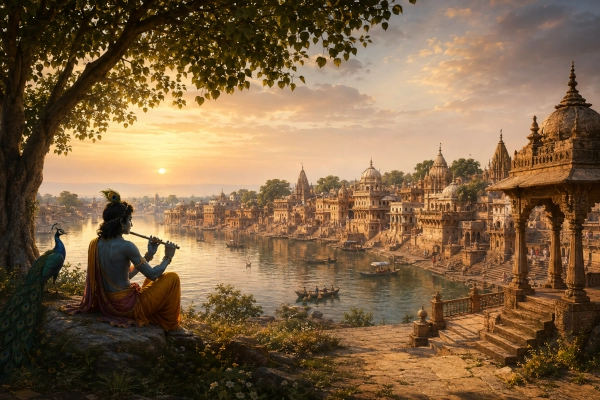
Among the ancient kingdoms connected with the Mahabharata, Surasena or Shurasena occupies a particularly important place. Its political centre was Mathura, on the Yamuna, while its wider cultural landscape corresponds broadly with the historic Braj region of western Uttar Pradesh. Ancient historical scholarship also identifies Mathura as the capital of the Surasena country.
Surasena was not important simply because Mathura later became one of the great sacred cities of India. In the Mahabharata, the region stands at the heart of the Yadava world. It is connected with Krishna, Balarama, Vasudeva, Kunti, the Vrishnis, Andhakas and Bhojas. It also becomes one of the principal theatres of the long political struggle between the Yadavas and Jarasandha of Magadha.
The modern geographical identification should therefore be understood as an approximation. The core of ancient Surasena can be placed around Mathura and the Yamuna valley, extending into the surrounding Braj country. Ancient political frontiers did not correspond to modern district boundaries, while the cultural region called Braj eventually became larger than the probable political territory of Surasena.
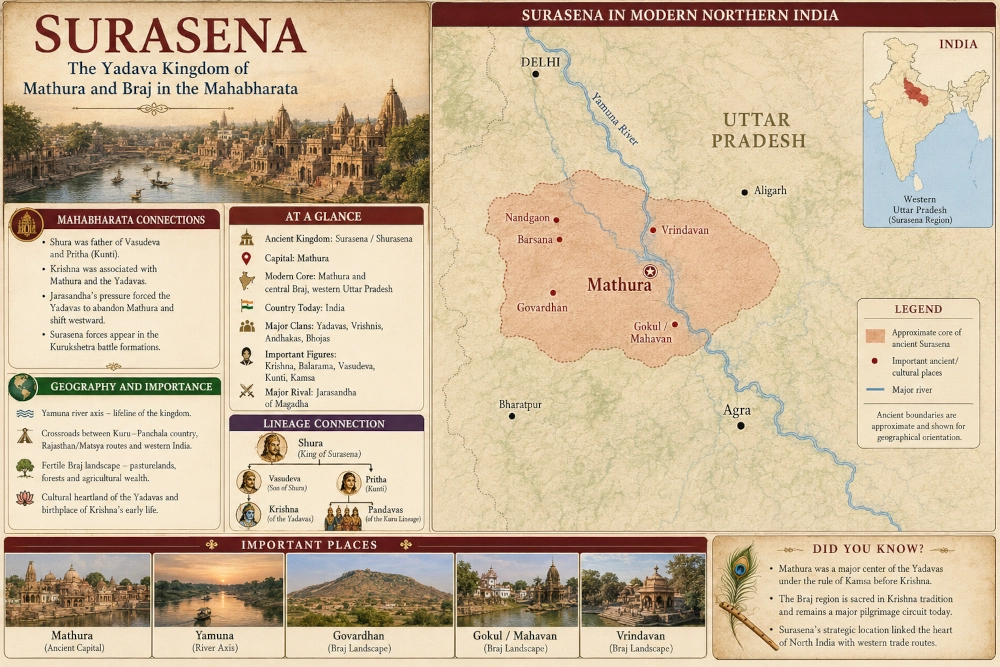
Surasena at a Glance
Ancient Kingdom: Surasena or Shurasena
Capital: Mathura
River: Yamuna
Modern Core: Mathura and the surrounding Braj region of western Uttar Pradesh
Country Today: India
Major Peoples and Clans: Yadavas, Vrishnis, Andhakas, Bhojas and related Satvata groups
Important Mahabharata Figures: Krishna, Balarama, Vasudeva, Kunti, Ugrasena, Kamsa, Satyaki and Kritavarma
Major External Rival: Jarasandha of Magadha
Later Political Shift: The Yadava centre moved westward from Mathura toward Dvaraka under pressure from powerful enemies
Where Was Ancient Surasena?
The geographical heart of Surasena was Mathura, situated on the Yamuna. Historian Hemchandra Raychaudhuri identified the Surasena country with Mathura as its capital on the river. Later historical traditions also remembered Surasena as one of the major states of northern India.
In modern terms, the best geographical reference is the Mathura-Braj region. Mathura lies about 50 kilometres north of Agra and around 145 kilometres southeast of Delhi. Vrindavan lies immediately to its north, while Govardhan is situated to the west.
The official Mathura district description of the Braj pilgrimage landscape includes Mathura, Vrindavan, Govardhan, Barsana, Nandgaon, Gokul, Mahavan and Baldeo among its principal places. The traditional Braj Chaurasi Kos circuit covers roughly 252 kilometres.
For a historical map of Surasena, however, it is better not to shade the entire later cultural Braj region as though it were a precisely documented ancient frontier. The strongest geographical anchor is Mathura and its surrounding Yamuna-Braj hinterland.
The Yadava Kingdom of Mathura
The Mahabharata does not present the Yadavas as a single simple dynasty ruled continuously by one king. Instead, it refers to several related Yadava groups, including the Vrishnis, Andhakas and Bhojas. Mathura formed the political centre around which many of these clans operated.
This makes Surasena especially interesting. It appears less like a rigid territorial monarchy in the later imperial sense and more like a regional political sphere dominated by interconnected Yadava houses.
Krishna emerges from this complex political world. His importance in the epic is therefore not confined to religion or philosophy. He is also a leading statesman of a powerful western Gangetic-Yamuna polity whose alliances influence the entire political balance of northern India.
Shura, Vasudeva and the Surasena Line
The connection between the Surasena-Yadava house and the Pandavas is established very early in the Mahabharata.
In the Adi Parva, Bhishma refers to a princess belonging to Surasena of the Yadava race while discussing suitable marriages for the Kuru dynasty.
The following section provides the genealogy more clearly. It states that a Yadava chief named Shura was the father of Vasudeva and of a daughter named Pritha. Shura gave Pritha to his childless cousin Kuntibhoja, after which she became famous as Kunti.
This genealogy creates one of the most important family links in the entire epic. Vasudeva became the father of Krishna, while Kunti became the mother of Yudhishthira, Bhima and Arjuna. Krishna was therefore not merely the political ally and friend of the Pandavas. Through Vasudeva and Kunti, he was also closely related to them through the Yadava family.
Surasena thus stands at a genealogical bridge between the Yadavas of Mathura and the Pandavas of the Kuru line.
Mathura, Kamsa and the Struggle for Power
Mathura’s political history in the epic tradition is deeply connected with the rise of Kamsa.
The Mahabharata remembers Krishna’s destruction of Kamsa as one of his major early exploits. In the Drona Parva, Dhritarashtra recalls that Kamsa, despite enjoying the protection of Jarasandha, was slain by Krishna. The same passage also refers to Sunaman, king of the Surasenas and brother of Kamsa, being defeated by Krishna and Balarama.
This passage is important because it shows that the political terminology surrounding Mathura was complex. Kamsa is associated with the Bhojas, while another ruler is explicitly described as king of the Surasenas. The region therefore appears to have contained several closely connected Yadava houses rather than one completely uniform royal line.
Krishna’s victory over Kamsa changed the balance of power in Mathura. It also brought the Yadavas into direct confrontation with one of the most powerful rulers of the eastern Gangetic world.
Jarasandha and the Pressure on Mathura
That ruler was Jarasandha, king of Magadha.
The conflict between Jarasandha and the Yadavas is one of the most important geopolitical struggles behind the Sabha Parva. Krishna explains to the Pandavas that Jarasandha had become so powerful that the Yadavas were placed under severe pressure. The Mahabharata even describes the Yadavas abandoning Mathura and carrying away their wealth in portable portions because of the threat posed by Jarasandha.
Another passage places Krishna at Mathura while describing Jarasandha’s hostility toward him and the Vrishni clans.
This episode transforms Surasena from a regional kingdom into part of a much larger political contest. Magadha in the east and the Yadavas around Mathura represented two major centres of power, and Jarasandha’s expansion threatened the survival of Krishna’s political community.
The pressure eventually encouraged the Yadavas to establish themselves farther west at Dvaraka. The movement from Mathura toward the western coast became one of the great geographical shifts associated with Krishna’s political career.
Why Mathura Was Strategically Important
Mathura occupied an exceptional position in northern India.
The city stood on the Yamuna, between the upper Gangetic plain and the routes leading toward Rajasthan, Malwa and western India. Control of Mathura therefore offered access both to the rich agricultural country of the Yamuna basin and to important routes running west and southwest.
Its location also explains why the region repeatedly appears within wider political networks. Surasena sat between the Kuru heartland farther north, Panchala to the east, Matsya toward Rajasthan, and the routes leading toward central and western India.
This position would later help Mathura grow into one of the major commercial, religious and artistic centres of ancient India.
Surasena and the Kurukshetra War
The political world of Mathura did not speak with one voice during the Kurukshetra conflict.
Krishna personally supported the Pandavas and became Arjuna’s charioteer. Satyaki, another major Vrishni warrior, fought on the Pandava side. Kritavarma, however, fought for the Kauravas. Balarama chose not to participate directly in the central struggle between the cousins.
The epic also preserves Surasena troops or warriors within Kaurava battle formations. In the Sanskrit text of the Bhishma Parva, the Surasenas are named among forces positioned in Bhishma’s great battle array.
This division is significant. It demonstrates that the Yadava political sphere was not a single centralised state whose entire military strength followed Krishna. Clan loyalties, individual alliances and political calculations produced different choices during the war.
Surasena therefore illustrates one of the defining features of the Mahabharata’s political landscape: kingdoms and clans were connected through marriage and ancestry, yet their loyalties could still divide when a major war began.
Kunti: Surasena’s Direct Link to the Pandavas
One of Surasena’s greatest contributions to the political structure of the epic came through Kunti.
The Adi Parva describes Pritha as the daughter of Shura and sister of Vasudeva. She was given in adoption to Kuntibhoja and thereafter became known as Kunti.
Through her, the Yadava family of the Mathura region became directly connected to the Kuru dynasty. Kunti became the mother of the Pandavas, while her brother Vasudeva became the father of Krishna.
The alliance between Krishna and the Pandavas was therefore reinforced by kinship. When Krishna advised Yudhishthira, protected Arjuna, negotiated with the Kauravas and finally directed the strategy of the Pandava war effort, he was acting within a network that joined diplomacy, friendship and family.
Mathura and the Sacred Landscape of Braj
The landscape surrounding Mathura later became celebrated as Braj, one of India’s most important sacred regions.
Modern Braj tradition associates Krishna with Mathura, Vrindavan, Gokul, Mahavan, Govardhan, Barsana, Nandgaon and numerous forests, ponds and pilgrimage routes. The Mathura district administration itself recognises these places as part of the Braj pilgrimage landscape.
For a Mahabharata-focused historical article, however, it is useful to distinguish between two layers of tradition. Mathura and the Yadava political sphere are firmly embedded in the Mahabharata narrative, while many detailed childhood associations of Krishna with individual Braj sites are developed much more fully in later Puranic and devotional literature.
The two traditions overlap geographically, but they should not be treated as identical textual sources.
Archaeology Around Mathura
Archaeological research confirms that Mathura and the surrounding country possessed a long and dense history of settlement.
Research by archaeologist Vinay Kumar Gupta, associated with the Archaeological Survey of India, documents numerous ancient sites around Mathura and attempts to correlate literary place-names with archaeological remains. Several sites in the region preserve cultural sequences reaching back to the Painted Grey Ware period and continuing into later historical times.
Such archaeology demonstrates that the wider Mathura region was an important zone of ancient settlement. It should not, however, be presented as archaeological proof of individual events in the Mahabharata. Archaeology can establish settlement, material culture and historical occupation more securely than it can verify particular epic episodes.
That distinction is important when reconstructing the geography of ancient Surasena.
Important Places to Show on a Surasena Map
A geographical map accompanying this article should place Mathura at the centre and clearly show the Yamuna. The main shaded zone should cover the Mathura-Braj heartland rather than the whole of western Uttar Pradesh.
Mathura should be marked as the ancient capital and principal political centre of Surasena.
The Yamuna River should form the major geographical axis of the kingdom.
Vrindavan should appear north of Mathura as one of the principal places of the wider Braj cultural landscape.
Gokul and Mahavan should appear southeast of Mathura across the Yamuna.
Govardhan should be shown west of Mathura.
Barsana and Nandgaon can be shown farther northwest within the wider Braj cultural region.
Agra, Aligarh, Bharatpur and Delhi can appear as modern reference points outside or near the ancient shaded zone. Their inclusion would help readers understand Surasena’s location in present-day northern India without implying that every one of these cities formed part of the ancient kingdom.
The map should also carry a clear note that ancient boundaries are approximate and are shown only for geographical orientation.
Surasena Between the Kuru Heartland and Western India
Surasena’s wider significance becomes clearer when it is viewed alongside the other kingdoms of the Mahabharata.
To the north and northeast lay the political world of the Kurus. To the east were Panchala and the central Gangetic kingdoms. To the southwest lay Matsya, while routes through Rajasthan and central India connected Mathura with the western part of the subcontinent.
Surasena therefore occupied a natural crossroads.
This geography helps explain why Krishna could operate simultaneously within several political worlds. His family belonged to the Yadava sphere of Mathura. His relatives were connected with the Pandavas. His rivals included Jarasandha in distant Magadha. His later political centre lay at Dvaraka on India’s western coast.
Few figures in the epic link such distant geographical regions as effectively as Krishna, and Mathura-Surasena was the eastern political base from which that wider network emerged.
The Legacy of Surasena
Surasena did not become famous through territorial conquest on the scale of Magadha. Its historical importance came from something different.
It occupied a strategic position on the Yamuna. It formed the homeland of major Yadava clans. It produced the family into which Krishna was born. Through Kunti, it became genealogically linked with the Pandavas. Through the struggle against Jarasandha, it became involved in one of the great interstate rivalries preceding the Rajasuya sacrifice and the Kurukshetra War.
Most importantly, the political geography of Surasena survived in cultural memory. Ancient Mathura eventually became the centre of the vast sacred landscape known as Braj.
Today, when the places of Mathura, Vrindavan, Govardhan, Gokul and the surrounding Yamuna country are viewed together, they preserve the geographical setting of a region whose importance reaches from the political narratives of the Mahabharata to the later devotional traditions of Krishna.
Surasena in Modern India
For a modern geographical identification, Surasena can be represented as:
Ancient Surasena → Mathura and the central Braj region → Western Uttar Pradesh, India
The shaded historical zone should be centred on present-day Mathura district and the adjoining Yamuna-Braj country. A wider secondary outline may indicate the cultural extent of Braj, but it should be visually distinguished from the probable core of ancient Surasena.
This approach gives readers a clearer picture than simply colouring a large section of western Uttar Pradesh. It keeps Mathura, the Yamuna and the Braj heartland at the centre of the ancient kingdom while acknowledging that exact political boundaries cannot be reconstructed with modern precision.
Sources and References
The principal epic references used for this article include the Mahabharata, Adi Parva, Sections CX-CXI, which preserve the Surasena-Yadava genealogy and identify Shura as the father of Vasudeva and Pritha.
The Sabha Parva preserves the political memory of Jarasandha’s pressure on Mathura and the Yadavas.
The Drona Parva recalls Krishna’s struggle with Kamsa and identifies Sunaman as a king of the Surasenas.
The Bhishma Parva includes Surasena forces within the armies assembled for the Kurukshetra War.
For historical geography, Hemchandra Raychaudhuri’s Political History of Ancient India identifies Mathura on the Yamuna as the capital of Surasena.
Modern Braj geography and the principal pilgrimage locations around Mathura are documented by the Mathura district administration.
Archaeological context for ancient settlements around Mathura is discussed in Vinay Kumar Gupta’s study of ancient places and archaeological sites in the Braj region.
You may also like
-
Samatata — The Low-Lying Deltaic Realm of Southeastern Bengal
-
Tamralipta — The Maritime Gateway of the Lower Ganga
-
Suhma — The River-and-Forest Country of Southwestern Bengal
-
Gauda — The Western Bengal Country of the Bhagirathi and the Rise of Karnasuvarna
-
Pundra — The Northern Bengal Kingdom of the Karatoya and the Ancient City of Pundranagara
