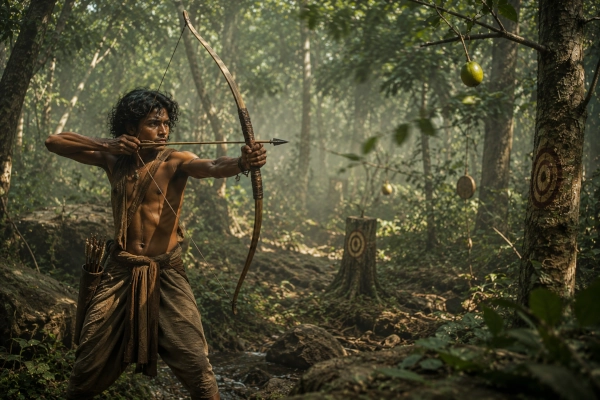
Deep within the forest, far from the royal training grounds of Hastinapura, a young archer practised in solitude. There were no cheering spectators around him, no palace instructors correcting the position of his hands and no princes competing beside him. His companions were the trees, the wind and the distant sounds of animals moving through the wilderness. Yet every day, Ekalavya lifted his bow and trained with a concentration that slowly transformed determination into extraordinary skill.
Ekalavya was the son of Hiranyadhanus, a chief of the Nishadas. He had once approached Dronacharya with the desire to learn archery from the renowned teacher who instructed the Kuru princes. Drona did not accept him among his royal pupils, but Ekalavya refused to abandon his ambition. He withdrew into the forest, fashioned an image of Drona from clay and treated that image as the presence of his guru. Before it, he began teaching himself the art of the bow. The Mahabharata places this remarkable episode in the Adi Parva, within the account of Drona’s training of the princes.
The Silent Student of the Forest
Ekalavya’s training demanded a very different kind of discipline from that enjoyed by the princes of Hastinapura. No teacher stood beside him to demonstrate how far to draw the bowstring, how to steady his breathing or how to compensate for a moving target. Every mistake had to become its own lesson, and every missed arrow had to tell him what he had done wrong. He trained by observing his own failures, correcting them and attempting the same shot again until his body remembered what his mind had learned.
Day after day, Ekalavya practised among the trees. He fired arrows at marks carved into trunks, small fruits hanging from branches and leaves trembling in the wind. He trained at different distances and from uneven ground, forcing himself to adjust his balance and aim. The forest gave him no perfectly prepared range and no predictable conditions. Instead, it offered changing light, moving branches, sudden sounds and shifting winds, all of which became part of his education.
The wilderness slowly became his teacher. A falling leaf could test his timing, while the distant movement of an animal could sharpen his observation. The wind taught him how an arrow could drift from its intended path, and the irregular terrain forced him to shoot from angles that a carefully prepared training ground might never provide. His fingers hardened against the bowstring, his movements became faster and his concentration grew increasingly intense.
Over time, the young Nishada archer developed astonishing precision. Ekalavya had been denied formal instruction, but he had not allowed rejection to become defeat. Instead, he transformed solitude into discipline and disappointment into an almost relentless determination to master the bow.
The Princes Enter the Forest
One day, the Kuru princes entered the forest during an excursion connected with their martial training. They were accompanied by attendants and a dog that moved eagerly through the woodland, running ahead of the group and investigating unfamiliar scents. The animal wandered farther and farther from the princes until it eventually reached the secluded place where Ekalavya was practising.
The dog stopped when it saw the unfamiliar archer. Ekalavya stood among the trees with his bow in hand, absorbed in his training and dressed like one accustomed to life in the wilderness. Alarmed or excited by the stranger, the animal began barking loudly. Its repeated cries broke through the quiet of the forest and disturbed the concentration that Ekalavya had carefully maintained.
At first, Ekalavya attempted to continue his practice despite the noise. The dog, however, continued barking. Its head moved as it called out repeatedly, and its voice echoed between the trees. Ekalavya finally turned towards the animal and raised his bow. What followed would reveal more about his ability than hundreds of ordinary shots at fixed targets ever could.
Seven Arrows and an Extraordinary Display
As the dog opened its mouth to bark again, Ekalavya acted with astonishing speed. His hand moved to the quiver, the bowstring was drawn and an arrow flew towards the animal. Another followed almost immediately, and then another. Within moments, seven arrows had been placed around the dog’s mouth with such precision that its barking was stopped without the animal being killed.
The feat demanded extraordinary control. The dog was not standing motionless like a target fixed to a tree. Its head was moving, its mouth was opening and closing, and Ekalavya had only brief moments in which to release each shaft. Yet his arrows reached exactly where he intended them to go. The frightening appearance of the animal showed the speed of his shooting, while the fact that it survived revealed the precision behind every release.
Terrified and confused, the dog fled from Ekalavya and raced back through the forest towards the Kuru princes. When it finally reached them, the young warriors stared at it in amazement. They immediately recognised that they were looking at the work of an exceptionally accomplished archer.
The princes had spent years learning the science of weapons under Dronacharya, so they understood how difficult such a feat would be. Striking a moving target was challenging enough, but releasing several arrows in rapid succession while controlling their position so precisely demanded a level of coordination that few archers could achieve. The dog therefore became unexpected evidence that somewhere in the forest lived an archer whose skill demanded their attention.
Searching for the Unknown Archer
The princes examined the animal and wondered who could have performed such a remarkable feat. Whoever had fired the arrows must have possessed immense speed, exceptional eyesight and remarkable command over the bow. Their curiosity quickly turned into a search, and they followed the direction from which the frightened dog had returned.
After moving through the forest, they eventually found Ekalavya. He stood before his targets with bow and arrows in hand, continuing the practice that had occupied so much of his life. There was nothing about his surroundings that resembled the organised training grounds of Hastinapura. Yet the evidence of his ability had already reached the princes before they ever saw him.
They approached the solitary archer and asked who he was. Ekalavya answered without hesitation. He identified himself as the son of Hiranyadhanus of the Nishadas and then made a statement that surprised the princes even more than his skill. He described himself as a disciple of Dronacharya.
The princes knew immediately that something was unusual. They trained directly under Drona and were familiar with the students who gathered around him. They had never seen Ekalavya among them. Their curiosity therefore deepened as they tried to understand how this unknown forest archer could claim the same guru while possessing such extraordinary ability.
The Guru Made from Clay
The explanation lay within Ekalavya’s secluded training ground. After Drona had refused to accept him as a pupil, Ekalavya had fashioned an image of the great teacher from clay. He placed the figure before him and mentally accepted Drona as his guru, even though the living teacher was not physically present to instruct him.
The clay image could not demonstrate the proper stance for a difficult shot. It could not correct the angle of Ekalavya’s wrist or explain why an arrow had missed its target. It offered no praise when he succeeded and no criticism when he failed. Ekalavya nevertheless returned before it each day and practised with unwavering devotion.
In this way, two very different schools of archery existed at the same time. At Hastinapura, princes trained under one of the greatest weapons masters of the age and benefited from carefully structured instruction. In the forest, Ekalavya created his own school around a silent image and learned through observation, repetition and discipline.
The arrows that silenced the barking dog demonstrated how far that unusual training had taken him. His accomplishment was not merely the result of natural talent. Behind his speed stood countless hours of practice, failed attempts, corrections and repeated exercises undertaken without anyone watching.
Arjuna Sees an Unexpected Rival
Among the princes, Arjuna understood the significance of Ekalavya’s achievement more sharply than anyone else. Drona had devoted great attention to Arjuna’s training, while Arjuna himself practised with extraordinary dedication. He had emerged as the outstanding archer among the Kuru princes and had every reason to believe that he would become the foremost pupil of his teacher.
The dog from the forest complicated that belief. An unknown archer, trained beyond the royal school and without Drona’s direct instruction, had demonstrated a feat that astonished even those who studied under the famous master. Ekalavya was therefore no longer merely a stranger in the wilderness. His ability presented an unexpected challenge to the established hierarchy of Drona’s students.
Arjuna later raised the matter with his teacher. He wanted to understand how a man who called himself Drona’s disciple could possess such extraordinary skill despite never having trained alongside the recognised pupils of Hastinapura. This concern would eventually bring Dronacharya himself into contact with Ekalavya and lead to one of the most debated episodes in the Mahabharata: the demand for Ekalavya’s right thumb as guru dakshina.
Before that painful encounter, however, there remained the unforgettable image of the dog returning through the forest with seven arrows around its mouth. For that moment, nothing else defined Ekalavya. The arrows alone revealed the extraordinary archer he had become.
The Skill Behind the Seven Arrows
The incident remains memorable because the difficulty of Ekalavya’s achievement can be understood immediately. A barking dog presents a moving and unpredictable target. Its head shifts position, its mouth opens only briefly and the archer must judge distance and movement in a fraction of a moment. Ekalavya responded with enough speed to release several arrows while maintaining astonishing control over their placement.
The achievement therefore required more than physical strength. It demanded exceptional coordination between eyesight, judgement, fingers, bowstring and arrow. Ekalavya’s movements had become so deeply practised that he could respond almost instinctively. Years of repetition had made the bow feel less like an object in his hands and more like an extension of his own body.
The spectacular moment lasted only a short time, but the preparation behind it had taken years. Every earlier arrow that missed a target, every painful hour spent drawing the string and every exercise repeated in solitude had contributed to those few seconds. The dog merely revealed to others what the forest had already witnessed developing day after day.
The Forest That Watched Him Grow
No king had observed Ekalavya’s long years of training. No court poet recorded his progress, and no audience applauded when his accuracy improved. Much of his development occurred in complete obscurity, far from the places where royal warriors usually earned recognition.
This gives the episode much of its enduring power. Ekalavya’s greatness develops outside the recognised institutions of his age. His ability is not first displayed during a magnificent tournament before assembled rulers. Instead, it is discovered by accident when a dog runs back to a group of princes carrying unmistakable evidence of an unknown archer’s mastery.
Until that moment, Ekalavya’s accomplishment belonged almost entirely to himself and the forest around him. The barking dog carried the secret beyond the trees and forced the princes of Hastinapura to acknowledge that extraordinary talent had developed far beyond their own training grounds.
Discipline Without Recognition
Ekalavya’s story also illustrates the difference between achievement and recognition. Recognition depends upon other people noticing what someone has accomplished, but achievement can exist for years without witnesses. Ekalavya had no guarantee that Drona would ever see his progress or that the princes of Hastinapura would ever know his name.
He practised nevertheless. His dedication survived even after the teacher he admired had refused to accept him. Instead of allowing disappointment to destroy his ambition, he built a new path towards the same goal. His motivation came from the desire to master archery rather than from the certainty that someone would eventually reward him for doing so.
This perseverance is central to understanding Ekalavya’s character. Whatever judgement later readers may make about the difficult events that followed, his extraordinary commitment to learning cannot easily be overlooked. He refused to allow a closed door to become the end of his journey.
When Practice Becomes Instinct
The seven arrows also demonstrate what happens when repeated practice becomes instinctive skill. A beginner must consciously think through each stage of shooting: gripping the bow, selecting the arrow, drawing the string, finding the target and releasing at the correct moment. A master performs those movements with such familiarity that they seem to merge into a single action.
Ekalavya had reached that level. When the barking disturbed him, he did not need long preparation before responding. His eyes judged the movement, his hands acted and the arrows flew in rapid succession. Such fluency could only have emerged from enormous repetition.
Behind his effortless appearance stood countless difficult hours. His fingers would have been hardened by the bowstring, his arms strengthened through repeated drawing and his concentration sharpened through endless attempts. The extraordinary shot witnessed by the princes was therefore the visible result of years of invisible labour.
The Dog That Revealed a Master Archer
In many heroic stories, a warrior announces his greatness on a battlefield or during a royal contest. Ekalavya’s skill becomes known in a far stranger manner. A dog entered the forest barking at an unfamiliar man and returned to the princes carrying seven arrows around its mouth. Through that unexpected encounter, the hidden archer of the wilderness suddenly became impossible to ignore.
The princes followed the evidence back to its source and discovered a young Nishada who had practised alone before a statue made of clay. He possessed none of the advantages of their royal training environment, yet his dedication had produced a level of skill that astonished them. That discovery would ultimately change the course of Ekalavya’s life and lead him once more towards Dronacharya.
The episode involving the barking dog deserves to stand on its own because it captures Ekalavya before the famous sacrifice of his thumb came to dominate his story. At this stage, he is simply an archer at the height of his growing powers, standing beneath the trees with a bow in his hands and years of relentless practice behind him.
The princes had received the direct instruction of Dronacharya, while Ekalavya had trained before Drona’s silent image. Yet when the dog returned with seven arrows arranged around its mouth, even the finest students of Hastinapura were forced to recognise that an extraordinary archer had arisen beyond their royal school.
The forest had trained him through hardship, repetition and solitude. The barking dog merely carried the evidence of that mastery back into the wider world.
The Mahabharata Source
The story of Ekalavya appears in the Adi Parva of the Mahabharata, within the narrative concerning Dronacharya and the martial education of the Kuru princes. The epic identifies Ekalavya as the son of Hiranyadhanus of the Nishadas and recounts his devotion to Drona, his practice before a clay image of the teacher, the extraordinary episode involving the barking dog and the later demand for his right thumb as guru dakshina. Together, these events make Ekalavya one of the Mahabharata’s most memorable examples of extraordinary talent shaped by persistence, self-discipline and an unwavering determination to learn.
You may also like
-
Girls from 108 Countries Build ShakthiSAT in India as Global All-Girls Space Mission Enters Hands-On Phase
-
Arjuna and the Wild Boar: The Hunter on Indrakila Who Was Shiva
-
Ashvasena Escapes the Khandava Fire: A Serpent’s Revenge Across Generations
-
Mandapala and the Bird Family of Khandava — The Four Chicks Who Faced a Forest of Fire
-
NBEMS Announces Additional FMGE by October
