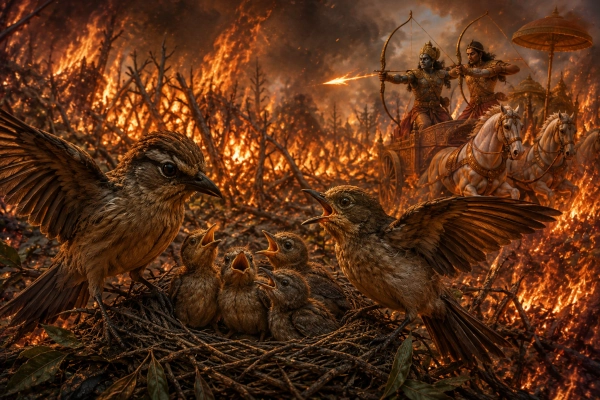
As flames swallowed the great Khandava forest, countless creatures fled before Agni’s advancing fire. Hidden among them was a tiny nest containing four young birds who could not yet fly. Their mother, Jarita, desperately searched for a way to save them, while their father, the sage Mandapala, could only appeal to Agni for mercy. Within the enormous destruction of Khandava, the Mahabharata pauses to tell this intimate story of parenthood, courage, responsibility and four remarkable young lives.
The Sage Who Reached the World of the Ancestors
Long before the flames came to Khandava, there lived a learned sage named Mandapala. He devoted himself to austerity, sacred study and disciplined living, believing that the merit created through such practices would secure blessed regions after death.
When his earthly life ended, Mandapala reached the realm associated with the Pitris, the ancestors. Yet he discovered that the spiritual rewards he expected were not fully available to him. Confused, he asked the celestial beings why the fruits of his long austerities appeared incomplete.
They explained that human life carried several obligations. Sacrifice, sacred study and the continuation of one’s lineage were all regarded as important duties, and while Mandapala had performed austerities and religious observances, he had left no children behind. His lack of offspring therefore stood between him and the complete reward he had expected.
Mandapala listened carefully. After spending much of his life turning away from worldly attachments, he now faced the strange conclusion that one neglected worldly responsibility had followed him beyond death.
He needed children.
Mandapala Chooses the Form of a Bird
Mandapala began considering how he could obtain offspring quickly. He reasoned that birds produced several young within a relatively short time, and so the sage assumed the form of a Sarngaka bird.
In that form he encountered a female bird named Jarita. The two came together, and Jarita eventually carried four children who would become the sons Mandapala desired. The Mahabharata gives their names as Jaritari, Sarisrikka, Stambamitra and Drona and describes them as extraordinary young birds associated with Vedic knowledge.
Mandapala had achieved what had brought him back towards earthly existence. He now had offspring who could continue his lineage.
Yet fatherhood required something more difficult than simply producing children.
It required remaining with them.
Mandapala Leaves Jarita
While the four young ones were still helpless, Mandapala left Jarita and went to another female bird named Lapita. Jarita therefore found herself carrying the responsibility of protecting and raising the children largely by herself.
The contrast is striking. Mandapala had sought children because he had learned that progeny represented an important obligation, yet after obtaining them he left their mother to face the practical burdens of parenthood.
Jarita could not abandon them.
She stayed with the young birds, cared for them and watched over them in the great Khandava forest. The chicks were intelligent, but they were still too young to escape danger by flying away.
For a time, the forest protected them.
Then Agni came.
The Day Khandava Began to Burn
Khandava was no ordinary woodland. It was a vast living world containing birds, animals, serpents and many other beings. When Agni, the god of fire, began consuming the forest with the assistance of Krishna and Arjuna, the entire region was transformed into an enormous furnace.
Flames raced from tree to tree. Smoke gathered beneath the sky, branches cracked in the heat and terrified creatures rushed through the undergrowth searching for escape. The peaceful forest became a place of confusion, roaring fire and desperate flight.
Among the countless beings trapped within Khandava were Jarita and her four young sons.
Other birds could spread their wings and escape beyond the burning canopy.
Jarita’s children could not.
Their wings were not yet strong enough to carry them away.
Jarita Sees the Fire Approaching
Jarita watched the sky change as the fire moved closer. Smoke thickened in the distance, and an orange glow began spreading between the trees.
The mother bird understood immediately what this meant.
Her children were trapped.
She could perhaps save herself by flying away, but she could not carry all four chicks to safety at once. Choosing one child would mean leaving the others behind, and remaining with all of them appeared to mean dying together.
Jarita’s fear was not for herself. Her thoughts turned again and again towards the young birds who depended entirely upon her.
The flames continued approaching.
Every moment reduced the number of choices available to her.
A Hole in the Ground Offers Hope
Near the nest was a hole that had belonged to a mouse. Jarita remembered seeing a hawk seize a mouse that had emerged from it and carry the creature away.
An idea came to her.
Perhaps the chicks could hide underground while the fire passed over them. If they entered the hole, Jarita could cover the entrance with dust or earth and return after the danger had passed.
She urged her children to go inside.
The young birds, however, were not convinced. They pointed out that although Jarita had seen one mouse carried away, she could not know with certainty that no other mice remained deeper within the burrow. If they entered the darkness and another mouse was present, they might be eaten with no possibility of escape.
Their mother insisted that she had seen the danger removed.
The chicks still refused.
The Chicks Choose the Open Fire Over the Hidden Hole
Their reasoning was extraordinary for creatures so young. The chicks argued that the danger within the hole was unknown, while the behaviour of the flames could still change because the wind was moving them in different directions.
They therefore preferred to remain where they were rather than enter a place from which escape might become impossible. The Mahabharata preserves this unusual debate between the frightened mother and her surprisingly thoughtful children as the Khandava fire draws nearer.
Jarita found herself in an agonising position.
She wanted to protect them, but her children were capable of reasoning about their own danger. They understood that their mother’s plan offered no certainty.
The forest grew hotter around them.
The sound of the fire became louder.
The Children Tell Their Mother to Save Herself
Then the four young birds said something that made Jarita’s decision even more painful.
They urged their mother to leave.
If she remained with them, the fire might destroy the entire family. If she escaped, she could live and perhaps have other children in the future.
Their own lives, they reasoned, should not become the cause of their mother’s death.
Jarita resisted the idea. A mother’s instinct demanded that she remain beside her helpless offspring even when no escape seemed possible.
Yet her children continued persuading her.
They were surrounded by an approaching wall of fire, but their thoughts were not only about themselves.
They were thinking about her.
Jarita Flies Away With a Heavy Heart
At last Jarita accepted that she could do nothing more by remaining beside them. She flew away towards an area the fire had not yet reached, leaving her four children together as the flames advanced. The Mahabharata describes her departure after the sons themselves persuade her to seek safety.
There could have been no easy relief in that flight.
Every beat of her wings carried her away from the nest she had protected. Behind her were four young birds who had never yet possessed the strength to fly after her.
Below, animals fled through smoke and burning vegetation.
Above, sparks rose into the air.
Jarita could only hope that something greater than her own strength would protect her children.
Unknown to her, their father had already seen the danger.
Mandapala Remembers the Children He Left Behind
Mandapala was with Lapita when he realised that Khandava was going to burn. The sight of Agni spreading across the forest immediately brought Jarita and the four young birds back into his thoughts.
For all his earlier absence, Mandapala understood how helpless the children were.
They could not fly.
They could not outrun the flames.
Their mother could not carry all four away.
Mandapala became deeply anxious and turned towards the only power capable of controlling the approaching destruction.
He appealed directly to Agni.
Mandapala Prays to Agni
Mandapala praised Agni as the great divine fire present in sacrifice and throughout creation. He honoured the deity’s cosmic importance and then made the request that mattered most to him.
When Agni burned Khandava, Mandapala asked him to spare his children.
Agni accepted the prayer.
The god promised that the four sons of Mandapala would not be consumed by the conflagration. The epic explicitly explains their survival through this promise made by Agni after Mandapala’s appeal.
Mandapala had finally acted as a father.
He could not physically carry his offspring from the forest, but he used the influence available to him to secure protection for them.
The children themselves, however, knew nothing of the agreement.
From where they sat, only the flames were visible.
The Wall of Fire Reaches the Nest
Agni rushed towards the place where the young birds waited.
The forest around them was now blazing. Heat rolled through the air, and the advancing fire devoured dry leaves, grass and trees. Smoke darkened the world beyond their tiny shelter.
The four brothers watched the flames approach.
There was no mother beside them.
Their father was nowhere to be seen.
Their wings could not carry them away.
Everything that ordinary instinct could depend upon had disappeared.
The eldest, Jaritari, began speaking as the fire came nearer. The young birds addressed Agni with intelligence and reverence, appealing to the divine power before them rather than surrendering to blind panic. The Mahabharata describes them speaking directly as Agni approaches their location.
Four Young Birds Before Agni
The children understood that the flames approaching them were not merely an uncontrolled natural force. Agni was a deity, and therefore the fire could hear.
They praised him and appealed for protection.
The scene creates one of the most unusual contrasts in the Khandava episode. Elsewhere, Krishna and Arjuna stand like mighty barriers around the burning forest while great creatures struggle desperately to escape. Here, four tiny unfledged birds possess no weapons and no physical means of survival.
Their defence consists of words.
They speak with knowledge beyond their age and place themselves before Agni’s judgment.
The deity who is consuming an entire forest reaches their dwelling.
Then the flames do not destroy them.
Agni Remembers His Promise
Mandapala’s prayer had not been forgotten.
Agni had promised to spare the sage’s sons, and when the fire reached them, that promise protected the four young birds. The Sarngaka children survived while the enormous conflagration continued around them.
The scale of their survival makes the moment especially vivid.
Great trees had fallen.
Powerful animals had perished.
The forest itself had been transformed.
Yet inside that destruction, four creatures too young even to fly remained alive.
Their survival did not come through strength.
It came through a father’s appeal, their own composure and Agni’s word.
Jarita Returns Through the Aftermath
When Jarita was finally able to return, she hurried towards the place where she had left her sons.
The forest she had known had been transformed by fire. Smoke hung over blackened ground, burned branches lay where thick vegetation had once grown and the familiar landscape had become scarred and silent.
Her fear must have increased with every moment.
Then she found them.
The four children were alive.
Jarita’s relief was overwhelming. The mother who had flown away believing she might never see them again found the chicks protected amid the devastation. The later section of the narrative describes her joy and Mandapala’s return to the surviving family.
The fire had passed.
Her children remained.
Mandapala Returns to His Family
Mandapala also came back to see whether the children had survived. He had obtained Agni’s promise, but a father’s anxiety did not completely disappear until he saw the result himself.
His return, however, was not greeted with uncomplicated happiness.
Jarita had been the one who remained with the children through their vulnerable period. She had fed them, protected them and faced the approaching fire beside them. Mandapala had left for Lapita while the children were still dependent upon their mother.
The surviving family therefore had reasons to feel wounded.
The Mahabharata describes Mandapala arriving after the fire and finding Jarita and the young birds less than enthusiastic about his return. Jarita even directs his attention towards Lapita, revealing the unresolved hurt produced by his earlier departure.
The physical danger had ended.
The consequences of abandonment had not.
The Story Is Not Simply About a Miraculous Escape
At first glance, the tale of Mandapala and Jarita might appear to be a small story inserted into the much larger burning of Khandava.
Krishna and Arjuna dominate the great action of the surrounding narrative. Gods enter the conflict, weapons fill the sky and an entire forest is consumed.
Yet the Mahabharata deliberately turns away from that enormous spectacle and brings the reader into the nest of one frightened family.
The change in scale matters.
A forest burning can be described as a grand event.
The moment we see four helpless young creatures inside it, destruction becomes personal.
Jarita Represents the Burden of Responsibility
Jarita is one of the most moving figures in the episode because she possesses very little power.
She cannot command Agni.
She cannot stop the forest fire.
She cannot carry all four children away.
Yet she refuses to abandon responsibility simply because she lacks the ability to control events.
She searches for solutions. She considers the mouse hole. She argues with her children because she desperately wants them to survive.
Even when she finally flies away, she does so only after the young birds themselves persuade her that remaining would achieve nothing.
Her courage is not the courage of a warrior charging into battle.
It is the courage of a mother forced to make decisions when every available choice is painful.
Mandapala Learns That Fatherhood Is More Than Producing Children
Mandapala’s story contains a different lesson.
His original concern was offspring.
He learned that children were necessary for fulfilling an obligation, so he sought the quickest way to produce them. Becoming a bird provided what appeared to be an efficient solution.
But children are not simply a means of satisfying a religious or social requirement.
Once they exist, responsibility begins.
Mandapala discovers this when the Khandava fire threatens the family he left behind. His sudden fear shows that biological fatherhood has become emotional attachment.
His appeal to Agni marks a change.
The children who once represented the fulfilment of a duty now matter to him because they are his children.
The Four Chicks Show Their Own Courage
The young birds are not passive victims.
They question their mother’s plan because they recognise hidden danger in the mouse hole. They urge Jarita to save herself rather than die pointlessly beside them. Finally, when Agni reaches them, they speak directly to the divine fire.
Their courage does not consist of pretending that they are unafraid.
They understand exactly how vulnerable they are.
What makes them remarkable is their ability to think while afraid.
This pattern appears repeatedly throughout the Mahabharata. Courage is not always overwhelming an enemy through superior strength. Sometimes courage means retaining judgment when escape appears impossible.
The four chicks cannot defeat the fire.
They can face it without losing themselves.
A Tiny Family Inside an Enormous Tragedy
The burning of Khandava is one of the most dramatic and morally complex episodes of the Adi Parva. The forest contains countless beings, and Agni’s consumption of it produces destruction on a vast scale.
The Mandapala story forces the reader to experience that event differently.
An entire forest can become an abstraction.
One mother watching flames approach four helpless children cannot.
The Mahabharata repeatedly uses such smaller stories to complicate its largest events. Heroic victories may produce suffering elsewhere. Divine purposes can collide with individual lives.
The survival of Jarita’s family does not erase the destruction of Khandava.
It allows one small thread of life to continue through it.
The Promise of Agni
Agni’s role in the story is also important.
The fire god is consuming Khandava because the larger narrative demands that he satisfy his hunger and regain his power. Yet he is still capable of recognising Mandapala’s appeal.
Once Agni gives his word, he honours it.
The flames that destroy the surrounding forest do not consume the four young birds.
Power therefore exists alongside restraint.
Agni remains the burning force of Khandava, but even within that terrible destruction there is room for a promise to be remembered.
The Deeper Meaning of Mandapala and Jarita
The story contains several forms of Dharma operating at once.
Mandapala must confront his obligation to continue his lineage.
Jarita must confront her responsibility to protect children who cannot protect themselves.
The young birds must decide whether to obey their mother or trust their own judgment about danger.
Agni must honour a promise even while carrying out the burning of the forest.
None of these duties exists in isolation.
That complexity is deeply characteristic of the Mahabharata. Dharma is rarely presented as a simple command that removes every difficulty.
It often appears when several obligations pull in different directions.
When Strength Is Impossible
The Khandava fire makes physical strength almost meaningless for Jarita’s family.
The chicks cannot fight.
Their mother cannot extinguish the flames.
Mandapala cannot physically reach them in time.
Under such conditions, each character must rely upon something else.
Jarita relies upon devotion to her children.
The chicks rely upon intelligence and composure.
Mandapala relies upon prayer and the relationship he establishes with Agni.
Agni relies upon the integrity of his own promise.
The result is survival created not by one heroic act, but by several different forms of responsibility meeting at the same moment.
Four Small Lives Survive Khandava
When the Khandava fire finally passed, Jarita still had all four sons.
Jaritari, Sarisrikka, Stambamitra and Drona had survived a catastrophe from which countless stronger creatures had been unable to escape. The Mahabharata specifically remembers the Sarngaka birds among those spared from the destruction.
Their survival is deliberately improbable.
They were tiny.
They were unable to fly.
They were sitting directly in the path of Agni.
Yet sometimes the epic allows the smallest lives to become the carriers of its largest lessons.
The Nest That the Fire Could Not Destroy
The story of Mandapala and the bird family of Khandava begins with a sage worried about reaching the proper world after death.
It ends with something far more immediate.
A mother finds her children alive.
Between those two moments, Mandapala learns that having descendants is different from caring for them. Jarita demonstrates that parenthood is measured through responsibility rather than merely relation. The four young birds show intelligence and courage while facing a danger far greater than themselves.
Around them, Khandava becomes an ocean of flame.
Trees crash.
Creatures flee.
Smoke fills the heavens.
Yet somewhere inside that burning world sits a tiny nest containing four young lives that Agni has promised not to touch.
The Mahabharata could have described only the vastness of the destruction.
Instead, it pauses beside Jarita and her children.
In doing so, the epic reminds us that even when history is dominated by kings, gods and warriors, the fate of one frightened family still matters.
Mahabharata Source
The story of Mandapala, Jarita and their four sons occurs in the Adi Parva, Khandava-daha Parva, particularly the sections following the burning of the Khandava forest. The narrative explains Mandapala’s lack of offspring, his assumption of the Sarngaka bird form, the birth of Jaritari, Sarisrikka, Stambamitra and Drona, Jarita’s efforts to protect them and Mandapala’s appeal to Agni to spare their lives.
You may also like
-
NBEMS Announces Additional FMGE by October
-
Nahusha as a Python: When Bhima’s Strength Failed and Yudhishthira’s Wisdom Prevailed
-
IICT and Netflix Launch Scholarships for 100 Students to Build India’s Next Generation of AVGC-XR Talent
-
Bhima Meets Hanuman: When Strength Bowed Before Strength
-
The Yaksha in the Form of a Crane — Yudhishthira and the Questions at the Enchanted Lake
