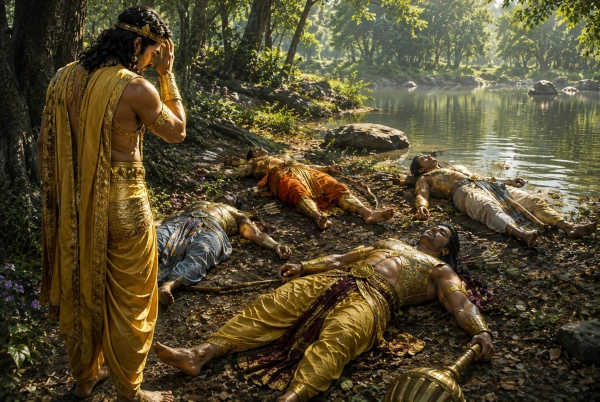
Four of the Pandavas lay motionless beside a beautiful forest lake. No arrows had struck them and no warrior had defeated them. Yudhishthira stood alone before the still water as a mysterious crane claimed dominion over the lake. What followed was not a contest of weapons but one of wisdom, restraint and Dharma, culminating in one of the most celebrated conversations of the Mahabharata.
Yudhishthira Comes Upon a Terrible Sight
The strange pursuit of the deer had brought the Pandavas deep into the forest. The animal had carried away a Brahmin’s sacred fire-making sticks, and the five brothers had followed it until exhaustion and thirst forced them to stop. When water was discovered nearby, Nakula had gone first to fetch it, followed by Sahadeva, Arjuna and Bhima. None had returned.
Yudhishthira finally went in search of them himself. Moving through the trees, he eventually reached a beautiful lake whose clear waters lay peacefully beneath the forest canopy. Yet the serenity of the place was shattered by what he saw along its bank.
Nakula lay motionless near the water. Sahadeva had fallen nearby. Arjuna, the wielder of the Gandiva, lay still upon the earth, while mighty Bhima, whose strength had terrified warriors and Rakshasas alike, had also collapsed.
For a moment, Yudhishthira could scarcely comprehend what stood before him. These were not ordinary men who could be silently overcome by a hidden hunter. Bhima could fight enormous enemies with his bare hands, and Arjuna possessed celestial weapons capable of devastating armies. Nakula and Sahadeva were accomplished warriors in their own right.
Yet all four appeared dead.
There were no obvious wounds upon their bodies and no signs of a violent struggle. The forest contained no enemy army, and the peaceful water offered no visible explanation.
Yudhishthira understood that something extraordinary had occurred at this lake. The danger before him could not be approached like an ordinary battlefield.
The Voice From the Lake
Yudhishthira was himself exhausted and desperately thirsty. The water before him looked cool and inviting, but as he moved towards it, a mysterious voice stopped him.
The unseen guardian warned that the lake belonged to it. Yudhishthira’s brothers had ignored the same warning and attempted to drink without permission. Their condition, the voice declared, was the consequence of that disobedience. Before Yudhishthira could take even a mouthful of water, he would first have to answer a series of questions.
The warning immediately revealed something important.
The four brothers had not simply died from exhaustion or poison. A conscious and powerful being controlled the lake.
Yudhishthira did not behave as Arjuna or Bhima had done. He did not immediately challenge the unseen speaker or rush towards the water. Grief filled him, and thirst tormented him, but neither emotion completely overwhelmed his judgment.
He stopped.
Then he listened.
That moment of restraint became the first sign that the encounter would end differently for Yudhishthira.
The Crane That Was No Ordinary Bird
The mysterious being was associated with the form of a crane, described in the traditional episode as a baka. The lake itself was inhabited by cranes, but the creature confronting Yudhishthira was clearly no ordinary bird. A mere forest bird could not have brought down Bhima, Arjuna, Nakula and Sahadeva without leaving the marks of battle.
Yudhishthira therefore understood that a supernatural power stood before him.
The mysterious guardian revealed itself as a Yaksha.
The warrior king now faced an opponent unlike any he had encountered in combat. There was no armour to pierce, no bowstring to cut and no mace to shatter. The Yaksha demanded answers rather than battle.
Yudhishthira accepted the challenge.
The lake became silent.
The questioning began.
The Contest Becomes a Test of Dharma
The Yaksha did not ask Yudhishthira about military formations, archery or royal conquest. Its questions moved through the deepest concerns of human existence.
What sustains a person?
What makes someone truly learned?
What is heavier than the earth?
What is higher than the heavens?
What is faster than the wind?
What should a person abandon to become loved?
What should be abandoned to escape grief?
What is the greatest wealth?
What is Dharma?
What makes a person truly honourable?
Again and again, Yudhishthira answered with calmness and clarity. The exchange preserved in the Vana Parva covers questions concerning duty, truth, knowledge, conduct, happiness, mortality, friendship, self-control and the proper way to live.
The contrast with the events preceding the dialogue could hardly have been greater. The Pandavas had reached the lake through physical exhaustion. Now the test demanded mental steadiness.
Yudhishthira had no time to consult sages or scriptures. He had to answer from the understanding he had accumulated through his own life.
What Makes a Person Truly Learned?
Among the Yaksha’s questions was the nature of genuine learning.
Yudhishthira did not define wisdom merely as the accumulation of words or the memorisation of sacred texts. True knowledge, in his answers, remained inseparable from an understanding of duty and proper conduct.
The Yaksha also asked what makes a person worthy of being regarded as a Brahmana. Yudhishthira placed conduct above birth alone, arguing that character and behaviour determine whether learning and status have genuine value. The surviving Vana Parva dialogue gives unusual emphasis to the importance of behaviour over mere claims of knowledge or ancestry.
This was characteristic of Yudhishthira.
He did not treat Dharma as an ornament attached to social position. Dharma had to become visible in action.
A learned person who behaved badly could not hide behind education.
A person of high birth could not use ancestry as a substitute for virtue.
The test was not what someone claimed to be.
The test was how that person lived.
What Is Faster Than the Wind?
Some of the Yaksha’s questions sounded almost like riddles, but their answers revealed deeper truths.
When asked what could move faster than the wind, Yudhishthira pointed towards the mind, whose thoughts can cross unimaginable distances instantly.
The answer demonstrated the psychological insight running throughout the Mahabharata. The human mind can reach the past, imagine the future, cross mountains and oceans and create entire worlds while the body remains in one place.
Yet this extraordinary speed also creates danger.
An uncontrolled mind can rush towards anger, fear, greed or desire before wisdom has time to intervene. The events at the lake had already demonstrated this principle. Nakula, Sahadeva, Arjuna and Bhima had responded immediately to thirst. Yudhishthira alone had managed to place thought between desire and action.
The questions of the Yaksha therefore reflected the very test the brothers were undergoing.
What Must Be Abandoned to Find Happiness?
The Yaksha repeatedly asked Yudhishthira what a person must give up to achieve peace, affection or freedom from suffering.
Yudhishthira’s answers emphasised the abandonment of destructive qualities such as pride, anger, greed and uncontrolled desire.
The lesson was particularly powerful because Yudhishthira was answering while standing beside the bodies of his brothers. He was not discussing self-control in the safety of a royal court.
He had lost his kingdom because of the dice game. He had witnessed Draupadi’s humiliation. He had endured years of exile. Now he appeared to have lost the four people upon whom the recovery of his kingdom depended.
Yet he still answered questions about restraint without surrendering himself to rage.
The Yaksha was not simply examining what Yudhishthira knew.
It was examining whether his knowledge remained intact under suffering.
Who Is Truly Happy?
The Yaksha also asked one of the most deceptively simple questions in the dialogue: who can truly be called happy?
Yudhishthira’s answer did not describe a king surrounded by gold, armies or luxury. He described happiness in terms of modest sufficiency, freedom from debt and the ability to live peacefully without dependence upon restless ambition.
The answer carried special meaning coming from a dispossessed monarch.
Yudhishthira had once lived in extraordinary splendour at Indraprastha. Kings had attended his Rajasuya sacrifice. Wealth had flowed through his halls.
Then everything vanished.
The forest had forced him to confront a truth that royal luxury could easily conceal: abundance did not guarantee peace.
A person could possess a kingdom and remain consumed by envy, as Duryodhana had been.
Another could possess little and yet live without debt, hatred or constant craving.
Happiness, therefore, could not simply be measured by possession.
The Greatest Wonder
Then came perhaps the most celebrated question of the entire Yaksha Prashna.
The Yaksha asked Yudhishthira what he considered the greatest wonder in the world.
Yudhishthira looked at existence itself.
Every day, human beings see others die. Generations disappear. Parents, rulers, warriors and sages all eventually pass away. Death is not hidden from anyone.
Yet those who remain continue to behave as though death somehow belongs only to others.
That contradiction, Yudhishthira explained, is among the greatest wonders of human life. The Vana Parva preserves this answer as one of the central reflections in the dialogue.
The setting makes the answer even more powerful.
Yudhishthira was not speaking about mortality abstractly.
Bhima lay before him.
Arjuna lay before him.
Nakula and Sahadeva lay beside them.
Death appeared to have entered his own family within the space of a single afternoon.
Yet the answer extended beyond personal grief.
Human beings know that life is temporary, but they routinely build ambitions as though time were endless.
The Yaksha’s question forced that contradiction into the open.
What Is the Path?
Another celebrated question concerned the path of Dharma.
The problem was difficult because human beings encounter conflicting arguments, different teachings and respected authorities who do not always agree with one another.
Yudhishthira acknowledged that reason alone can lead people towards different conclusions. Sacred teachings may appear differently interpreted, and sages themselves may disagree.
Dharma, he suggested, is often subtle and difficult to discover. In such circumstances, the conduct of the truly great and righteous becomes an important guide.
This idea appears repeatedly throughout the Mahabharata.
Dharma cannot always be reduced to a simple formula.
The same action can be righteous in one circumstance and destructive in another. Intention matters. Duty matters. Consequence matters. The responsibilities created by relationships also matter.
Yudhishthira’s greatness therefore does not come from possessing an answer book containing a rule for every situation.
It comes from his willingness to think carefully when rules collide.
The Yaksha Is Satisfied
Question followed question, and Yudhishthira continued answering.
The Yaksha tested his understanding of virtue, friendship, knowledge, sacrifice, morality, self-control and the nature of human life. Eventually, the mysterious being was satisfied.
The challenge that had defeated the four younger Pandavas had been overcome without a single weapon being raised.
Yudhishthira had won by listening.
Yet the greatest test had still not arrived.
The Yaksha now offered him something no grieving brother could easily refuse.
He could choose one of the four fallen Pandavas to be restored to life.
Yudhishthira looked at the bodies before him.
His answer would reveal more about his character than all the riddles he had answered before it.
Which Brother Should Live?
The practical choice appeared obvious.
Bhima should be revived.
Without Bhima’s enormous strength, how could the Pandavas eventually confront Duryodhana and his brothers?
Or perhaps Arjuna should return.
Arjuna was the supreme archer upon whom much of the Pandavas’ military hope rested. He possessed the Gandiva and celestial weapons obtained through extraordinary austerities and journeys. Without him, recovering the kingdom of Indraprastha would become almost impossible.
Nakula and Sahadeva were beloved brothers, but neither possessed Bhima’s unmatched physical power or Arjuna’s decisive military importance.
A king thinking primarily about political survival would choose Bhima or Arjuna.
A warrior preparing for the future war would almost certainly choose one of them.
Yudhishthira chose Nakula.
The Yaksha was astonished.
Why Nakula?
The Yaksha asked Yudhishthira why he had selected Nakula when Bhima and Arjuna were so obviously essential to his future.
Yudhishthira’s answer revealed the depth of his commitment to fairness.
King Pandu had two wives: Kunti and Madri.
Kunti’s sons were Yudhishthira, Bhima and Arjuna. Madri’s sons were Nakula and Sahadeva.
Yudhishthira himself was still alive. Therefore, Kunti still had one living son standing beside the lake. If he chose Bhima or Arjuna, Kunti would have two surviving sons while Madri would have none.
Yudhishthira therefore asked that Nakula be restored so that one son of Kunti and one son of Madri would remain alive. The choice was based not upon military usefulness but upon equal justice towards his father’s two wives.
This was the true heart of the test.
The earlier questions had asked Yudhishthira to define Dharma.
Now the Yaksha forced him to practise it when the cost was unbearable.
Dharma When It Hurts
It is easy to speak about fairness when nothing valuable is at stake.
Yudhishthira’s choice mattered because he desperately needed Bhima and Arjuna.
Bhima had sworn terrible vows against those who had humiliated Draupadi. His strength would be essential if the Pandavas ever fought the Kauravas.
Arjuna was even more strategically important. He was the warrior most capable of facing the greatest fighters aligned with Hastinapura.
Yet Yudhishthira refused to measure his brothers only according to usefulness.
Nakula’s life mattered even if his restoration offered less military advantage.
Madri’s claim upon justice mattered even though Madri herself was no longer alive to demand it.
That is what impressed the Yaksha.
Yudhishthira had not merely memorised Dharma.
He was willing to accept personal disadvantage for its sake.
The Yaksha Restores All Four Brothers
The Yaksha’s sternness gave way to approval.
A man who could choose justice even while apparently standing on the edge of disaster had passed the deeper examination.
The Yaksha therefore did more than restore Nakula.
Bhima, Arjuna, Nakula and Sahadeva were all returned to life. The brothers rose again, freed from the mysterious state that had held them beside the lake.
The unbearable grief that had surrounded Yudhishthira suddenly vanished.
The five Pandavas stood together once more.
Yet another revelation remained.
The Yaksha was not merely an anonymous supernatural guardian of a forest lake.
The Yaksha Reveals His True Identity
The mysterious being finally disclosed who he truly was.
He was Dharma, the divine embodiment of righteousness and justice, regarded in the Mahabharata as the celestial father of Yudhishthira. The epic itself refers elsewhere to Dharma assuming the form of a Yaksha in order to question Yudhishthira.
The entire encounter had therefore been a father’s examination of his son.
Dharma had not tested Yudhishthira while he sat comfortably upon a throne.
He had tested him while thirsty.
He had tested him while grieving.
He had tested him when his future appeared destroyed.
He had tested him by offering a choice in which affection, political necessity and justice pulled in different directions.
Only under such conditions could Yudhishthira’s commitment to Dharma truly be measured.
The Deer Was Dharma Too
The revelation also explained the strange events that had begun the entire adventure.
The Brahmin’s fire-making sticks had not become attached to an ordinary deer by meaningless accident. The mysterious deer that had escaped every attempt by the Pandavas to capture it had itself been part of the test.
When Yudhishthira later asked that the Brahmin’s sacred fire rites should not be interrupted, the divine being revealed that he had assumed the form of the deer and deliberately carried away the fire sticks in order to examine Yudhishthira.
The impossible chase now made sense.
The deer had always remained just beyond the reach of Arjuna’s arrows and Bhima’s pursuit because it was never an ordinary forest animal.
It had led the five brothers exactly where Dharma wanted them to go.
The forest lake had been waiting.
The First Boon Is for the Brahmin
After restoring the brothers, Dharma offered Yudhishthira boons.
Yudhishthira’s thoughts immediately returned to the Brahmin whose lost fire sticks had started the entire episode. He asked that the man’s worship of Agni should not be interrupted.
The request was remarkable because Yudhishthira could have asked first for something concerning himself.
The Pandavas were approaching the thirteenth and most dangerous year of their exile. They would have to live undiscovered for an entire year, and discovery could force them to repeat their exile.
Yet Yudhishthira’s first concern remained the duty he had accepted before the strange chase began.
Dharma assured him that the fire sticks would be returned.
The promise to the Brahmin would be fulfilled.
A Boon for the Year of Concealment
The Pandavas now faced another great challenge.
Their twelve years in the forest were nearly complete, but the agreement imposed after the dice game required a thirteenth year in which they had to remain concealed. If the Kauravas discovered them before that period ended, exile could begin again.
Dharma therefore assured Yudhishthira that the brothers would be able to pass their year of concealment successfully. The Pandavas would ultimately enter the kingdom of Virata in disguise, each adopting a different identity.
Yudhishthira would become Kanka.
Bhima would become Vallabha.
Arjuna would live as Brihannala.
Nakula would care for horses.
Sahadeva would tend cattle.
Draupadi would enter Queen Sudeshna’s household as Sairandhri.
The enchanted lake thus stood at the threshold between two great stages of their exile.
The forest years were ending.
The year of concealment was about to begin.
Yudhishthira Asks for Something Greater Than Power
Dharma was pleased with his son and offered further blessings.
Yudhishthira could have desired wealth, victory or irresistible strength. He knew that conflict with the Kauravas remained possible and that enormous political challenges waited ahead.
Yet the qualities he sought were inward ones.
He desired mastery over destructive tendencies such as greed, delusion and anger, while remaining devoted to truth, generosity and disciplined conduct. The closing section of the episode presents these moral aspirations as central to Yudhishthira’s final request.
This completes the deeper movement of the story.
The brothers initially went into the forest chasing an external object.
By the end, Yudhishthira was asking for mastery over the forces within himself.
Why the Crane Matters
The form of the crane gives the episode a haunting beauty.
A crane standing beside a forest lake appears harmless. It has neither the body of a warrior nor the terrifying appearance of a Rakshasa.
Yet through that quiet form, Dharma brought the greatest warriors of the Pandava family to helplessness.
The contrast is deliberate and powerful.
Bhima could fight monsters, but strength could not answer the crane.
Arjuna could launch celestial weapons, but arrows could not solve the challenge.
The lake demanded another kind of power.
It demanded restraint, understanding and the ability to hear before acting.
Yudhishthira possessed those qualities when they were needed most.
The Difference Between Knowing Dharma and Living Dharma
The Yaksha Prashna is often remembered for its questions and answers, but the most important lesson may come after the questioning.
Anyone can provide impressive answers under comfortable circumstances.
Yudhishthira had to prove that his answers governed his decisions.
When asked about justice, he spoke wisely.
Then he was asked to choose between brothers.
When asked about self-control, he answered correctly.
Then he had to control his own thirst and grief.
When asked about Dharma, he explained its subtlety.
Then he had to sacrifice strategic advantage in order to treat Kunti and Madri equally.
The lake therefore transformed philosophy into action.
Yudhishthira passed not because he could speak beautifully about Dharma, but because he continued to follow it when doing so hurt.
Why Bhima and Arjuna Were Not Chosen
The decision to revive Nakula deserves special attention because it reveals something essential about Yudhishthira’s kingship.
A ruler normally thinks about consequences.
From that perspective, Bhima or Arjuna would have been the logical choice. Bhima was essential to fulfilling vows made against the Kauravas, while Arjuna represented the Pandavas’ greatest military strength.
Yudhishthira chose neither.
His reasoning showed that Dharma could not always be reduced to political calculation.
If he chose according to usefulness alone, he would effectively declare that one brother’s life possessed greater value because of military talent. Instead, he considered an obligation to two mothers.
Kunti had Yudhishthira.
Madri should therefore have Nakula.
The choice balanced a moral scale invisible to ordinary strategy.
That was precisely why Dharma was satisfied.
The Lake as a Mirror of the Mind
The enchanted lake can also be understood as a powerful image within the story.
Its water was clear and peaceful.
The danger did not appear on its surface.
The four younger brothers saw what they wanted and acted immediately. Their thirst prevented them from respecting a warning whose source they did not understand.
Yudhishthira saw the same water but recognised that appearance alone could not reveal truth.
The difference lay within the observer.
The lake did not need to change.
The mind approaching it had to change.
In this sense, the episode reflects a recurring teaching of the Mahabharata: external circumstances often expose the condition already present within the human mind.
The Greatest Warrior at the Lake Carried No Weapon
At Kurukshetra, greatness would be measured through bows, chariots, maces and celestial weapons.
At the Yaksha’s lake, none of those things mattered.
The decisive qualities were patience, attention, memory, fairness and self-command.
Yudhishthira defeated no enemy because Dharma was not truly his enemy.
Instead, he demonstrated that he could remain himself even when everything he loved seemed to have been taken from him.
That is a different form of heroism.
A person who is virtuous only when circumstances are favourable has not yet been fully tested.
Yudhishthira was tested when thirst demanded haste, grief demanded despair and strategic necessity demanded that he choose Bhima or Arjuna.
He refused all three pressures.
A Father Tests His Son
The final revelation gives the entire episode an intimate dimension.
Dharma was Yudhishthira’s divine father.
The test was therefore not designed simply to humiliate the Pandavas or demonstrate supernatural power.
It examined whether Yudhishthira truly embodied the principle from which his own birth was said to arise.
His father was Dharma.
Could the son remain Dharmic?
The answer came not through Yudhishthira’s reputation but through his behaviour when no human audience was present.
There was no royal court to praise him.
There were no Brahmins watching his generosity.
There were no subjects applauding their righteous king.
There was only a lonely forest lake and four apparently dead brothers.
That was where Yudhishthira proved himself.
The Deeper Lesson of the Yaksha Prashna
The story of the Yaksha in the form of a crane remains one of the Mahabharata’s most enduring episodes because its battlefield is the human mind.
The enemies are not Kaurava warriors.
They are impatience, pride, grief, desire and fear.
The weapon is not the Gandiva.
It is discernment.
The victory is not the destruction of another person.
It is the preservation of Dharma when circumstances make Dharma difficult.
Yudhishthira’s wisdom saved his brothers, but his answers alone did not win the final reward. His decision to revive Nakula demonstrated that the principles he had spoken about were alive within him.
He chose fairness when strategy suggested otherwise.
He remembered Madri when no one could force him to do so.
He remembered the Brahmin’s fire sticks even after recovering his brothers.
He asked for mastery over his own weaknesses rather than domination over his enemies.
The Yaksha had received the answer it truly wanted.
When Dharma Stood Beside the Water
The Pandavas had entered the forest searching for a deer.
They arrived at the lake searching for water.
Yudhishthira left having encountered his divine father and received one of the greatest examinations of his life.
The beautiful crane beside the lake had concealed Dharma itself.
Bhima’s strength could not overcome it.
Arjuna’s celestial weapons could not threaten it.
Nakula’s grace and Sahadeva’s learning could not protect them when thirst conquered restraint.
Only Yudhishthira stopped.
He listened before acting.
He thought before choosing.
He placed justice above advantage.
And because he refused to abandon Dharma even while believing four beloved brothers were dead before him, Dharma returned all four brothers to him.
The waters of the lake became still once more.
Bhima rose.
Arjuna opened his eyes.
Nakula and Sahadeva returned to their elder brother.
The sacred fire sticks would be restored to the waiting Brahmin, and the five Pandavas would soon begin the final year of their exile.
Yet Yudhishthira would carry something greater away from that forest than a recovered piece of wood or a divine boon.
He had been weighed by Dharma itself.
And at the enchanted lake, Yudhishthira had not been found wanting.
Mahabharata Source
The episode occurs at the conclusion of the Vana Parva, within the Araneya Parva, especially Sections 310–312 in the Kisari Mohan Ganguli translation. The narrative records the brothers falling after disregarding the guardian of the lake, Yudhishthira answering the Yaksha’s questions, his choice of Nakula, the restoration of all four Pandavas and the revelation that the mysterious tester was Dharma.
You may also like
-
India Launches Nationwide AI and Cloud Training Drive for 1.5 Lakh Learners
-
AIIA Launches ‘Garbhini Mitra’ Course to Train Maternal Wellness Support Workers in Ayurveda-Based Care
-
The Deer That Carried Away the Fire Sticks — The Hunt That Led the Pandavas to the Yaksha’s Lake
-
The Pigeon Couple and the Hunter: When Compassion Conquered Cruelty
-
King Shibi, the Dove and the Hawk: When a King Placed Himself on the Scales of Dharma
