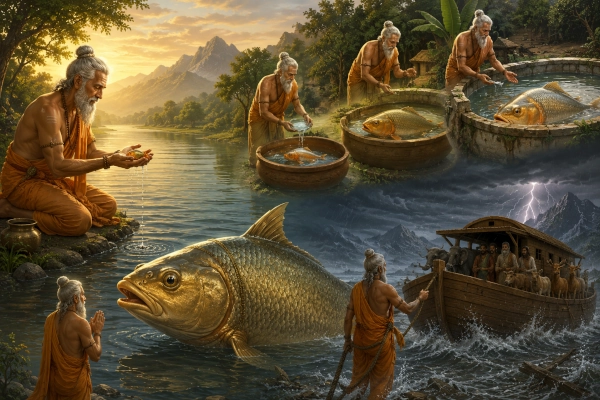
Long before the armies of the Kauravas and Pandavas gathered upon Kurukshetra, before many of the kingdoms remembered in the Mahabharata had arisen, the epic looks back to an age when the world itself stood on the edge of destruction. In the Vana Parva, the sage Markandeya tells Yudhishthira the ancient story of Vaivasvata Manu and the mysterious fish that saved life from a devastating flood. In the Mahabharata’s version, the fish ultimately reveals himself as Brahma, the Lord of creatures, and entrusts Manu with the task of restoring life after the waters withdraw.
The story begins not with thunder, mountains or oceans, but with an act of compassion toward a creature small enough to rest in a man’s hands. From that tiny beginning unfolds one of the Mahabharata’s grandest stories of protection, Dharma and renewal.
Manu and the Tiny Fish
Vaivasvata Manu, the son of Vivasvan, was renowned for his austerity and righteousness. He had withdrawn himself from ordinary pleasures and devoted his mind to severe penance. His life was governed by discipline, restraint and contemplation, and he possessed the calm that comes from years spent mastering one’s senses.
One day, while Manu was near the water, a tiny fish approached him. The creature was so small that it seemed almost helpless against the vast world surrounding it. Yet this was no ordinary fish, for it spoke to Manu and pleaded for his protection.
The little creature explained that the waters were dangerous for one so small. Large fish devoured smaller fish, and the weak had little defence against the strong. If Manu returned it to the water without protection, it feared that another fish would swallow it before it had the chance to grow. The Mahabharata makes this appeal especially significant because the fish asks a righteous man to protect the vulnerable from those more powerful than itself.
Manu could easily have dismissed the creature. His austerities concerned matters far greater than the survival of one tiny fish. Yet Dharma is often revealed not through grand declarations but through the way the strong respond when something powerless comes before them.
Moved by compassion, Manu lifted the fish carefully from the water.
He placed it inside an earthen vessel filled with clean water and promised to protect it.
Neither Manu nor the world around him could yet have imagined how important that simple act would become.
The Fish Begins to Grow
Under Manu’s protection, the fish was safe from predators. Manu cared for it attentively, treating the little creature almost as one might care for a child. The fish thrived, but before long something remarkable happened.
It began to grow with astonishing speed.
The small earthen vessel that had once seemed enormous compared with the fish soon became too confined. The creature could barely move comfortably within it, and it appealed once again to Manu.
The fish asked to be transferred somewhere larger.
Manu did not question the strange growth. Having undertaken to protect the creature, he remained faithful to that responsibility. He moved the fish into a large reservoir where it could swim freely.
For a time, the new home seemed more than sufficient.
Then the impossible happened again.
The fish continued growing.
Its body expanded until even the reservoir could no longer contain it comfortably. What had begun as a tiny creature small enough to fit inside a pot was becoming something extraordinary.
The fish again called to Manu and asked him to provide a greater body of water.
Manu now understood that he was dealing with no ordinary inhabitant of a river or pond. Yet he did not abandon the responsibility he had accepted. He took the growing fish and carried it to the sacred Ganga. In the great river, he believed, surely the creature would finally have sufficient room.
For a while, the enormous waters of the Ganga surrounded the fish.
But the fish continued to grow.
From the Ganga to the Ocean
The transformation became increasingly astonishing. The creature grew until even the mighty Ganga seemed unable to contain it. Its body had become enormous, and once again it asked Manu to move it.
There was only one body of water vast enough to receive such a creature.
The ocean.
Manu therefore took the fish toward the sea. The task itself revealed the strange power surrounding their relationship, for despite its immense size the fish allowed Manu to transport it without difficulty. The little creature that had once feared being eaten by larger fish was now becoming too great even for rivers.
At last Manu released it into the ocean.
Before him stretched the immeasurable sea, its waves disappearing toward the horizon. Surely nothing could outgrow such a home.
Yet as Manu watched the fish in those vast waters, he understood that the creature he had protected was not merely an unusually large animal. Some tremendous mystery stood before him.
The fish now spoke with a new seriousness.
The time had come to repay Manu’s compassion.
The Warning of the Coming Destruction
The great fish told Manu that a terrible time was approaching. A vast dissolution would come upon the world, and immense waters would cover the earth. The familiar order of life would disappear beneath the flood.
Manu had protected the fish when it was small and helpless. Now the fish promised to protect Manu when he and the living world became helpless before the waters.
The warning came with precise instructions.
Manu was to construct a strong vessel capable of surviving the coming catastrophe. He was to prepare a sturdy rope for it. When the time arrived, he was to enter the ship together with the seven great Rishis and carry carefully preserved seeds representing the forms of vegetation needed for the world that would follow. The fish promised that when the flood began, it would return and guide them through waters that no ordinary vessel could cross.
Manu listened carefully.
He had no reason to doubt the being before him. Everything about the fish had already defied the ordinary order of nature, and its promise carried the weight of divine knowledge.
He therefore began preparing.
Manu Builds the Vessel
The world around Manu still continued as before. Rivers flowed through their courses, trees stood rooted in the earth, animals moved through forests and human beings lived beneath familiar skies. There may have been little outward sign that a catastrophe was approaching.
Yet Manu trusted the warning.
He constructed the vessel as the fish had instructed and made it strong enough to endure violent waters. He prepared the rope by which the ship could be secured. The seven Rishis were gathered, and the seeds needed to preserve the potential of plant life were carefully collected.
There is a profound quality to Manu’s preparation. He was not told merely to save himself. Survival without continuity would have been meaningless. The vessel had to carry the wisdom of the Rishis and the seeds from which life could again spread across the earth.
Manu was therefore preparing not simply an escape from destruction but the foundation of a future world.
Then the appointed time arrived.
The skies changed.
And the flood began.
The Waters Rise Over the Earth
The rain descended with terrifying force. Rivers swelled beyond their banks and merged with surrounding waters. The seas expanded across the land, swallowing regions that had seemed permanent only a short time before.
The distinction between river, lake and ocean vanished.
Water spread everywhere.
The world that Manu had known disappeared beneath a vast and restless expanse. Forests were submerged. The earth vanished from sight. The waters rose until there seemed to be no boundary between sea and sky.
Manu entered the vessel with the seven Rishis and the precious seeds as he had been instructed.
The ship was strong, but strength alone could not master such a flood.
Powerful waves seized the vessel and threw it across the waters. Winds roared over the limitless sea, driving the ship first in one direction and then another. With no land visible and no fixed point by which to navigate, those aboard could only place their faith in the promise made by the mysterious fish.
Manu remembered him.
And the great fish came.
The Horned Fish Appears
Out of the raging waters emerged the gigantic fish Manu had once protected.
Its form was now magnificent beyond anything the tiny creature in the earthen vessel could have suggested. Upon its head was a great horn, exactly as Manu needed for the task that now confronted him.
The fish approached the vessel through the storm.
Manu took the strong rope he had prepared and fastened the ship securely to the horn of the fish.
Then the great fish began to swim.
Behind it followed Manu’s vessel, carrying the seven Rishis and the seeds upon which the renewal of earthly life depended. The fish drew them through the violent waters while the storm raged around them.
The ship rose upon immense waves and plunged into deep valleys between them. Winds struck it from every side. There was no visible shore toward which Manu could steer and no familiar star or landmark that could guide them.
The fish alone knew the way.
The World Beneath the Flood
As the vessel travelled, the scale of the destruction became clear.
There was no ordinary earth to be seen. The familiar landscape had disappeared beneath the flood. According to the Mahabharata’s telling, Manu, the seven Rishis and the great fish remained visible amid a world overwhelmed by water.
The ship travelled across that endless expanse for a long time. The Rishis remained within the vessel while the fish tirelessly pulled them onward. Behind them lay a world erased by water. Ahead of them lay a future none could yet see.
The journey must have demanded extraordinary faith. Manu had obeyed the fish when it was small, when it was large, when it entered the Ganga and when it reached the ocean. He had trusted its warning and built the vessel before the catastrophe appeared.
Now there was nothing left to trust except the promise of the being towing them through the flood.
At last something appeared upon the distant waters.
It was not another wave.
It was a mountain.
The Heights of Himavat
The great fish had brought the vessel toward the mighty Himavat, rising above the waters while the rest of the world lay submerged.
The mountain offered the first secure refuge they had seen since the flood began. As the vessel approached its heights, the fish instructed Manu and the Rishis to fasten the ship to a mountain peak.
They obeyed.
The rope that had bound the vessel to the fish was now used to secure their refuge to the mountain. At last the ship ceased its endless movement upon the waves.
Because of this event, the Mahabharata says that the peak came to be known as Naubandhana, the place where the ship was bound.
Manu and the Rishis had survived.
The seeds had survived.
But the mystery of the fish had not yet been fully revealed.
The Great Fish Reveals Himself
The enormous fish addressed Manu and the Rishis after bringing them safely to the mountain.
The being whom Manu had once protected as a tiny creature now disclosed his true identity. In the Mahabharata’s version of the story, the Great Fish identifies himself with Brahma, the Lord of creatures. He explains that he had taken the form of the fish in order to save them from the great destruction.
This detail is important because later Puranic tellings often identify the saviour fish as Matsya, an avatara of Vishnu. The Mahabharata preserves a different form of the ancient tradition and explicitly connects the fish with Brahma.
For Manu, the revelation transformed everything that had happened.
The helpless creature he had protected had never truly been helpless.
The tiny fish that feared being swallowed had possessed the power to save life from the destruction of the world.
Its appeal for protection had been a test of Manu’s compassion and Dharma.
And Manu had passed.
Manu Receives the Task of Creation
Survival was not the end of Manu’s responsibility.
The world below had been emptied by the flood. The waters would eventually recede, but survival would have little meaning unless life returned to the earth.
The divine fish therefore entrusted Manu with an immense task. Through the power of his austerity and the divine grace bestowed upon him, Manu was to bring forth living beings and establish creation once again. The preserved seeds would allow vegetation to return, while the wisdom embodied by the Rishis would pass into the new age.
The man who had once protected a tiny life was now entrusted with the renewal of countless lives.
There is a beautiful symmetry in the story. Manu’s greatness does not begin when he becomes the survivor of the flood. It begins when he refuses to ignore the fear of a creature small enough to fit inside his hands.
Because he protects life when it appears insignificant, he is later chosen to protect the possibility of life itself.
The Meaning of the Small Fish
The earliest part of the story contains one of its deepest teachings. The fish comes to Manu because the small are consumed by the great. The waters follow the harsh principle sometimes expressed as Matsya Nyaya, the law of the fishes, in which the stronger fish devours the weaker when no protecting order exists. The Mahabharata’s fish explicitly appeals to Manu against precisely this danger.
Manu’s response represents the opposite principle.
He possesses strength, but he does not use it to dominate the weak. He uses it to protect them.
This is one of the foundations of Rajadharma. The purpose of righteous power is not merely to make the ruler stronger. It is to ensure that those without strength are not simply consumed by those who possess it.
The tiny fish therefore teaches a lesson worthy of kings.
Yudhishthira, hearing the tale while himself enduring exile, would have understood its significance. Dharma may appear powerless for a time, while injustice seems large and triumphant. Yet the measure of righteousness lies in protecting what deserves protection even when no immediate reward is visible.
Compassion Returned as Protection
The relationship between Manu and the fish is built upon reciprocity, but Manu does not act because he expects repayment.
When the fish first asks for protection, Manu has no reason to imagine that it possesses supernatural power. He sees only a frightened creature pursued by larger predators and chooses to save it.
Years later, the positions are reversed.
Manu becomes the vulnerable one.
The flood is far greater than he is. No human strength can command the rising oceans. No austerity can serve as a physical vessel upon the waves.
The tiny fish, now enormous, returns the protection it once received.
The one who was saved becomes the saviour.
The Mahabharata thus gives compassion a cosmic dimension. A righteous act performed toward the smallest being can become part of consequences far greater than the person performing it could ever predict.
Growth Beyond Every Boundary
The strange growth of the fish also gives the story much of its beauty.
First a pot is too small.
Then a larger reservoir becomes too small.
Then even the Ganga cannot contain the fish.
Finally only the ocean can receive it.
At each stage, Manu is required to enlarge his understanding along with the creature he protects. What appears small cannot be judged merely by its present form. The potential hidden within it may be immeasurably greater.
This is true not only of the divine fish but of Dharma itself. A small act may carry enormous consequences. A moment of compassion may preserve the future. The humble decision to protect something vulnerable may become the beginning of a transformation that reaches far beyond one life.
Manu does not know this when he first cups the tiny fish in his hands.
He simply chooses not to let the weak be destroyed.
The Vessel as a Bridge Between Worlds
The ship carries far more than passengers.
Within it are the seven Rishis, guardians of sacred knowledge and spiritual continuity. Within it are the seeds through which vegetation can return. Manu himself carries the responsibility of rebuilding human and living order after destruction.
The vessel therefore becomes a bridge between two worlds.
Behind it lies dissolution.
Ahead lies creation.
The flood may destroy the visible forms of life, but it cannot destroy everything necessary for renewal because wisdom, seed and Dharma have been preserved.
This idea gives the Mahabharata’s flood story a character different from a simple tale of escape. The purpose is not merely to survive catastrophe. It is to preserve enough of what is valuable that civilisation and life can begin again.
Survival becomes meaningful only when it carries responsibility.
Destruction Is Followed by Renewal
The flood appears absolute while it lasts. The earth disappears. Familiar life vanishes. The ship is surrounded by water without end.
Yet the Mahabharata does not allow destruction to have the final word.
Beyond the flood stands Himavat.
Within the vessel remain the Rishis and the seeds.
Beside Manu stands the divine being who has guided him through the catastrophe.
The end of one order therefore contains the beginning of another.
This pattern appears throughout Indian cosmological thought. Creation is not imagined simply as a straight line moving from one absolute beginning toward one final ending. Worlds emerge, endure, decline and are renewed. Destruction can therefore represent transition rather than meaningless annihilation.
Manu stands at precisely such a threshold.
He is the survivor of the world that has passed and the ancestor of the world that will follow.
Why Manu Was Worth Saving
The story could easily have begun with the divine fish simply announcing that Manu had been selected to survive.
Instead, the Mahabharata first shows us something about Manu’s character.
He protects the fish.
That action explains why he is suited to become the bearer of life through destruction. Someone who ignores a helpless creature would be an unlikely guardian of creation. Someone who recognises responsibility toward even the smallest life has demonstrated the quality required for a far greater trust.
The flood therefore does more than test the strength of the ship.
The real test occurs much earlier, when there is no storm at all.
It happens beside quiet water, when a tiny fish asks a powerful man for mercy.
Manu’s response determines everything that follows.
Manu and the Great Fish in the Mahabharata
The story of Manu and the Great Fish survives in several Indian traditions, and later retellings contain additional details. For a Mahabharata story, however, it is important to preserve the character of the version narrated in the Vana Parva. Here Vaivasvata Manu protects the fish, transfers it from progressively larger bodies of water to the ocean, receives warning of the coming destruction, builds a vessel, gathers the seven Rishis and seeds, and is drawn through the flood by the horned fish to Himavat. The fish then reveals himself as Brahma and entrusts Manu with the renewal of creation.
Later Puranic traditions develop the story differently and famously identify the Great Fish as Matsya, the avatara of Vishnu. Both traditions belong to the wider sacred literature of India, but the distinction allows us to appreciate how an ancient story developed across different texts rather than blending all its forms into one narrative.
The Dharma of Protecting the Small
At its heart, the story is astonishingly simple despite its cosmic scale.
A small being asks a stronger being for protection.
The stronger one agrees.
The small becomes great.
Then the great protects the one who once protected it.
Everything else—the growing fish, the enormous ocean, the terrible flood, the seven Rishis, the vessel and the mountain—unfolds from that first moral choice.
The Mahabharata often places Dharma inside complicated conflicts where every decision carries painful consequences. Here, however, its principle is beautifully clear. Power acquires nobility when it protects rather than consumes. Compassion does not diminish strength; it gives strength a righteous purpose.
The tiny fish came to Manu because the law of the waters allowed the great to swallow the small.
Manu created another law through his actions.
The strong could choose to protect.
From a Handful of Water to the Renewal of Creation
There is perhaps no more striking image in the story than its beginning and ending placed beside each other.
At the beginning, Manu holds a tiny fish that cannot protect itself.
At the end, that fish has become vast enough to draw a vessel through a world-covering flood, while Manu has become responsible for preserving the future of life.
Both have grown into the roles destiny held for them.
The fish’s growth is visible and magnificent.
Manu’s growth is inward.
His compassion becomes responsibility, his responsibility becomes trust, and that trust eventually expands until the renewal of creation itself rests upon him.
The world is not saved by power alone. It is saved through the meeting of divine guidance and human Dharma.
The End of the Flood and the Beginning of a New World
At last, the raging waters had carried out their work of dissolution. Manu’s vessel rested upon the heights of Himavat, bound securely to the mountain that would remember the event in its name. Around him stood the seven Rishis, and within their care remained the seeds from which the green world could rise again.
The Great Fish had fulfilled his promise.
The creature that once begged Manu to save it from larger fish had carried him beyond the greatest danger imaginable. It had guided the vessel when no human navigator could have found a path and brought its precious cargo to the one place that stood above the waters.
Then came the greater responsibility.
Manu had survived not merely so that one man might continue living. He had survived because life required a guardian through the passage between destruction and renewal.
The same hands that had once sheltered a tiny fish would now participate in rebuilding a world.
This is what makes Manu and the Great Fish far more than an ancient story about a flood. It is a story about the purpose of strength, the unexpected consequences of compassion and the continuity of Dharma when everything familiar has disappeared.
The world may be overwhelmed.
Kingdoms may vanish.
Even the earth beneath one’s feet may disappear beneath the waters.
Yet as long as wisdom is preserved, the seeds of life remain, and Dharma survives within those entrusted with the future, destruction need not become the final chapter.
The Mahabharata’s Great Fish carries Manu across the waters, but the story begins because Manu first chose to carry the fish.
In that simple reversal lies its enduring beauty.
You may also like
-
Indian Physicist Ashoke Sen Becomes First Indian to Receive Prestigious Oskar Klein Medal
-
Indian Army’s Northern Command Opens 75-Day Defence Technology Internship Programme for Young Innovators
-
Ayush Patent Filings Rise Eightfold as India Records 4,077 Applications and 711 Grants in 12 Years
-
DRDO Announces Paid Research Internships at Gwalior for Science and Engineering Students
-
PM-SETU: Government Approves ₹1,194.92 Crore to Modernise 25 ITIs Across Maharashtra, Odisha and Jammu & Kashmir
