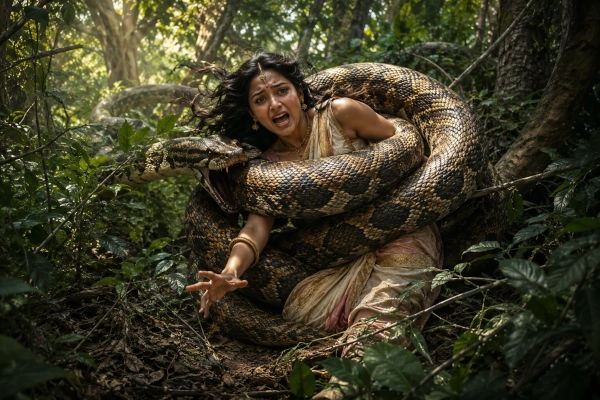
The forest around Damayanti seemed endless. Great trees rose into the darkness, their branches woven together so densely that only scattered shafts of sunlight reached the ground. The cries of birds echoed through the wilderness, while the distant roars of wild animals reminded her that she was completely alone. Only a short while earlier, she had been the queen of Nishadha, the beloved wife of King Nala, surrounded by the comforts of royal life. Now she wandered through a dangerous forest, exhausted, hungry and clothed in only half a garment, searching desperately for the husband who had vanished while she slept.
When Damayanti awoke and discovered that Nala was gone, disbelief quickly gave way to anguish. She called his name again and again, expecting that he might be nearby or that he would answer from beyond the trees. No reply came. As she searched the ground, she realised that the cloth they had shared had been cut in two. One half remained with her, while Nala had taken the other. The meaning was unmistakable. He had left her alone in the wilderness.
Even in that moment of abandonment, Damayanti did not turn against Nala in anger. Her first thoughts were of his suffering. She knew the man he had once been: a noble king, a skilled warrior and a devoted husband. She also knew that misfortune had overwhelmed him. She wondered where he had gone, whether he had eaten, whether wild animals threatened him and whether grief over the loss of his kingdom still tormented his mind. Her own danger seemed less important than the thought that Nala might be wandering somewhere in the same forest without anyone beside him.
She continued walking, calling out to him as she moved through the trees. Her feet were cut by stones and thorns, and her voice grew weak from crying his name. At times she imagined that she had seen him moving behind a tree or through the undergrowth, only to discover that it was a shadow or the movement of leaves in the wind. Yet she refused to stop. The hope of finding Nala drew her deeper into the wilderness.
As Damayanti pushed through a dense patch of vegetation, she failed to notice a massive serpent lying concealed among the leaves. The creature suddenly moved and seized her before she could escape. Its powerful coils wrapped around her body and began tightening. The princess struggled, but the serpent’s strength was overwhelming. It dragged her towards itself as though she were helpless prey.
Caught in the coils of the python and facing death, Damayanti again thought not of herself but of Nala. She cried out his name and lamented that she might die before ever finding him. She wondered what would happen if Nala later returned in search of her and discovered that she had vanished forever. Even while the serpent tightened around her, her concern remained with the husband who had abandoned her.
Her cries travelled through the forest and reached the ears of a hunter who happened to be nearby. Familiar with the sounds of the wilderness, he immediately recognised that a human being was in danger. He ran towards the voice and found Damayanti trapped in the coils of a gigantic serpent. Without hesitation, he attacked the creature with his weapon, killed it and freed her from its grip.
The hunter then helped the exhausted Damayanti recover. He sprinkled water upon her, gave her food and asked who she was and why a woman of such noble appearance was wandering alone through a dangerous forest. Damayanti, grateful for the rescue, told him her story. She explained that she was the wife of King Nala of Nishadha and the daughter of King Bhima of Vidarbha. She spoke of Nala’s loss of his kingdom, their exile into the forest and the terrible moment when she awoke to discover that he had disappeared.
At first, the hunter listened with sympathy. He had just saved her from death, and his actions appeared courageous and compassionate. Yet as Damayanti continued speaking, his thoughts began to change. He became captivated by her beauty. Despite her exhaustion, torn clothing and grief, the dignity and grace of the princess remained unmistakable. Instead of respecting her vulnerability, the hunter allowed desire to overcome his judgement.
His manner towards Damayanti gradually became improper. What had begun as concern changed into unwanted attention. Damayanti immediately understood his intentions and rejected him firmly. She made it clear that her heart belonged entirely to Nala and that she would never accept another man. The hunter, however, ignored her refusal. The very man who had rescued her from the python now became a danger himself.
The contrast was striking. The serpent had attacked Damayanti because it was a wild creature following its natural instincts. The hunter, however, possessed human intelligence and understood the difference between right and wrong. He had performed a noble act when he saved her life, but he allowed uncontrolled desire to destroy the merit of that deed. His failure was not one of strength or courage. It was a failure of self-control.
When the hunter attempted to force himself upon her, Damayanti’s sorrow turned to righteous anger. She stood before him without weapons, guards or any physical means of defence, but she possessed another kind of strength. Throughout every hardship, her devotion to Nala had remained absolute. She had chosen him at her swayamvara even when the gods themselves had sought her hand. She had followed him into exile when he lost his kingdom, shared his suffering in the wilderness and continued to love him even after he abandoned her.
Damayanti therefore called upon the power of that truth. She declared that if she had never desired any man other than Nala, then the hunter who sought to dishonour her should immediately perish. Her words carried the force of her unwavering fidelity. The hunter suddenly collapsed and died, falling to the earth like a tree consumed by fire.
The forest became silent once more. Damayanti stood alone beside the man who had only moments earlier saved her from the serpent. He had possessed enough courage to defeat a dangerous python, but he had been unable to defeat the desire within his own mind. The episode revealed one of the Mahabharata’s recurring truths: external strength means little when a person cannot govern himself.
Damayanti did not remain there. She resumed her journey through the wilderness, still determined to find Nala. The forest through which she travelled was filled with lions, tigers, bears, elephants, deer and serpents. Great mountains rose in the distance, streams cut through the land and thick groves concealed unknown dangers. Yet she continued onward, driven by love, duty and an extraordinary refusal to surrender to despair.
As she wandered, Damayanti sometimes spoke to the creatures and features of the forest as though they might answer her. She asked the animals whether they had seen Nala. She appealed to mountains, rivers and trees, hoping that somewhere in the wilderness there might be a sign of his passage. Her grief was immense, but it did not make her helpless. Instead, it became the force that carried her forward.
The encounter with the python and the hunter also reveals the depth of Damayanti’s character. She had lost everything that outwardly represented royal power. She had no palace, no servants, no army, no chariot and no jewellery. Her husband was missing and her kingdom lay far behind her. Yet she remained unmistakably a queen because her dignity did not depend upon wealth or position.
Damayanti’s true strength lay in courage, intelligence, self-command and fidelity to Dharma. She did not simply wait to be rescued by others. Again and again throughout the story of Nala and Damayanti, she survives through her own resolve. The hunter may have saved her from the python, but when the hunter himself became the threat, Damayanti had to protect herself, and she did so through the moral power of her own life.
The episode also creates a powerful comparison between the python and the hunter. The serpent possessed tremendous physical strength, but it was only an animal acting according to instinct. The hunter possessed reason and moral understanding, yet he allowed desire to corrupt him. In this sense, the Mahabharata suggests that an undisciplined human mind can become more dangerous than a wild beast.
Damayanti eventually walked away from the hunter’s body and continued alone through the forest. Dust covered her body, her clothing was torn and her feet were wounded from the difficult journey. No royal umbrella shaded her, and no attendants announced her approach. Yet the wilderness had revealed a form of royalty greater than any throne could provide. Her character remained untouched by the destruction of her worldly fortune.
Somewhere far away, Nala was also passing through suffering and transformation. Neither husband nor wife yet knew when they would meet again. Their paths had separated, and each would endure further trials before fate brought them together. For Damayanti, however, the encounter in the forest had already demonstrated that misfortune could take away comfort, wealth, status and companionship, but it could not easily destroy a person whose strength came from within.
The python had possessed crushing physical power. The hunter had carried a weapon. Damayanti possessed neither. Yet when both encounters had ended, it was Damayanti who continued walking through the forest.
Her journey had become more than a search for Nala. It had become a demonstration of courage, steadfastness and Dharma in the face of complete isolation. The queen of Nishadha might have appeared outwardly helpless, but the forest was revealing the extraordinary strength of the woman behind the crown.
The episode forms part of the Nalopakhyana in the Vana Parva of the Mahabharata, where Rishi Brihadashva narrates the story of Nala and Damayanti to Yudhishthira. It stands as one of the most memorable moments in Damayanti’s long ordeal, showing that her greatness rested not merely in her beauty or royal birth, but in the strength of character that remained when almost everything else had been taken from her.
You may also like
-
Indian Physicist Ashoke Sen Becomes First Indian to Receive Prestigious Oskar Klein Medal
-
Indian Army’s Northern Command Opens 75-Day Defence Technology Internship Programme for Young Innovators
-
Ayush Patent Filings Rise Eightfold as India Records 4,077 Applications and 711 Grants in 12 Years
-
DRDO Announces Paid Research Internships at Gwalior for Science and Engineering Students
-
PM-SETU: Government Approves ₹1,194.92 Crore to Modernise 25 ITIs Across Maharashtra, Odisha and Jammu & Kashmir
