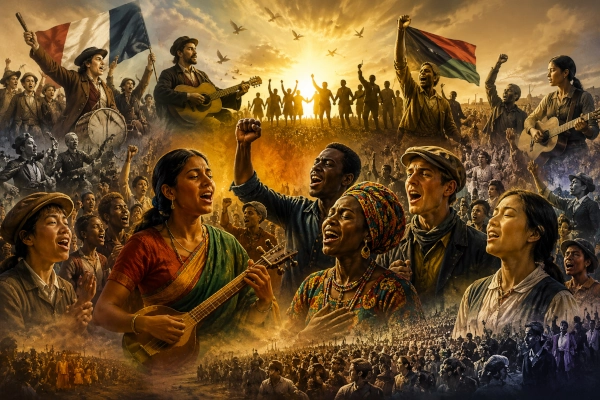
Freedom movements are usually remembered through political leaders, mass protests, prison terms, revolutions and decisive battles. Yet across history, another force has often moved silently beside them. Songs have given oppressed people courage, united scattered communities and transformed private emotion into public resolve. In many countries, music became an important part of the struggle for liberty because it carried ideas of dignity, sacrifice, resistance and national identity directly into the hearts of ordinary people.
A speech may inspire those who hear it once, but a song can travel from village to village, from one generation to another and from public meetings into homes. It can be remembered without paper, repeated without printing presses and sung even when open political expression becomes dangerous. This simple quality made music one of the most enduring cultural forces behind many freedom movements.
Why Songs Became Powerful Instruments of Freedom
Movements for independence or civil rights rarely succeed through political organisation alone. They also depend on morale. People must believe that change is possible, that sacrifice has meaning and that they are not alone in their struggle.
Songs helped create that belief.
When thousands of people sang the same words, individual fear could turn into collective confidence. The act of singing reminded people that they belonged to a larger cause. It also gave movements a shared emotional language that could cross barriers of class, region and education.
This made songs particularly effective during periods of repression. Governments could ban organisations, censor newspapers and arrest leaders, but a melody already memorised by thousands of people was far more difficult to erase.
Songs therefore became both cultural memory and political energy.
Vande Mataram and the Emotional Force of India’s Freedom Struggle
India offers one of the clearest examples of a song becoming inseparable from the struggle for national freedom.
Bankim Chandra Chattopadhyay’s Vande Mataram became much more than a literary composition. By presenting the motherland as a living and sacred presence, the song created a deeply emotional connection between patriotism and the land itself.
During the Swadeshi movement and the protests against the Partition of Bengal in 1905, Vande Mataram became a rallying cry. It was sung at meetings, processions and nationalist gatherings, where it helped transform political resistance into a broader cultural awakening.
Its power lay in the way it connected freedom with civilisational identity. The struggle against colonial rule was no longer understood merely as a contest for administrative control. It became a moral and emotional effort to restore dignity to the motherland.
That emotional force gave the song a place in India’s national memory that has survived long after the circumstances in which it first became politically significant.
Sare Jahan Se Achha and the Confidence of Belonging
Another song that strengthened India’s national consciousness was Sare Jahan Se Achha.
Written by Muhammad Iqbal in the early twentieth century, the song celebrated India through cultural pride and a strong sense of belonging. It spoke to a society living under colonial rule but conscious of its civilisational depth and continuity.
Such songs played an important psychological role. Colonialism was sustained not only by military and administrative power, but also by the repeated suggestion that the colonised lacked the confidence or capacity to govern themselves.
Patriotic music challenged that assumption.
By celebrating the homeland, its people and its civilisational heritage, songs restored confidence in a society whose political sovereignty had been compromised. In this way, music became part of the larger process through which people recovered belief in their own national identity.
La Marseillaise and the Spirit of Revolutionary France
In France, La Marseillaise became one of the most famous examples of revolutionary music shaping national identity.
Composed in 1792 during the French Revolution, the song emerged at a time when France was undergoing profound political transformation. The monarchy was collapsing, revolutionary ideals were spreading and foreign armies threatened the new political order.
The song carried urgency, defiance and a call to collective action. Volunteers from Marseille helped popularise it, and it quickly became associated with the revolutionary cause.
Over time, La Marseillaise evolved from a wartime composition into a permanent symbol of the French nation.
Its history demonstrates how a song written for a specific political crisis can eventually become part of a country’s enduring identity.
Greece and the Hymn to Liberty
The Greek struggle for independence also produced music and poetry that became closely linked with the idea of national liberation.
Dionysios Solomos wrote the Hymn to Liberty in 1823 during the Greek War of Independence against Ottoman rule. The poem celebrated liberty not merely as a political goal, but as a deeply rooted national aspiration.
Its opening verses later became the national anthem of Greece and Cyprus.
For Greeks seeking sovereignty after centuries of foreign rule, the hymn connected the immediate struggle for independence with the survival of language, culture and historical memory.
This pattern has appeared repeatedly across the world. In many liberation movements, songs did not simply demand political change. They also reminded people that their identity had survived despite prolonged periods of domination.
Nkosi Sikelel’ iAfrika and the Struggle Against Apartheid
South Africa provides another powerful example of music evolving into a symbol of resistance.
Nkosi Sikelel’ iAfrika began as a hymn composed by Enoch Sontonga in the late nineteenth century. Over time, it became closely associated with African political mobilisation and the struggle against racial oppression.
During the apartheid era, collective singing became an important expression of dignity and solidarity. Political gatherings and protests often used music to strengthen morale and create unity among people facing discrimination, violence and imprisonment.
Nkosi Sikelel’ iAfrika eventually became one of the most recognisable songs of African liberation.
After the end of apartheid, portions of the song were incorporated into South Africa’s national anthem. Its journey from hymn to resistance song and then to national anthem reflected the country’s own transition from oppression to democracy.
We Shall Overcome and the American Civil Rights Movement
In the United States, We Shall Overcome became closely associated with the Civil Rights Movement.
The song was widely sung by activists campaigning against racial segregation and discrimination. Its message was simple, but its simplicity was its strength. It expressed determination without hatred and confidence without aggression.
Activists sang it during marches, meetings and moments of great uncertainty.
For those facing arrest, intimidation and violence, the song provided emotional strength. It reinforced the belief that peaceful resistance could eventually succeed.
Music therefore became part of the discipline of the movement itself.
The song did not merely describe hope. It helped sustain it.
Bella Ciao and the Memory of Resistance
Italy’s Bella Ciao became internationally associated with resistance to fascism and Nazi occupation during the Second World War.
Its connection with partisan fighters gave it lasting political meaning, and the song eventually travelled far beyond Italy.
Today, Bella Ciao is recognised across the world, but its continued popularity also highlights an important responsibility. When freedom songs become part of popular culture, the historical struggles behind them can sometimes fade from public memory.
Remembering the origins of such songs is therefore essential.
A resistance song should not survive only as a melody. It should also carry forward the memory of those who risked their lives for the ideas represented within it.
The Baltic Singing Revolution and the Power of Cultural Memory
Perhaps one of the most extraordinary modern examples of music supporting a political movement occurred in Estonia, Latvia and Lithuania during the final years of Soviet rule.
The independence movements in these countries became known collectively as the Singing Revolution.
Large public gatherings brought thousands of people together to sing traditional and patriotic songs. These events demonstrated that culture itself could become a form of political resistance.
For decades, the Baltic states had lived under Soviet control. Yet their national identities continued through language, customs and music.
When people gathered publicly to sing songs connected with their national heritage, they were also asserting that their identities had survived political domination.
By the time Estonia, Latvia and Lithuania restored their independence in 1991, music had already helped rebuild the emotional foundations of nationhood.
Why Authorities Have Often Feared Songs
The political importance of music can also be understood from the way governments have treated it.
Throughout history, rulers and authoritarian systems have frequently attempted to censor songs associated with resistance. This happened because music could spread ideas more rapidly than formal political texts.
A banned newspaper requires a printing press. A banned organisation requires offices and leadership structures. A song requires only memory.
Once people know the words and melody, every individual becomes capable of carrying it forward.
This gave freedom songs a remarkable resilience.
They could survive arrests, censorship and political suppression because they belonged not to an institution, but to the people themselves.
Freedom Must First Exist in the Mind
Every successful freedom movement begins with a psychological change.
People must first believe that domination is not permanent.
Colonialism, racial oppression and authoritarian rule often depend on fear and resignation. When a population begins to believe that change is impossible, political control becomes easier to maintain.
Freedom songs challenged that resignation.
They reminded people that their present condition did not have to define their future.
Whether the words were Vande Mataram, We Shall Overcome or El Pueblo Unido Jamás Será Vencido, the central message was similar. People were being told that unity, courage and persistence could change history.
This is why songs often became sources of energy during movements for liberation.
They gave people a future to imagine before that future had actually arrived.
Why These Songs Must Be Cherished
Freedom songs deserve to be preserved because they are not merely cultural artefacts. They are records of historical experience.
Every generation that grows up in a free society inherits rights and opportunities shaped by people who lived through far more difficult circumstances.
As time passes, however, the emotional memory of those struggles can fade.
Dates become textbook entries. Leaders become portraits. Political movements become chapters that students study for examinations.
Songs can prevent history from becoming distant.
When a freedom song is sung with an understanding of its origins, listeners are connected to the people who once sang it under completely different circumstances.
Some sang while marching through streets.
Some sang in prison.
Some sang knowing that arrest or violence could follow.
Others sang because music was one of the few forms of resistance still available to them.
Remembering those circumstances gives these songs meaning far beyond their melodies.
Cherishing Freedom Songs Requires Understanding Their History
Preserving freedom songs should involve more than ceremonial performance.
Every generation should also learn who created them, when they emerged and why they became important.
A song such as Vande Mataram should be understood within the wider history of India’s national awakening. La Marseillaise should be remembered in the context of revolutionary France. Nkosi Sikelel’ iAfrika gains deeper meaning when its connection with African resistance is understood.
Historical context transforms singing from ritual into remembrance.
Schools, cultural institutions, historians, musicians and families all have a role in keeping this memory alive.
Traditional compositions can also be introduced to younger generations through respectful contemporary performances, provided their historical meaning is preserved.
A Nation That Remembers Its Songs Remembers Its Struggle
Freedom movements eventually end, but their songs often survive.
The protest march concludes. Political prisoners are released. Governments change. New constitutions are written and new generations are born into societies that may no longer remember the fear their ancestors experienced.
Yet a melody can still remain.
That is the enduring power of the freedom song.
It carries voices from the past into the present and reminds people that liberty was once uncertain.
Such songs should therefore be cherished not simply because they are patriotic or historic, but because they preserve the human emotions behind political change.
They contain hope, sacrifice, defiance, dignity and collective courage.
A nation that remembers the songs of its freedom struggle remembers more than music. It remembers the people who believed in freedom before freedom was guaranteed, and it remembers why that hard-earned freedom must always be valued and protected.
You may also like
-
Parasika in the Mahabharata: Tracing the Persian Lands Through Modern Iran
-
Kapisa: The Ancient Kingdom North of Kabul at the Gateway of the Hindu Kush
-
Lampaka: The Mountain Kingdom of Laghman on the Kabul River Frontier
-
Navaratri and Ayurveda: The Nine Divine Medicinal Plants Associated with Navadurga
-
Bahlika: The Ancient Bactrian Realm of Balkh in the Mahabharata
