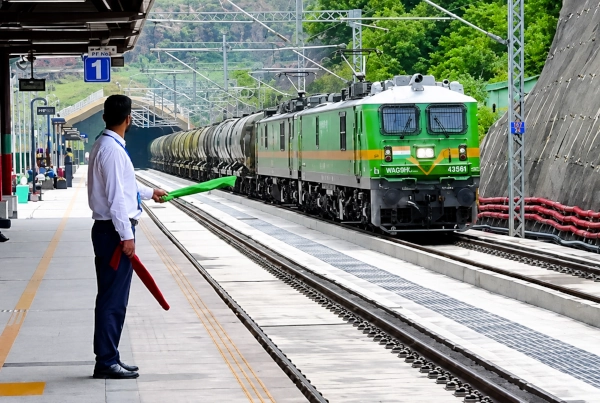
Indian Railways has completed the first trial run of a fuel-laden freight train into the Kashmir Valley through the Udhampur-Srinagar-Baramulla Rail Link (USBRL), marking another important expansion of freight operations on the strategically significant railway corridor.
The train carried BTPN bogie tank wagons loaded with petrol and diesel, opening the possibility of supplying fuel to the Valley by rail instead of depending almost entirely on road transport.
For decades, the Kashmir Valley has relied heavily on the Jammu-Srinagar National Highway, or NH-44, for petroleum products and other essential commodities. Weather disruptions, landslides and road damage along the mountainous highway have repeatedly affected the movement of supplies.
The successful fuel train trial therefore represents an important step towards building a more resilient logistics network for the Valley.
Safety Clearance Opens Way for Fuel Transportation
Although railway connectivity to Kashmir has expanded, the movement of fuel tankers by rail had required additional safety assessment.
The USBRL route passes through long tunnels and difficult mountainous terrain. Transporting petrol and diesel through such sections requires strict fire-safety and operational procedures.
Following detailed safety evaluations, Indian Railways carried out the first fuel train trial successfully.
Regular rail transportation of petroleum products could provide Kashmir with a faster and more dependable supply route. It could also reduce logistics costs and ease some of the pressure on NH-44.
USBRL Emerging as Kashmir’s Freight Lifeline
The fuel trial is part of a wider expansion of freight traffic into and out of the Kashmir Valley.
Indian Railways has already been using rail services to transport apples, cherries and other horticultural produce from Kashmir to markets outside the region. Dedicated parcel and cargo trains offer growers an alternative when road traffic is disrupted.
Rail freight has also begun carrying a growing range of essential and commercial goods into the Valley.
Recent consignments have included cement, Food Corporation of India food grains, fertilisers and automobiles. Kashmir has also received its first Maruti Suzuki vehicles by rail, while Indian Army winter supplies have been transported through the railway network.
This gradual diversification shows how the USBRL is evolving from a passenger railway into an important logistics corridor.
Rail Connectivity Reduces Dependence on NH-44
The importance of alternative transportation became particularly evident after heavy rainfall damaged sections of the Jammu-Srinagar National Highway.
Chief Minister Omar Abdullah inspected affected stretches and reviewed restoration work following landslides and road damage.
The disruption comes at a sensitive period for Kashmir, with the Amarnath Yatra and the peak fruit season placing additional pressure on transport infrastructure.
The administration has prioritised fruit-laden trucks to prevent losses to growers. Petroleum tankers travelling from Jammu have also received priority to maintain supplies of essential commodities.
NH-44 nevertheless remains the Valley’s primary all-weather road connection.
The alternative Rajouri-Poonch route through Peer Ki Gali and Buffliaz cannot currently provide the same level of dependable connectivity, particularly when weather conditions deteriorate.
Rail Freight Adds Strategic Resilience
The introduction of fuel trains could significantly strengthen Kashmir’s supply chain.
Petrol and diesel are among the commodities most vulnerable to prolonged highway disruptions because road tankers have traditionally carried the bulk of supplies into the Valley.
Rail transportation creates a second major logistics channel capable of moving large volumes independently of highway traffic.
The development is also strategically important because Kashmir’s geography makes reliable year-round transportation infrastructure essential for civilian supplies, agriculture, industry and defence logistics.
As more freight categories shift to rail, the USBRL can increasingly complement the highway rather than simply serve as an alternative passenger route.
The first successful fuel train trial therefore marks another stage in the transformation of Kashmir’s transport network. From horticultural produce and food grains to automobiles, military supplies and now petroleum products, the railway is steadily becoming an important part of the Valley’s economic and logistics infrastructure.
You may also like
-
India’s Forex Reserves Surge by $14.1 Billion to $707 Billion
-
India’s STP Units Record ₹7.73 Lakh Crore in Software Exports in FY2025–26
-
Logistics Data Bank Crosses 10 Crore EXIM Containers, Strengthening India’s Digital Logistics Network
-
PM-MKSSY Targets 1.70 Lakh Jobs as Government Strengthens India’s Fisheries Value Chain
-
India Expands Youth Development Push Across Education, Skills, Jobs, Sports and Health
