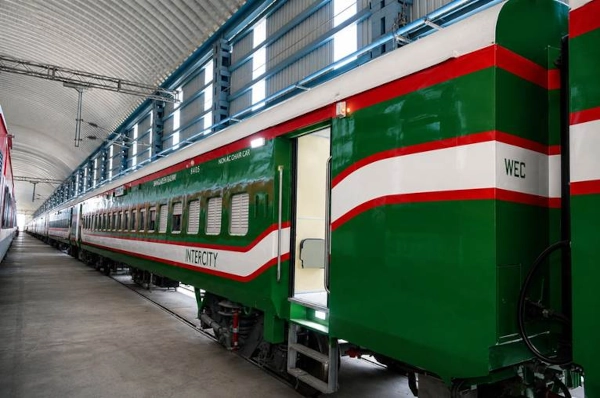
India’s railway manufacturing capabilities are set to gain another international showcase as the Rail Coach Factory (RCF), Kapurthala, rolls out the first rake of 19 LHB broad-gauge passenger coaches for Bangladesh Railway on August 12, 2026. The delivery marks an important milestone in India’s railway exports and strengthens the long-standing cooperation between Indian Railways and Bangladesh Railway.
The first rake consists of three AC Sleeper Cars, three AC Chair Cars, 11 Non-AC Chair Cars and two Power Cars. Although based on the proven Linke Hofmann Busch, or LHB, platform widely used by Indian Railways, the coaches have undergone extensive modifications to meet the specific operational conditions and passenger requirements of Bangladesh Railway.
Passenger comfort has been given considerable attention in the design. The coaches feature specially developed reclining seats equipped with stainless-steel armrests and footrests, with multiple reclining positions intended to improve comfort on longer journeys. They also incorporate an integrated CCTV surveillance system, passenger alarm arrangements, partially openable windows and fans even in air-conditioned coaches.
Among the more distinctive additions are a Baby Care Room and a Prayer Room, reflecting the requirements specified for Bangladesh Railway services. The coaches have therefore been designed not merely as standard export versions of Indian rolling stock, but as customised vehicles developed around the operational and social needs of the customer railway.
RCF has also introduced important structural modifications for Bangladesh’s operating environment. The roof structure has been strengthened to withstand additional loading associated with passengers travelling on coach roofs during periods of exceptionally high traffic. This unusual engineering requirement demonstrates the extent to which the platform has been adapted for conditions encountered on the Bangladesh railway network.
Passenger safety represents another major technological advance in the project. The coaches incorporate crashworthy design provisions compliant with European Standard EN 15227, requiring significant redesign of the LHB car-body shell to improve its ability to absorb and manage collision forces. The modification is intended to enhance structural protection for passengers and represents one of the most significant engineering developments incorporated into the export coaches.
The electrical architecture has similarly been customised. While conventional Indian Railways LHB coaches generally operate with a 750-volt electrical system, the Bangladesh Railway coaches have been specifically designed for 415-volt operation, ensuring compatibility with the customer’s infrastructure and operational requirements.
The latest delivery builds upon an established relationship between RCF Kapurthala and Bangladesh Railway. During 2015-16, RCF successfully supplied 120 LHB broad-gauge passenger coaches to Bangladesh, establishing the Indian manufacturing facility as an important supplier of modern rolling stock to the neighbouring country.
Following the successful operation of those coaches, Bangladesh Railway placed another major order through RITES in 2024 for 200 broad-gauge passenger coaches in seven different variants. The 19-coach rake being rolled out at Kapurthala represents the first major physical delivery under this larger programme.
The order highlights the growing potential of India’s railway manufacturing ecosystem in international markets. RCF’s ability to modify the proven LHB platform for different electrical standards, passenger requirements, operating environments and international crashworthiness norms demonstrates that Indian railway factories are increasingly capable of supplying highly customised rolling stock rather than merely exporting standard domestic designs.
For India, the Bangladesh Railway project is therefore more than a conventional coach export contract. It reflects the expanding technological depth of the country’s railway manufacturing sector while reinforcing transport and economic connectivity with one of India’s most important neighbours.
Source: PIB
https://www.pib.gov.in/PressReleasePage.aspx?PRID=2297903®=48&lang=1
You may also like
-
India’s Economic Warfare Challenge: Strategic Autonomy, Energy Security and the Rise of a Global Power
-
India-US Trade Deal Stalemate: Why Washington’s Tariff Pressure Has Failed to Secure an Agreement
-
US Double Standards in Foreign Policy: 16 Recent Cases Involving India, Russia, China and Global Trade
-
India’s Arctic Energy Ambitions: Russian Oil, LNG and a New Sea Route to Indian Ports
-
Indian Navy Vice Chief Inspects Japan’s Mogami-Class Stealth Frigate as India-Japan Shipbuilding Cooperation Expands
