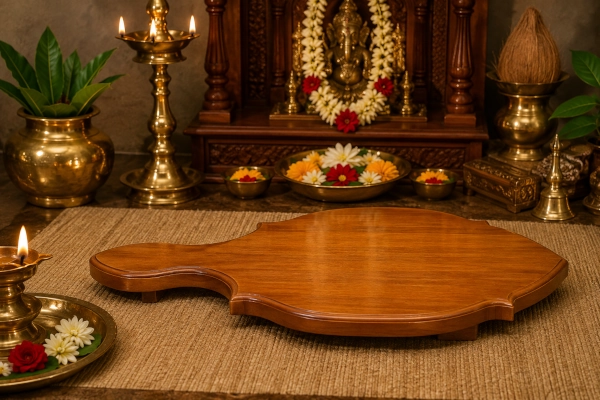
In many traditional homes and temples of Kerala, one may notice a distinctive low wooden seat on which the priest or householder sits while conducting puja, chanting mantras, performing homa or undertaking other sacred rites. Known locally as the Avanipalaka or Aavanipalaka, it is also associated in Kerala ritual tradition with the Kurma Peedika, the sacred seat symbolically connected with the tortoise.
At first glance, it can appear to be little more than a convenient wooden plank. Yet the ideas behind the seat reach into some of the oldest layers of Hindu ritual thought. The Avanipalaka brings together three powerful concepts: Prithvi, the Earth that bears the worshipper; Kurma, the cosmic support represented by the tortoise; and Asana, the stable ritual seat upon which the mind and body are established before approaching the Divine.
The Kurma connection is particularly significant. In Vedic ritual literature, the tortoise represents the worlds and the supporting principle of creation. In the Puranas, Vishnu becomes Kurma to bear Mount Mandara during the churning of the Ocean of Milk. In the Bhagavad Gita, the tortoise becomes the model for withdrawing the senses and establishing inner steadiness. Most strikingly, traditional puja manuals explicitly identify Kurma as the devata associated with the worshipper’s asana.
The Avanipalaka can therefore be understood not merely as furniture used during worship, but as a small ritual representation of a much larger Hindu idea: before spiritual action can begin, there must first be a stable foundation.
What Is the Avanipalaka?
The Avanipalaka is traditionally a low wooden plank or seat used in Kerala for puja and other ritual activities. It may be used by the priest or devotee as the seat from which worship is performed, and similar wooden platforms are also used for placing deities and ritual objects. Traditional Kerala examples are frequently made from jackfruit wood, a material long associated with domestic and temple woodworking in the region.
The name itself is suggestive. Avani is a Sanskrit word meaning the earth or ground, while phalaka means a board, plank, flat slab or wooden seat. Sanskrit lexicons specifically record phalaka not only as a board or plank but also as a wooden seat.
In Kerala usage, therefore, the name Avanipalaka naturally evokes the idea of a wooden seat associated with the ground or Earth.
But the ritual meaning becomes clearer when the seat is viewed through another traditional name: Kurma Peedika — the tortoise seat.
Hindu Worship Begins by Establishing a Sacred Seat
The importance of an appropriate seat for meditation and spiritual discipline is explicitly stated in the Bhagavad Gita.
Krishna instructs the practitioner:
शुचौ देशे प्रतिष्ठाप्य स्थिरमासनमात्मनः ।
नात्युच्छ्रितं नातिनीचं चैलाजिनकुशोत्तरम् ॥
Śucau deśe pratiṣṭhāpya sthiram āsanam ātmanaḥ
nātyucchritaṁ nātinīcaṁ cailājina-kuśottaram.
The practitioner is instructed to establish a firm seat in a clean place, neither excessively high nor excessively low. The verse describes the traditional arrangement of kusa grass, skin and cloth. Ramanuja’s commentary, as preserved by the IIT Kanpur Gita Supersite, specifically explains the firm seat as one made of wood or similar material, upon which the other layers may be placed.
The underlying principle is important.
A sacred activity should not begin from a physically or ritually unstable position. The worshipper first establishes a defined place. Only then does meditation, mantra or worship proceed.
The seat therefore marks the transition between ordinary space and ritual space.
When the priest sits upon the Avanipalaka, he is symbolically ceasing to occupy the floor as an ordinary person engaged in everyday activity. He assumes a designated ritual position from which the sacred act will be performed.
Kurma: The Ancient Symbol of the Foundation
The association between the tortoise and a sacred foundation is extremely old.
One of the most remarkable references occurs in the Shatapatha Brahmana, in its description of the construction of the Vedic fire altar.
A tortoise is ritually placed within the altar structure. The text explains that the tortoise represents the life essence of the worlds. It then gives an extraordinary cosmological interpretation of the animal:
the lower shell represents the Earth, the upper shell represents the heavens, and the space between the two represents the atmosphere.
The tortoise is therefore described as encompassing the worlds themselves.
The same passage further associates the tortoise with Prajapati, the Sun and vital life.
This is crucial for understanding the Kurma seat.
The tortoise in Hindu ritual symbolism is not merely an animal believed to bring good fortune. It represents something far more fundamental: the stable substratum upon which the ordered cosmos can be established.
Thus, when a ritual seat becomes a Kurma Peedika, its symbolism is appropriate. The priest conducting worship requires a stable ritual foundation just as the altar requires a foundation and, on the cosmic level, creation requires a principle capable of bearing it.
Vishnu as Kurma: The One Who Bears the Mountain
The Puranic account of the Samudra Manthana, the Churning of the Ocean of Milk, develops this symbolism even further.
The Devas and Asuras use Mount Mandara as the churning rod and Vasuki as the rope. However, the enormous mountain has no stable base and begins to sink.
At precisely this point Vishnu assumes the form of the great tortoise, Kurma, enters beneath the mountain and supports it upon His back.
The Bhagavata Purana describes the Lord assuming the tortoise form, entering the waters and lifting Mandara. Other Puranic accounts similarly portray Kurma as the pivot or foundation that makes the churning possible.
The symbolism is remarkably relevant to worship.
The Devas possess strength. The Asuras possess strength. Vasuki is available as the rope and Mandara as the churning rod. Yet none of these can accomplish their purpose until there is a stable foundation beneath them.
Only after Kurma supports Mandara can the great churning proceed.
The same spiritual principle can be applied to puja.
There may be mantras, flowers, lamps, offerings, mudras and elaborate ritual procedures. But the practitioner himself must first become established.
The Kurma seat represents that establishment.
Kurma is the support beneath the spiritual churning.
The Most Direct Evidence: Kurma Is the Devata of the Ritual Seat
There is an even more direct connection between Kurma and the worshipper’s seat in traditional ritual manuals.
The Brahma Archana Paddhati, in its description of daily worship, instructs the worshipper to prepare and worship the asana before beginning the principal puja.
Among the invocations made to the seat is:
Om Kurmasanaya Namah
— salutations to the Kurma seat.
The same ritual sequence then gives the Asana Viniyoga, assigning the ritual elements of the mantra and explicitly declaring:
Kūrmo Devatā
— Kurma is the deity of the seat.
This is perhaps the clearest key to understanding why the tortoise symbolism became associated with the worship seat.
The relationship is not based merely upon the physical resemblance of a wooden stool to a tortoise. Hindu ritual itself treats the seat as resting upon the principle represented by Kurma.
The worshipper is therefore ritually establishing himself upon the principle of stability before invoking the deity.
The Beautiful Asana Mantra: Earth Supports the Worshipper
Immediately after identifying Kurma as the devata of the asana, the same ritual tradition gives one of the most meaningful prayers connected with the worship seat:
पृथ्वी त्वया धृता लोका देवी त्वं विष्णुना धृता ।
त्वं च धारय मां देवि पवित्रं कुरु चासनम् ॥
Pṛthvī tvayā dhṛtā lokā
devi tvaṁ Viṣṇunā dhṛtā;
tvaṁ ca dhāraya māṁ devi
pavitraṁ kuru cāsanam.
Its meaning may be rendered:
“O Divine Earth, the worlds are borne by you, and you yourself are sustained by Vishnu. Therefore support me also, O Devi, and make this seat pure.”
The puja manual places this mantra directly within the purification of the worshipper’s seat.
The entire philosophy of the Avanipalaka can almost be understood through this single prayer.
The worshipper does not simply sit down.
He acknowledges a hierarchy of support.
The worlds rest upon the Earth.
The Earth rests upon the Divine.
The worshipper now asks the Earth to support him.
The seat consequently becomes a miniature representation of cosmic order.
Why the Tortoise Is the Perfect Symbol
There is another aspect of the tortoise that makes it particularly appropriate for prayer.
The Bhagavad Gita 2.58 describes the person of steady wisdom through the image of a tortoise:
यदा संहरते चायं कूर्मोऽङ्गानीव सर्वशः ।
इन्द्रियाणीन्द्रियार्थेभ्यस्तस्य प्रज्ञा प्रतिष्ठिता ॥
Krishna explains that just as the tortoise withdraws its limbs, the spiritually disciplined person withdraws the senses from their objects; then wisdom becomes firmly established.
This gives the Kurma symbolism a psychological as well as cosmological dimension.
When a devotee begins puja, the essential movement is inward.
The eyes cease wandering through the world and become focused upon the deity. The ears attend to mantra. The hands perform mudra and offering. The tongue recites sacred names. The mind is gradually withdrawn from ordinary concerns.
The worshipper symbolically becomes like the tortoise.
The Kurma withdraws its limbs into its centre. The devotee withdraws the senses towards the inner centre of consciousness.
Thus the same creature represents both outer stability and inner withdrawal.
That combination makes Kurma an exceptionally appropriate symbol for an asana used in worship.
Kurma Represents Dhriti — The Ability to Bear
A tortoise carries its own protective structure wherever it goes. Its body is close to the Earth, its movement is deliberate and its form suggests endurance rather than agitation.
Hindu cosmological symbolism develops these natural characteristics into the concept of support.
Kurma does not conquer Mandara through violence. He simply bears its immense weight without losing stability.
This is also an important quality for the person undertaking spiritual practice.
A serious puja, japa or homa requires the capacity to remain steady despite bodily discomfort, distracting thoughts, sounds, emotions and external disturbances.
The Kurma seat silently teaches:
Remain established. Bear the weight. Do not be disturbed. Continue the sacred work.
Why Not Simply Sit on the Bare Floor?
From the traditional ritual perspective, the answer is not merely comfort.
Hindu ritual repeatedly distinguishes between ordinary space and consecrated space. The altar is marked. The kalasha is established. The lamp has a designated place. Offerings are arranged according to ritual order. The practitioner likewise occupies a specifically prepared asana.
The seat creates a defined ritual station.
The Bhagavad Gita’s instruction to establish a clean, firm seat reinforces this principle.
A wooden Avanipalaka is particularly suitable because it is firm, durable, slightly raised from the floor and capable of remaining dedicated to religious use.
Some popular modern explanations claim that the wooden seat prevents “spiritual energy” from being electrically discharged into the Earth. Such explanations are frequently repeated, but they should not be confused with the primary scriptural rationale.
The older textual explanation is richer and does not require such modern pseudo-electrical interpretations.
The seat is about purity, stability, ritual separation, concentration and cosmic support.
Why Avani — the Earth — Is So Important
The name Avanipalaka becomes especially meaningful when viewed beside the asana mantra.
Avani means Earth.
Earth in Hindu thought is not merely inert soil. Prithvi is the bearer. She receives the weight of beings, temples, mountains, rivers and cities without discrimination.
During the asana purification mantra, the practitioner explicitly remembers this quality:
“The worlds are borne by you.”
Then he asks:
“Support me also.”
The act of sitting for worship therefore contains a subtle humility.
The worshipper recognises that even the ability to sit, breathe, chant and make an offering depends upon something beneath him.
The Avanipalaka reminds him of that support.
Why Kerala Calls It the Kurma Peedika
Within Kerala traditional explanations, the distinctive Avanipalaka is frequently identified with the Kurma Peedika. Traditional accounts interpret its form through the symbolism of the tortoise and sometimes attach additional cosmological meanings to its different projections and proportions.
Some of these detailed interpretations belong specifically to regional ritual and artisan traditions rather than to the universally accepted Sanskrit textual corpus, and they should therefore be understood in that context.
The larger Kurma symbolism, however, has very strong textual foundations.
The Vedic tortoise represents the worlds. The Puranic Kurma supports Mandara. The Gita’s tortoise represents mastery of the senses. Puja manuals identify Kurma as the devata of the ritual seat.
Kerala’s Kurma Peedika draws all these themes together into a physical object used in everyday worship.
The Avanipalaka as a Miniature Cosmos
Traditional Hindu ritual often reproduces the structure of the cosmos on a smaller scale.
A kalasha can represent the universe and its sacred waters. A mandala arranges cosmic principles geometrically. The homa kunda becomes the sacred field of Agni. A temple itself is constructed as an ordered sacred cosmos.
The Kurma seat belongs to the same ritual imagination.
The Shatapatha Brahmana’s description of the tortoise is particularly powerful in this regard: its lower shell is Earth, its upper shell Heaven and the region between them the atmosphere.
A priest seated symbolically upon Kurma therefore sits upon an image of the ordered cosmos.
The implication is profound.
The puja is not imagined simply as an individual speaking privately to God. The ritual establishes correspondence between the human being, the sacred space and the universe.
A Seat of Stability Before the Divine
The Avanipalaka consequently performs several functions simultaneously.
Physically, it gives the worshipper a firm and clean place to sit.
Ritually, it separates the sacred position of the priest from ordinary floor space.
Symbolically, it represents Earth as the bearer.
Cosmologically, it evokes Kurma as the support of the worlds.
Puranically, it remembers Vishnu bearing Mount Mandara.
Yogically, it recalls the tortoise withdrawing its limbs and teaches the withdrawal of the senses.
Spiritually, it tells the worshipper that concentration requires a foundation.
These meanings reinforce one another rather than existing separately.
From Samudra Manthana to the Puja Room
There is a beautiful continuity between the enormous Kurma of the Puranas and the small wooden Avanipalaka found in a Kerala prayer room.
During the Samudra Manthana, the cosmic mountain cannot remain steady until Vishnu becomes its foundation.
During worship, the human mind similarly turns and churns through thoughts, memories, desires and distractions.
Before beginning that inner churning, the practitioner establishes himself upon the Kurma principle.
Mandara rests upon Kurma.
The ritual rests upon the asana.
The body rests upon the Earth.
The mind rests upon the Divine.
Seen in this light, the Avanipalaka is not an insignificant piece of traditional furniture.
It is a condensed teaching in wood.
Every time the priest sits upon the Kurma Peedika, the structure beneath him silently expresses one of the oldest principles of Sanatana Dharma:
That which seeks to rise towards the Divine must first become firmly established.
The Avanipalaka therefore represents Prithvi beneath the worshipper, Kurma beneath the cosmos, Vishnu beneath creation and steadiness beneath spiritual practice.
That is why the humble tortoise-shaped seat has retained an honoured place in the ritual traditions of Kerala.
References
Shatapatha Brahmana 7.5.1 — describes the tortoise placed within the Vedic altar and identifies its lower shell with Earth, upper shell with Heaven and the region between them with the atmosphere; it also associates Kurma with the worlds, Prajapati, the Sun and vital life.
Bhagavad Gita 6.11 — instructs the practitioner to establish a clean and firm asana, neither excessively high nor excessively low. Ramanuja’s commentary includes wood among the appropriate materials for the firm seat.
Bhagavad Gita 2.58 — compares mastery of the senses to a tortoise withdrawing its limbs, making Kurma an enduring symbol of inward concentration and self-control.
Bhagavata Purana 8.7.8 — describes Vishnu assuming the form of Kurma and supporting Mount Mandara during the churning of the Ocean of Milk.
Brahma Archana Paddhati, Dainiki Puja Vidhi — includes Om Kurmasanaya Namah in the worship of the ritual seat, identifies Kurma as the devata of the asana, and gives the Prithvi tvaya dhrita loka mantra during purification of the worship seat.
