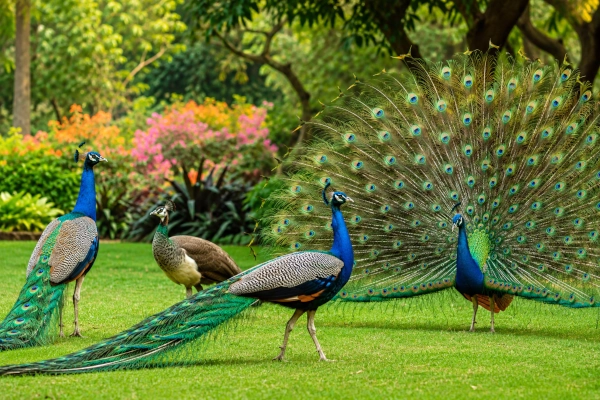
India has revived an unusual and decades-old diplomatic tradition by gifting five peacocks to the United Nations Office at Geneva, bringing the country’s national bird once again to the historic grounds of the Palais des Nations.
The gesture renews a little-known connection between India and the famous peacocks that have for decades roamed freely through Ariana Park, the sprawling green estate surrounding the UN’s European headquarters in Geneva.
Unlike conventional diplomatic gifts displayed inside conference halls or offices, India’s peacocks form part of the living landscape of one of the world’s most important centres of international diplomacy.
Peacocks Have Long Roamed the UN’s Geneva Headquarters
Visitors to the Palais des Nations frequently encounter peacocks wandering through its lawns, gardens and wooded areas.
The United Nations itself describes the sight of peacocks roaming freely and displaying their plumage as a familiar feature of Ariana Park. The organisation records that some of the birds originated from earlier gifts made by the Permanent Mission of India, while another significant group was donated by a Japanese zoo in 1997.
The earlier Indian contribution dates back several decades. The UN’s French-language account of Ariana Park states that peafowl were presented by India’s Permanent Mission during the 1980s.
The latest gift of five birds therefore represents not the creation of a new tradition, but the revival of an old one.
India’s National Bird in the Heart of International Geneva
The symbolism is particularly striking because the Indian peafowl, Pavo cristatus, is India’s national bird.
With its brilliant blue plumage and spectacular train of iridescent feathers, the male peafowl is one of the most recognisable birds associated with the Indian subcontinent.
Its presence at the Palais des Nations creates a subtle but enduring Indian cultural imprint within the headquarters of the United Nations in Geneva.
Unlike statues, paintings or ceremonial artefacts, the peacocks have become part of the everyday character of the UN estate.
They walk between buildings, occupy lawns used by diplomats and visitors, and have occasionally become subjects of UN photographs and social-media posts. The UN Office at Geneva has itself highlighted resident peacocks displaying their plumage outside the complex.
Ariana Park Provides an Unusual Home
The birds live within Ariana Park, the extensive grounds surrounding the Palais des Nations.
The estate covers roughly 46 hectares and overlooks Lake Geneva, with views towards the Alps and Mont Blanc. It originally belonged to the Revilliod de Rive family before Gustave Revilliod bequeathed the property to the City of Geneva. The site was subsequently made available first to the League of Nations and later to the United Nations.
Today the park combines diplomatic buildings with old villas, woodland, lawns and areas managed for biodiversity.
The peacocks are looked after by the gardeners responsible for maintaining the UN grounds.
Their ability to live relatively freely within the estate has made them one of the more unusual features of international Geneva.
A Living Link With India’s Earlier Diplomacy
India’s new donation also reconnects the present-day Permanent Mission with an initiative undertaken by Indian diplomats several decades earlier.
The Permanent Mission of India in Geneva represents the country before the United Nations and a range of international organisations headquartered there. India is currently represented at the UN in Geneva by Ambassador Arindam Bagchi, according to the UN’s diplomatic directory.
The peacock tradition is a softer dimension of India’s diplomatic presence.
India’s engagement at Geneva normally revolves around issues such as human rights, global health, trade, intellectual property, disarmament and multilateral negotiations. Yet cultural gestures can sometimes acquire an enduring visibility that formal diplomatic activities do not.
The earlier Indian peacocks became permanent residents of the UN estate and remained part of the institutional memory of the Palais des Nations long after the diplomats responsible for the original gesture had moved on.
Peacocks Have Become Part of Palais des Nations Culture
Over the years, the birds have developed something approaching celebrity status within the UN complex.
They can often be seen walking near diplomatic buildings or spreading their elaborate trains during the breeding season.
A UN-affiliated account of the birds notes that peacocks use the trees of Ariana Park for shelter and may sleep high in cedar trees overlooking Lake Geneva. Their relatively protected surroundings allow them to coexist with the unusual mixture of wildlife found within the international compound.
Their continued presence illustrates how the Palais des Nations is not merely a collection of conference halls and diplomatic offices but also a substantial historic landscape.
Ariana Park has itself received recognition for environmental management and biodiversity conservation.
A Small Gift With Strong Symbolism
The donation of five peacocks may be modest compared with the major political and diplomatic negotiations conducted every day in Geneva, but its symbolism is unusually powerful.
The national bird of India will once again become part of the living environment of one of the world’s foremost centres of multilateral diplomacy.
It connects contemporary India with an earlier generation of Indian diplomats, reinforces the country’s cultural presence at the United Nations and helps preserve one of the Palais des Nations’ most distinctive traditions.
For diplomats walking between negotiating rooms, tourists exploring the grounds and UN employees going about their daily work, the sight of India’s national bird displaying its magnificent plumage against the historic Palais provides a rare intersection of nature, culture and diplomacy.
And with India’s latest gift of five peacocks, a tradition that began decades ago is now being renewed for another generation.
You may also like
-
ICGS Shaunak Sails for Perth With Quad Officers Under At-Sea Observer Mission
-
Krishna’s Private Meeting With Karna: Back-Channel Diplomacy Before the Kurukshetra War
-
India Emerges in Black Sea Shipping Diplomacy as Ukraine Seeks Maritime Truce With Russia
-
Tiny 3.3-mm Parasitic Wasp Discovered in Assam Marks First Record of Its Genus in India
-
Drupada’s Priest at Hastinapura: The Mahabharata’s First Formal Diplomatic Attempt to Prevent the Kurukshetra War
