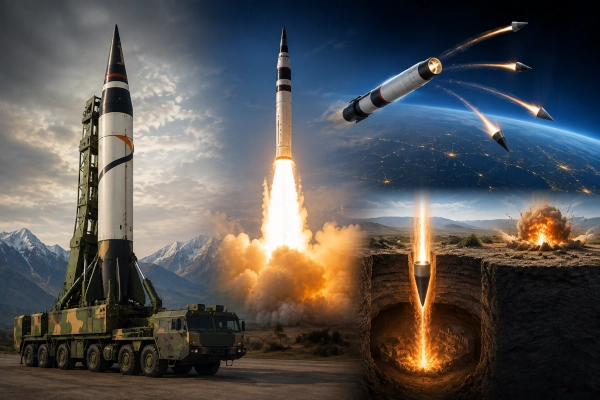
India’s Agni-5 was originally developed around a straightforward strategic requirement: give the country a survivable, road-mobile, long-range ballistic missile capable of maintaining credible nuclear deterrence against distant adversaries.
That objective has already been achieved.
But the more important story now emerging from India’s missile programme is that Agni-5 may no longer be viewed simply as a single missile carrying a single type of payload.
The combination of its three-stage solid-fuel propulsion system, substantial throw-weight potential, advanced navigation, sophisticated re-entry technology and mobile-launch architecture provides India with a technological base from which several specialised missile configurations could potentially be developed.
One such evolution is already a reality.
India has successfully demonstrated Multiple Independently Targetable Re-entry Vehicle — MIRV — technology aboard Agni-5.
Another possible branch is considerably more unusual.
Defence reports have claimed that DRDO has been studying conventionally armed derivatives of the Agni-5 architecture, including a massive deep-penetration weapon intended to destroy heavily protected underground installations and another heavy conventional configuration intended for surface targets.
Those conventional variants have not been officially confirmed by the Ministry of Defence or DRDO, and their reported specifications therefore need to be treated cautiously.
But taken together with the confirmed MIRV programme, they point towards an intriguing possibility:
Agni-5 could gradually evolve from one strategic missile into a family of long-range strike systems.
Agni-5: The Foundation
The baseline Agni-5 is an Indian-developed three-stage, solid-fuelled ballistic missile.
The Ministry of Defence officially states that the missile can strike targets at ranges of up to 5,000 kilometres with a very high degree of accuracy. India has consistently linked Agni-5 to its doctrine of credible minimum deterrence and its declared commitment to nuclear No First Use.
Solid propulsion gives the missile important operational advantages.
Unlike older liquid-fuel missiles requiring lengthy preparation, a solid-fuel ballistic missile can remain stored for long periods and be brought to launch readiness comparatively rapidly.
Agni-5 is also designed around mobile deployment rather than dependence upon vulnerable fixed launch installations.
India demonstrated the maturity of the operational missile again on August 20, 2025, when the Strategic Forces Command successfully test-fired Agni-5 from the Integrated Test Range at Chandipur. According to the Ministry of Defence, the launch validated the missile’s operational and technical parameters.
But while the propulsion system provides the missile’s range, another set of technologies determines what Agni-5 can become.
These include:
re-entry vehicles,
guidance systems,
payload integration,
thermal protection,
stage separation,
and increasingly,
the ability to deploy multiple payloads during a single mission.
That is where the transformation of the Agni-5 architecture becomes particularly important.
Derivative One: Agni-5 MIRV — Already a Reality
The most important confirmed derivative of Agni-5 emerged publicly on March 11, 2024.
Under Mission Divyastra, DRDO conducted the first successful flight test of an indigenously developed Agni-5 equipped with Multiple Independently Targetable Re-entry Vehicle technology.
Instead of carrying one re-entry vehicle towards one target, the MIRV configuration allows a single missile to deploy multiple re-entry vehicles that can be directed towards different targets.
Telemetry and radar stations tracked multiple re-entry vehicles during the test, and the government stated that Mission Divyastra achieved its designed parameters.
This fundamentally changes the military value of a ballistic missile.
A traditional missile follows the basic equation:
One missile → one payload → one target
A MIRV-equipped missile can potentially deliver:
One missile → multiple payloads → multiple independently selected targets
That substantially complicates an adversary’s missile-defence problem.
Instead of detecting and attempting to intercept one incoming warhead, defensive systems may have to deal with multiple re-entry vehicles originating from a single booster.
And the technology required to accomplish this is considerably more complex than merely placing several warheads inside a missile.
The missile must deploy multiple payloads accurately after the boost phase and ensure that each re-entry vehicle reaches its intended trajectory.
Mission Divyastra therefore represented one of the biggest technological advances in the history of India’s strategic missile programme.
The 2026 Advanced Agni Test
India demonstrated the capability again in May 2026, although with an interesting change in terminology.
On May 8, 2026, India conducted what the Ministry of Defence officially described as the successful flight trial of an “Advanced Agni missile” equipped with a MIRV system.
Multiple payloads were directed towards targets distributed across a large geographical area in the Indian Ocean Region.
Ground and ship-based tracking stations monitored the entire trajectory through to the impact of the individual payloads, and the government said all mission objectives were achieved.
The Ministry of Defence did not specifically identify this 2026 missile as Agni-5.
That distinction is important.
The March 2024 government announcement explicitly named Agni-5.
The May 2026 announcement instead used the broader term Advanced Agni missile.
It would therefore be premature to conclusively label the May 2026 configuration an “Agni-5 Mk II”, “Agni-6” or any other designation circulating outside official channels.
What the test unquestionably demonstrates, however, is that India is continuing to advance the technologies required for multiple independently targeted ballistic re-entry vehicles.
Agni is becoming an architecture rather than merely a succession of range categories.
Derivative Two: The Reported Agni-5 Conventional Bunker Buster
The most intriguing proposed Agni-5 derivative is very different from India’s nuclear deterrent.
Reports beginning in 2025 claimed that DRDO was examining a heavily modified Agni-5 configured around an enormous conventional deep-penetration warhead.
India Today reported a planned conventional payload of approximately 7,500 kilograms, with other defence reporting placing the figure around eight tonnes. Because of the dramatically heavier payload, the reported missile range would fall to roughly 2,500 kilometres.
The objective would not primarily be maximum range.
It would be maximum destructive effect against targets such as:
- deeply buried command centres,
- protected military headquarters,
- underground missile facilities,
- fortified storage complexes,
- hardened strategic infrastructure,
- and other underground installations.
Some reports have attributed an 80–100 metre underground penetration capability to the proposed weapon.
That number should be treated carefully.
DRDO has not publicly released a specification confirming either the claimed depth or the material through which such penetration would be achieved.
Penetrating 100 metres of soil is very different from penetrating 100 metres of reinforced concrete or rock.
The most responsible description therefore remains:
a reported Agni-5-derived heavy conventional penetrator whose detailed performance has not been officially confirmed.
Why Use Agni-5 for a Bunker Buster?
At first, using a strategic ballistic missile as the basis for a bunker-destruction weapon may appear excessive.
But there is an underlying engineering logic.
Destroying deeply buried facilities is one of the hardest conventional strike missions.
A penetrator requires a combination of:
mass,
structural strength,
high impact energy,
extreme accuracy,
and
a fuze capable of surviving impact before detonating inside or beneath the target.
Most extremely heavy bunker-busting weapons are delivered by aircraft.
The American GBU-57 Massive Ordnance Penetrator, for example, is carried by specialised strategic bombers.
A ballistic missile offers a completely different delivery mechanism.
Instead of sending a large aircraft through or around hostile air-defence systems, the penetrator could theoretically be launched from Indian territory and arrive at ballistic velocity.
The missile becomes the delivery aircraft.
And unlike a bomber, it does not have to survive the return journey.
Trading Range for Warhead Weight
The reported conventional Agni derivative illustrates one of the fundamental principles of ballistic-missile design.
A missile’s range is heavily influenced by the mass it has to accelerate.
Reduce the payload and the same general propulsion architecture can potentially reach farther.
Increase the payload significantly and range falls.
The reported Agni-5 conventional derivative appears to exploit this relationship deliberately.
Instead of using the missile’s energy to send a comparatively lighter strategic payload beyond 5,000 kilometres, it would reportedly carry a massive conventional payload approximately half that distance.
In simplified terms:
Strategic Agni-5
Lighter payload + very long range = strategic deterrence
Reported Conventional Agni-5
Very heavy payload + shorter range = immense conventional strike capability
That would represent a fundamental change in mission philosophy without necessarily discarding the mature propulsion technology already developed for Agni-5.
Derivative Three: A Heavy Conventional Airburst Agni
Defence reporting surrounding the bunker-buster programme has also referred to a second proposed conventional derivative.
Instead of penetrating underground structures, this configuration would reportedly use a large conventional warhead detonating above or near surface targets.
The precise configuration, explosive composition and intended target set remain unconfirmed.
Conceptually, however, the mission would differ greatly from the penetrator.
The bunker-buster concentrates energy into a relatively confined hardened target.
An airburst configuration attempts to create destructive effects across a much wider surface area.
Such a weapon could theoretically be designed against concentrations of military infrastructure or other large-area strategic targets.
But unlike the Agni-5 MIRV programme, no official DRDO or Ministry of Defence announcement currently confirms that such an Agni-5 conventional airburst missile has entered testing or service.
It should therefore remain classified as a reported development concept rather than an established Indian weapon.
One Booster Architecture, Several Possible Missions
If the conventional programmes eventually materialise, the Agni-5 family could present a remarkable spread of capabilities.
| Agni configuration | Principal role | Status |
|---|---|---|
| Baseline Agni-5 | Long-range strategic deterrence | Operational/tested |
| Agni-5 MIRV | Multiple independently targeted strategic payloads | Flight-tested and confirmed |
| Advanced Agni MIRV | More advanced multiple-payload strategic capability | Successfully tested May 2026; exact designation undisclosed |
| Heavy conventional penetrator | Deeply buried/hardened targets | Reported; not officially confirmed |
| Heavy conventional airburst variant | Large surface target complexes | Reported; not officially confirmed |
This is why the word “derivative” matters.
A derivative does not necessarily mean simply replacing one warhead with another.
Substantial modifications may be required to accommodate different payload masses, re-entry characteristics, centre-of-gravity changes, guidance requirements and terminal effects.
But a mature missile architecture allows propulsion, manufacturing knowledge, guidance technology, launch infrastructure and testing experience to be reused.
That can dramatically reduce the technological distance between concept and deployable system.
Agni-5 Is Becoming a Technology Platform
Perhaps the most important transformation is therefore conceptual.
India’s early Agni programme was largely described according to range:
Agni-I.
Agni-II.
Agni-III.
Agni-IV.
Agni-V.
But modern missile development increasingly depends on far more than simply increasing kilometres.
The decisive technologies are increasingly found in what happens after the booster has done its work.
Can the missile release multiple vehicles?
Can those vehicles pursue separate trajectories?
Can they survive increasingly sophisticated missile defences?
Can the same propulsion system deliver radically different payloads?
Can conventional missions be performed without relying upon aircraft?
Can re-entry vehicles achieve extremely high accuracy?
The Agni-5 programme is increasingly demonstrating that India possesses many of the underlying technologies needed to explore these questions.
MIRV Changes Deterrence — Conventional Agni Would Change Warfare
There is also an important doctrinal distinction between the two branches.
MIRV Agni-5 strengthens India’s nuclear deterrent.
A conventionally armed Agni derivative, if developed, would create an entirely different military capability.
India could potentially strike exceptionally hardened strategic targets over very long distances without crossing the nuclear threshold.
That is strategically significant.
For decades, the most powerful long-range ballistic missiles were overwhelmingly associated with nuclear weapons.
But technological changes are increasingly blurring the separation between strategic-range missiles and precision conventional strike systems.
A sufficiently accurate conventionally armed ballistic missile can potentially attack targets that once required either nuclear weapons or deep-penetrating bomber missions.
India possessing such a capability would therefore widen the conventional options available to military planners during an extreme conflict.
From Missile Range to Payload Flexibility
For many years, public discussion surrounding Agni-5 concentrated almost entirely on one number:
5,000 kilometres.
That is increasingly an incomplete way of understanding the missile.
The more important development is payload flexibility.
Mission Divyastra demonstrated that the Agni-5 architecture could support multiple independently targetable re-entry vehicles.
The May 2026 Advanced Agni trial demonstrated another multiple-payload configuration striking spatially separated targets over the Indian Ocean Region.
And although still unconfirmed officially, reports of heavy conventional Agni derivatives suggest that India’s missile designers may be exploring the opposite end of the payload spectrum — sacrificing range in exchange for an exceptionally large conventional warhead.
The progression could therefore be understood as:
Agni-5 → MIRV Agni-5 → Advanced Agni → specialised payload derivatives
rather than simply:
Agni-5 → longer-range Agni-6.
That is arguably the more important technological story.
An Indigenous Strategic Missile Ecosystem
The significance also extends beyond any individual missile.
India has had to develop indigenous capabilities in:
solid rocket motors,
high-temperature materials,
composite structures,
navigation systems,
inertial guidance,
re-entry physics,
terminal guidance,
missile electronics,
canisterisation,
mobile-launch systems,
warhead integration,
telemetry,
and range instrumentation.
Every improvement made in one Agni programme contributes knowledge that can influence future systems.
That accumulated technological base is what allows a missile originally developed for one strategic mission to become the foundation for increasingly sophisticated derivatives.
India is therefore no longer merely developing missiles.
It is developing an indigenous strategic missile technology ecosystem.
The Agni-5 Story Is No Longer About a Single Missile
Agni-5’s original achievement was giving India a credible indigenous long-range strategic deterrent.
Its next achievement may prove to be something broader.
The MIRV-equipped Agni-5 is already confirmed.
India’s Advanced Agni MIRV system has now been successfully flight-tested.
And reports indicate that researchers may also be examining whether the Agni-5 propulsion architecture can be adapted for extremely heavy conventional payloads, including specialised deep-penetration weapons.
The conventional programmes remain unconfirmed and should not yet be presented as operational Indian capabilities.
But technologically, the direction is significant.
The mature missile programmes of major powers rarely remain frozen in their original configuration. Boosters become platforms. Re-entry systems evolve. Payloads diversify. Guidance becomes more sophisticated. New missions emerge.
India appears to be entering that phase with Agni.
The next chapter of the programme may therefore not be defined simply by whether an Agni-6 eventually appears.
The more consequential development may be the creation of an entire family of Agni-derived weapons, each exploiting India’s accumulated expertise in propulsion, re-entry technology, guidance and strategic missile engineering for a different mission.
Agni-5 began as India’s long-range deterrent.
It may ultimately become the technological foundation for an entire generation of Indian strategic strike systems.
References
- Press Information Bureau — DRDO successfully conducts Mission Divyastra, first Agni-5 flight with MIRV technology — 11 March 2024
https://www.pib.gov.in/PressReleasePage.aspx?PRID=2013549 - Press Information Bureau — Successful test-firing of Agni-5 Intermediate Range Ballistic Missile — 20 August 2025
https://www.pib.gov.in/PressReleasePage.aspx?PRID=2158574 - Press Information Bureau — India conducts successful flight-trial of Advanced Agni missile with MIRV system — 8 May 2026
https://www.pib.gov.in/PressReleasePage.aspx?PRID=2259380 - India Today — India’s Agni-5 ‘bunker buster’ missile to carry largest conventional warhead — 30 June 2025
https://www.indiatoday.in/india/story/after-us-iran-strikes-india-accelerates-bunker-buster-missile-project-2748410-2025-06-30 - United Service Institution of India — Prospects of Agni-5 Bunker-Buster Missile
https://www.usiofindia.org/pdf/file_68affaaa90480%281%29sp.pdf
You may also like
-
India’s Economic Warfare Challenge: Strategic Autonomy, Energy Security and the Rise of a Global Power
-
India-US Trade Deal Stalemate: Why Washington’s Tariff Pressure Has Failed to Secure an Agreement
-
US Double Standards in Foreign Policy: 16 Recent Cases Involving India, Russia, China and Global Trade
-
India’s Arctic Energy Ambitions: Russian Oil, LNG and a New Sea Route to Indian Ports
-
Indian Navy Vice Chief Inspects Japan’s Mogami-Class Stealth Frigate as India-Japan Shipbuilding Cooperation Expands
