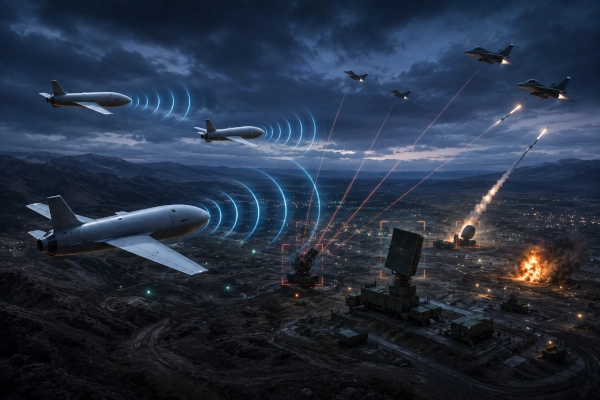
Before precision weapons struck Pakistani military targets during the final phase of Operation Sindoor, some of the first objects detected by Pakistani radars may not have been Indian fighter aircraft at all.
They were reportedly unmanned decoys—pilotless aircraft configured to resemble a larger and more threatening combat formation on radar.
Media reports citing Indian defence sources said the Indian Air Force deployed these “dummy aircraft” ahead of its strikes during the night of May 9–10, 2025. Their purpose was to convince Pakistani air-defence operators that Indian fighters were approaching, forcing surveillance radars and surface-to-air missile systems to switch into active combat modes.
Once the Pakistani radars began transmitting, their positions could be detected, classified and targeted by India’s electronic-intelligence, unmanned and long-range strike systems.
The episode, popularly described as the use of “ghost drones,” represented a form of aerial deception in which an inexpensive unmanned platform was reportedly made to appear far more valuable and dangerous than it actually was.
It also demonstrated an important principle of modern air warfare: destroying an enemy radar often begins by persuading it to reveal itself.
India Possesses Relevant Target-Drone Technology
The exact platform used during the reported deception mission remains undisclosed, but India operates target aircraft capable of carrying signature-enhancement systems.
DRDO’s Lakshya is a reusable, high-subsonic pilotless target aircraft developed for training air-defence crews and combat pilots. According to DRDO, it can tow targets equipped with radar, infrared or visual signature augmentation.
Such systems normally allow air-defence forces to practise against targets that resemble combat aircraft or missiles more closely than an ordinary small drone.
India has also employed QinetiQ’s Banshee Jet 80-series aerial targets during weapons testing. QinetiQ states that the Banshee can carry optional threat-representation payloads, including an active radar-enhancement system designed to provide a mobile radar source and simulate different attack scenarios.
These published capabilities prove that fighter-like radar enhancement is technically feasible and that relevant systems exist in or have been used by India.
They do not, by themselves, establish whether Lakshya, Banshee or another classified platform conducted the Operation Sindoor missions.
India could have employed an existing target drone, a modified unmanned aircraft, an expendable decoy or a specially configured system whose details remain classified.
Drawing the Enemy Radar Out of Hiding
Modern surface-to-air missile batteries face a constant dilemma.
A radar must transmit to search for targets, calculate their range and altitude, guide interceptors and coordinate engagements. But every transmission also creates an electronic beacon that can be detected by hostile sensors.
A well-trained air-defence unit may therefore keep its engagement radar switched off or operate it only briefly. It can receive initial warning from another sensor before activating its own fire-control radar at the last possible moment.
This practice—sometimes called emission control—makes the battery harder to locate and attack.
A convincing decoy changes the calculation.
When what appears to be an incoming fighter formation approaches a protected airbase, headquarters or missile site, the defender must decide whether to remain silent or activate its weapons. Waiting too long risks allowing the apparent attackers to launch their weapons. Activating early protects the target but exposes the radar.
The reported Indian decoys were intended to force exactly this decision.
According to reports citing defence sources, Pakistani radars interpreted the pilotless aircraft as approaching Indian fighters. This prompted elements of the air-defence network, including reported HQ-9 deployments, to become active and reveal previously concealed or relocated positions.
The unmanned aircraft did not need to survive. Their mission was accomplished once the enemy reacted.
From Deception to Suppression
The operation reportedly followed the logic of Suppression of Enemy Air Defences, commonly abbreviated as SEAD.
SEAD missions seek to degrade an opponent’s ability to detect and engage friendly aircraft. The objective may be achieved through electronic jamming, anti-radiation weapons, decoys, cyber operations, loitering munitions or attacks against radars, command centres and missile launchers.
A related mission, known as Destruction of Enemy Air Defences, attempts to physically eliminate the air-defence system rather than temporarily suppress it.
The reported Indian operation appears to have combined elements of both:
- Unmanned decoys created the appearance of an approaching air attack.
- Pakistani surveillance and engagement radars were compelled to transmit.
- Electronic-support systems detected and located those transmissions.
- The exposed network was disrupted or attacked.
- Long-range weapons could then approach their targets through a weakened and confused defensive picture.
India officially confirmed that enemy air-defence radars were attacked and that an air-defence system at Lahore was neutralised. It also confirmed the use of loitering munitions against high-value radar and missile targets.
The government has not released a complete weapon-by-weapon sequence, meaning claims about the precise number and type of missiles used against each target remain partly dependent on media reporting.
A Low-Cost Target Against an Expensive Missile
Decoys create an unfavourable economic exchange for the defender.
A target drone costs far less than a frontline fighter and may also be considerably cheaper than the interceptor missile fired against it. If an air-defence battery launches an expensive surface-to-air missile at a disposable drone, the attacker gains even when the decoy is destroyed.
The defender loses:
- An interceptor missile
- Radar operating time
- The secrecy of the battery’s position
- Information about its engagement procedures
- Part of its available magazine
- Confidence in the recognised air picture
A wave of decoys can also saturate command centres with multiple tracks. Operators must determine which targets are fighters, cruise missiles, drones, electronic ghosts or deliberate distractions.
This creates opportunities for real weapons to approach from another direction, at a different altitude or several minutes behind the decoy formation.
The most effective deception does not make the enemy completely blind. It gives the enemy a believable but incorrect picture.
Protecting Indian Pilots
The reported decoy operation also reduced the need to place manned aircraft directly inside heavily defended Pakistani airspace.
A conventional SEAD mission can be exceptionally dangerous. Fighter crews must approach hostile radars, identify their locations and attack before surface-to-air missiles or enemy fighters engage them.
Unmanned decoys can absorb much of this initial risk.
They can enter contested airspace, provoke a reaction and even be deliberately sacrificed without endangering a pilot or an expensive combat aircraft. Manned fighters can remain farther away while launching stand-off weapons supported by airborne surveillance, satellites and electronic-intelligence platforms.
This does not eliminate the danger to combat aviation, but it shifts the most hazardous part of the operation towards expendable machines.
Why Chinese-Supplied Systems Were Still Vulnerable
Pakistani air defences include Chinese-origin surveillance radars and surface-to-air missile systems. Modern systems such as the HQ-9 family are designed to track aircraft, missiles and other aerial threats over considerable distances.
Yet the quality of a missile does not remove the fundamental vulnerability of radar-based air defence.
The system must still detect, classify and prioritise targets. It must determine whether an approaching radar return represents a genuine fighter, a decoy or an unmanned weapon. During a compressed engagement window, commanders may have only seconds to make that decision.
Electronic counter-countermeasures can make a radar more resistant to jamming and deception, but no defensive network is completely immune to a carefully constructed operation combining decoys, electronic intelligence, multiple approach vectors and precision weapons.
The reported Indian tactic did not necessarily defeat the radar technologically in a direct contest. It reportedly defeated the decision-making process around the radar by creating a threat that commanders could not safely ignore.
More Than a Drone Operation
The success of such a mission depends on an integrated combat network.
A decoy alone can attract attention, but converting that reaction into a successful strike requires:
- Accurate intelligence about enemy deployments
- Mission planning and target prioritisation
- Electronic detection and geolocation
- Secure communication links
- Airborne and space-based surveillance
- Unmanned systems
- Long-range precision weapons
- Real-time command and control
The most significant lesson is therefore not that a small drone fooled a large radar.
It is that information gathered from the radar’s reaction could reportedly be passed through the Indian command network and converted into targeting data before the enemy could relocate or shut down.
That represents network-centric warfare: sensors, decoys, decision-makers and weapons functioning as parts of a single operational system.
The Psychological Effect of Ghost Targets
Military deception also produces effects that persist after the original operation.
Once air-defence operators learn that drones can resemble fighters, every future radar contact becomes more difficult to interpret.
A genuine fighter may be dismissed as a decoy.
A harmless decoy may trigger a costly missile launch.
A radar may remain silent to avoid detection and consequently fail to engage a real weapon.
Commanders may move batteries more frequently, divide their missile inventory or impose restrictive engagement procedures. Each response reduces the efficiency of the overall defensive network.
The uncertainty created by a successful decoy operation can therefore remain valuable long after the drones themselves have disappeared.
A Capability That Is Likely to Expand
Operation Sindoor demonstrated the growing importance of unmanned systems, electronic warfare and long-range precision attack in India’s military planning. Official statements have highlighted the effectiveness of UAVs, counter-UAS systems, integrated air defence and loitering munitions during the confrontation.
Future Indian decoys could incorporate more sophisticated radar-cross-section control, electronic attack payloads, autonomous formation flight and coordinated swarm behaviour.
Some may act only as false targets. Others could combine deception with surveillance, jamming or a terminal attack capability.
This would force an adversary to treat every approaching unmanned aircraft as a possible sensor, jammer, weapon or imitation fighter.
An Important Claim—With Operational Details Still Classified
The reported “ghost drone” mission is technically credible, consistent with established SEAD doctrine and supported by India’s known access to radar-signature augmentation technology.
Media reports citing defence sources provide a plausible account of how unmanned dummy aircraft were used to provoke Pakistani air-defence systems before precision strikes. Official Indian releases independently confirm that Pakistani radars and missile systems were attacked during Operation Sindoor.
What remains undisclosed is equally important.
India has not identified the decoy aircraft, revealed the electronic equipment carried aboard them or confirmed that they exactly reproduced the signature of any named Indian fighter.
The strongest defensible conclusion is therefore that India reportedly employed pilotless decoys configured to appear as fighter-sized threats on Pakistani radar, forcing air-defence systems to reveal themselves before being suppressed or attacked.
These aircraft may have carried no pilot and perhaps no explosive warhead. Yet by persuading the opponent to see an attack that was not there, they helped prepare the battlespace for the real weapons that followed.
In modern warfare, the most consequential aircraft on a radar screen may sometimes be the one that never truly existed.
References
- Press Information Bureau, Government of India. “Pakistan’s Bid to Escalate Negated—Proportionate Response by India.” Ministry of Defence, 8 May 2025.
https://www.pib.gov.in/PressReleasePage.aspx?PRID=2127670&lang=1 - Press Information Bureau, Government of India. “Operation Sindoor: India’s Precision Response and Integrated Air-Defence Operations.”
https://www.pib.gov.in/PressNoteDetails.aspx?ModuleId=3&NoteId=154455&lang=2®=48 - Hindustan Times. “How India Used Unmanned Dummy Aircraft to Fool Pakistan During Operation Sindoor.” 17 May 2025.
https://www.hindustantimes.com/india-news/how-india-used-unmanned-dummy-aircrafts-to-fool-pakistan-during-operation-sindoor-101747463017133.html - Defence Research and Development Organisation. “Pilotless Target Aircraft—Lakshya.” Ministry of Defence, Government of India.
https://drdo.gov.in/drdo/en/offerings/products/pilotless-target-aircraft-lakshya - QinetiQ Target Systems. “Active Radar Enhancement System.”
https://www.qinetiq.com/en/what-we-do/test-and-training/threat-representation/target-systems/other-products-and-services/active-radar-enhancement - The Times of India. “Operation Sindoor: How India Delivered a Devastating Blow to Pakistan’s Air Defence with Dummy Jets and BrahMos Missiles.” 15 May 2025.
https://timesofindia.indiatimes.com/india/operation-sindoor-how-india-delivered-devastating-blow-to-pakistans-air-defence-with-dummy-jets-brahmos-missiles/articleshow/121192203.cms
You may also like
-
DRDO Moves 30 kW Laser Weapon Towards Production, Industry Partner Selection Planned Within Six Months
-
IG Defence Validates KAL Long-Range Strike Drone’s Integrated Systems in Pokhran Trial
-
Vajra Air Defence Warriors Validate AKASHTEER Sensor-to-Shooter Network in Day-Night Firing Drills
-
INS Sahyadri and INS Kulish Reach Philippines for ADMM-Plus Maritime Cooperation
-
India’s Defence Production Hits Record ₹1.78 Lakh Crore as Private-Sector Share Rises to 24%
