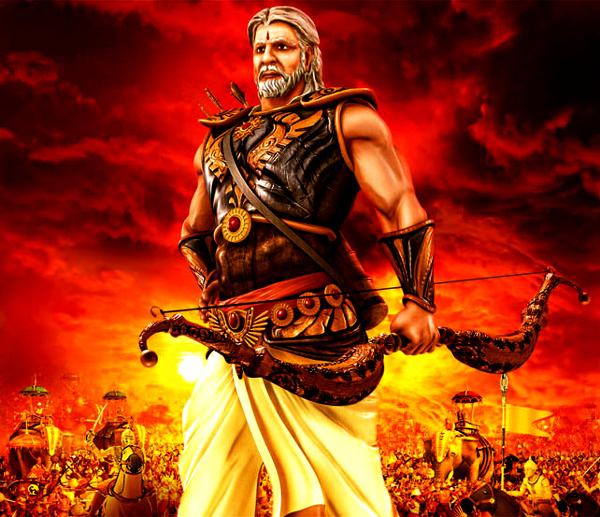
Long before the armies of the Kauravas and Pandavas gathered upon the field of Kurukshetra, before Bhishma lay upon his bed of arrows and watched the fate of the Kuru dynasty unfold, eight celestial beings committed a single act of desire that changed the history of Bharata forever.
They were the Eight Vasus, radiant deities associated with the fundamental powers of nature. They moved freely through heaven and earth, untouched by age, disease or sorrow. Their bodies shone with celestial light, and wherever they travelled, the air became fragrant and the sky seemed brighter.
Among them was Dyu, proud, powerful and greatly honoured by his brothers.
One day, the Vasus descended to the earthly realm accompanied by their wives. They wandered through forests where ancient trees rose like pillars supporting the heavens. Mountain streams flashed between moss-covered stones, deer moved fearlessly through the grass and the songs of unseen birds filled the green silence.
Their journey brought them near the hermitage of the great sage Vasistha.
The Hermitage of Vasistha
Vasistha’s ashrama stood beside a clear river beneath spreading trees. It was a place of profound peace. Sacred fires burned steadily before simple huts of leaves and wood. Disciples collected flowers, carried water and recited the Vedas beneath the shade.
Wild creatures lived there without fear.
Deer rested beside ascetics. Peacocks walked between the cottages. Birds descended to eat grains from the hands of young students. Even animals that were enemies elsewhere forgot their hostility within the sage’s peaceful domain.
The spiritual power of Vasistha protected the hermitage like an invisible wall.
Among its greatest wonders was the divine cow Nandini, daughter of the celestial cow Surabhi.
Nandini was white as the foam of the heavenly Ganga. Her eyes were calm and luminous, and her horns seemed touched by moonlight. Around her moved a gentle calf, never straying far from its mother.
Yet Nandini was far more than a beautiful animal.
Through her divine power, she could produce food, milk, clarified butter and every object required for sacrifice. At Vasistha’s wish, she could feed thousands of guests, provide riches beyond counting and even summon forces to defend the hermitage.
She was not merely the sage’s possession. She was part of the sacred life of the ashrama and an instrument through which he served gods, guests, disciples and all creatures seeking refuge.
As the Vasus passed nearby, the wife of Dyu saw Nandini grazing in a meadow.
She stopped at once.
The Desire for Nandini
Sunlight fell through the branches and rested upon Nandini’s back. The divine cow stood among flowering grasses while her calf moved beside her. A gentle radiance surrounded them both.
Dyu’s wife stared in amazement.
“Whose cow is this?” she asked. “Never in heaven or upon earth have I seen a creature of such beauty.”
Dyu looked towards the hermitage.
“She belongs to the sage Vasistha,” he replied. “She is Nandini, born from the celestial lineage of Surabhi. Her milk possesses extraordinary power. A mortal who drinks it may enjoy youth and vitality for thousands of years.”
At these words, desire entered his wife’s heart.
She remembered a dear mortal friend named Jitavati, the daughter of King Ushinara. Jitavati was virtuous and graceful, but like every human being, she was destined to grow old and die.
Dyu’s wife turned to her husband.
“Take this cow for me,” she said. “I shall give her milk to Jitavati. Let my friend remain young and beautiful for many years.”
Dyu’s expression changed.
“This is the cow of Vasistha,” he warned. “The wealth of a sage is protected by the power of his austerities. Taking it without permission would be a grave offence.”
But his wife continued to plead.
“You are a Vasu,” she said. “What difficulty can there be for you? We do not seek the cow for greed or trade. I ask for her only out of affection for a friend.”
Dyu hesitated.
He knew the act was wrong. He knew that Nandini had not been abandoned and that Vasistha depended upon her for sacred purposes. Yet he could not bear to disappoint his wife.
Desire disguised itself as compassion, and affection silenced wisdom.
At last, Dyu approached his seven brothers.
“My wife longs for Vasistha’s cow,” he told them. “Help me take Nandini and her calf before the sage returns.”
Some of the Vasus were uneasy.
They too understood Vasistha’s greatness. His anger was rare, but his spiritual power was immense. A curse pronounced by such a sage could pierce even the protection of heaven.
Yet loyalty to their brother overcame caution.
The Eight Vasus descended upon the meadow.
Nandini sensed them approaching. She lifted her head, and her large eyes watched the radiant beings in silence. Her calf pressed close against her side.
Dyu seized the divine cow.
The others surrounded her and used their celestial power to carry both mother and calf away from the hermitage.
Nandini struggled and cried out. Her call echoed through the trees, but Vasistha was absent, performing his duties beyond the ashrama.
Within moments, the Vasus vanished into the sky.
The meadow became still.
Only the crushed grass and the marks of Nandini’s hooves remained.
Vasistha Discovers the Theft
When Vasistha returned, the afternoon light had begun to fade.
The disciples came forward to greet him, but the sage immediately sensed that something was wrong. The familiar sound of Nandini’s bell was absent. Her calf did not run towards him. The meadow where she usually grazed stood empty.
Vasistha searched the hermitage.
“Nandini!” he called.
His voice travelled through the trees, but no answering cry came.
The sage stood silently beside the empty pasture. He saw the broken grass and the marks left by the struggle. His face remained calm, but sorrow entered his eyes.
Nandini had served him faithfully. Through her generosity, no visitor had ever left his hermitage hungry. She provided the offerings through which sacred rites were maintained. She was beloved by every disciple and animal in the ashrama.
Vasistha closed his eyes.
He did not need trackers or witnesses. Turning his vision inward, he entered meditation. The barriers of distance and concealment vanished before his spiritual sight.
He saw the Eight Vasus.
He saw Dyu’s wife admiring Nandini. He heard her request. He saw Dyu persuade his brothers, and he watched them carry away the cow and her calf.
When Vasistha opened his eyes, the stillness around him had changed.
The air grew heavy.
Birds ceased singing. The wind stopped moving through the trees. Even the sacred fire seemed to draw inward.
The sage’s anger was not the wild fury of an uncontrolled man. It was the terrible judgement of one who had seen dharma knowingly violated.
“You are gods,” Vasistha said, though the Vasus were far away. “You possess everything that heaven can offer, yet you have stolen the cow of a hermit. Because you acted like mortals ruled by desire, you shall become mortals.”
His voice carried through the worlds.
“I curse the Eight Vasus to be born upon earth as human beings!”
The words became law.
They crossed the sky, entered the celestial realms and struck the Vasus with the force of a thunderbolt.
Their radiance dimmed.
For the first time, the immortal brothers felt the shadow of human birth—the confinement of the body, the passage of time, the certainty of suffering and the approach of death.
The Vasus Beg for Mercy
The Vasus hurried back to the hermitage.
They no longer appeared proud. Their ornaments seemed dull, and their heads were lowered. Nandini and her calf were returned unharmed.
Falling before Vasistha, they begged forgiveness.
“Great sage,” they said, “we acted without wisdom. Desire blinded us, and loyalty to our brother drew us into sin. Forgive us. Do not condemn us to a long mortal existence.”
Vasistha looked upon them.
The power of his curse could not be withdrawn completely. Words spoken by a sage of perfect austerity could not simply be made false.
Yet his anger had begun to cool.
“You seven who followed Dyu shall be released quickly,” he declared. “Your human lives will last only a short time. Soon after birth, you will return to the celestial realms.”
Relief appeared upon the faces of seven Vasus.
Then Vasistha turned towards Dyu.
“You conceived the theft. You yielded to desire and persuaded your brothers to participate. Therefore, your punishment shall be greater.”
Dyu bowed his head.
“You shall remain upon earth for a long human life,” Vasistha continued. “You will become a man of unsurpassed courage, wisdom and righteousness. You will master every weapon and be honoured by kings. Yet you shall possess no kingdom of your own and leave no children to continue your line.”
Dyu trembled.
Immortality would be replaced by decades of human duty. He would know love but renounce marriage. He would possess the strength to rule but surrender the throne. He would watch generations rise and fall while remaining bound to a terrible promise.
The sage’s judgement was complete.
The Vasus departed, carrying the weight of their approaching births.
The Vasus Appeal to Ganga
The eight brothers now required a mother through whom they could enter the mortal world.
As they travelled, they came upon the goddess Ganga, radiant in human form. She moved like flowing moonlight, her garments shimmering like water beneath the sun.
The Vasus bowed before her.
“Divine Ganga,” they said, “the sage Vasistha has cursed us to be born as men. Become our mother upon earth.”
Ganga listened with compassion.
The Vasus explained that seven of them were permitted to return quickly to heaven, while Dyu would have to remain for a long mortal life.
“Give birth to us,” they pleaded, “and release the first seven from their human bodies immediately. Let them return to the celestial realms before earthly attachment binds them.”
Ganga’s expression became solemn.
“What of the eighth?” she asked.
“He must live,” they answered. “Let portions of our strength enter him so that he may become the greatest warrior of his age. But he shall have no children.”
Ganga agreed.
“I shall bear you as my sons,” she said. “The first seven will be freed soon after birth. The eighth will remain upon earth and fulfil the destiny created by Vasistha’s curse.”
Thus the path towards Bhishma’s birth was prepared.
Ganga Meets King Shantanu
Years later, King Shantanu of the Kuru dynasty came to the banks of the Ganga.
Evening had settled across the river. The water flowed gold beneath the setting sun, and white birds glided over its surface. A cool breeze carried the fragrance of wet earth and flowering reeds.
There, standing beside the sacred river, Shantanu saw a woman of incomparable beauty.
She was Ganga in human form.
Her eyes held the depth of ancient waters. Her movements possessed the grace of a river flowing between mountains. The king was captivated at once.
“Become my queen,” Shantanu said.
Ganga regarded him calmly.
“I shall marry you under one condition. You must never question anything I do. You must never speak harshly to me or attempt to prevent my actions. The moment you break this promise, I shall leave you.”
Blinded by love, Shantanu agreed.
They married, and for a time the king knew great happiness.
Then their first son was born.
The child was beautiful and radiant. Shantanu’s heart filled with joy. But before he could celebrate, Ganga took the newborn infant in her arms and walked towards the river.
The king followed at a distance.
Without hesitation, Ganga entered the water and placed the child beneath the current.
The river closed over him.
Shantanu stood frozen.
Horror and grief tore through him, but he remembered his promise. He could neither question nor stop her.
Ganga returned with a peaceful expression, as though nothing terrible had occurred.
The king remained silent.
He did not know that the child had been one of the cursed Vasus. The moment the river received him, his brief human existence ended and he returned to the celestial realm.
A second son was born.
Again Ganga carried the infant to the river.
Again she surrendered him to the water.
Shantanu’s anguish deepened, but he kept his word.
The same occurred with the third child, the fourth, the fifth, the sixth and the seventh.
Each infant disappeared beneath the sacred current. Each time, the king’s joy turned into unbearable grief. His palace, which should have echoed with the laughter of princes, remained silent.
Seven sons had been born.
Seven sons had vanished.
And seven Vasus had been freed from Vasistha’s curse.
The Eighth Child
When the eighth son was born, Ganga again walked towards the river.
Shantanu followed.
He had endured the loss of seven children in silence, but now his promise could no longer contain his grief. As Ganga stepped into the water with the infant in her arms, the king rushed forward.
“Stop!” he cried. “Who are you, cruel woman, that you destroy your own children? I will not allow you to kill this son!”
Ganga turned.
There was neither anger nor shame in her face.
“You have questioned me,” she said. “Your promise is broken, and therefore I must leave you. But this child shall live.”
Shantanu stared at her, overcome by grief and confusion.
Then Ganga revealed her divine identity and explained the curse of the Eight Vasus.
“The seven children I placed in the river were celestial beings,” she said. “By ending their human lives immediately, I freed them from Vasistha’s curse. This eighth child is Dyu, who led the theft of Nandini. He must remain upon earth for many years.”
The goddess looked down at the infant.
“He will become greater than any warrior. He will master the Vedas, the duties of kings and every form of celestial weaponry. His fame will endure as long as the rivers flow.”
Ganga then disappeared into the river, taking the child with her.
Shantanu was left alone upon the bank.
The Making of Devavrata
Ganga raised the child in hidden celestial regions.
He was named Devavrata.
Under Vasistha himself, he studied the Vedas, sacred law and the deepest principles of dharma. From Brihaspati and Shukra, he learned statecraft and political wisdom. From the greatest masters, including Parashurama, he acquired knowledge of weapons and warfare.
The child grew into a warrior of extraordinary power.
His arrows could darken the sky. His understanding of duty surpassed that of seasoned kings. His discipline was absolute, his speech measured and his devotion to truth unshakable.
When his education was complete, Ganga brought him to the riverbank where Shantanu stood.
The king saw a young warrior restraining the mighty current of the Ganga with a wall of arrows. The river rose against the barrier but could not pass.
Shantanu watched in amazement.
Then Ganga appeared.
“This is your son,” she told him. “He is Devavrata, born from the eighth Vasu. Take him to your kingdom. No prince upon earth will equal him.”
Shantanu embraced the son he believed lost.
Devavrata returned to Hastinapura and was declared heir to the Kuru throne. The people rejoiced, for they saw in him the perfect future king.
Yet Vasistha’s curse had not finished unfolding.
Years later, to secure his father’s happiness and remove every obstacle to Shantanu’s marriage with Satyavati, Devavrata renounced the throne. When doubts remained concerning the claims of his future children, he made an even more terrible promise.
Before the assembled kings and fishermen, Devavrata raised his hand.
“I shall never marry,” he declared. “I shall remain celibate for my entire life. I shall have no children, and I shall dedicate myself wholly to the throne of Hastinapura.”
The heavens trembled at the severity of the vow.
Gods and sages showered flowers from the sky and cried:
“Bhishma! Bhishma!”
The name meant the one who has taken a terrible vow.
Thus Devavrata became Bhishma.
The Consequence of a Single Desire
The theft of Nandini appeared at first to be a small act—one divine being yielding to his wife’s request, seven brothers assisting him and a celestial cow taken from a quiet hermitage.
Yet from that act emerged one of the central figures of the Mahabharata.
Because Dyu desired what belonged to another, he was born as Bhishma.
Because of Vasistha’s curse, Bhishma lived without wife or children.
Because of his vow, the succession of Hastinapura became uncertain.
From that uncertainty came rivalry, ambition and the chain of events that eventually led to the war of Kurukshetra.
Bhishma’s life remained marked by the ancient curse. He possessed the strength to conquer kingdoms but ruled none. He loved his family but watched it divide itself. He understood dharma more deeply than most men, yet duty bound him to a throne whose rulers often strayed from righteousness.
The celestial Vasu who had once taken another’s cow spent his human life renouncing everything for others.
He surrendered kingship.
He surrendered marriage.
He surrendered fatherhood.
At last, upon Kurukshetra, he even surrendered his body, lying upon a bed formed from the arrows of Arjuna while waiting for the chosen hour of his death.
The story of Nandini and the Eight Vasus therefore stands at the hidden beginning of the Mahabharata.
It teaches that no action is truly small when it violates dharma. A moment of desire can travel across generations, reshaping kingdoms and determining the destinies of heroes yet unborn.
And from the quiet hermitage of Vasistha, from the cry of a stolen cow and the curse of an angered sage, arose Bhishma—the mightiest guardian and most tragic elder of the Kuru dynasty.
You may also like
-
Indian Railways Announces 3,548 NTPC Graduate Vacancies, Applications Open Until November 6, 2026
-
Durga versus Mahishasura: Weapons, Battlefield Tactics and the Triumph of Shakti
-
National Institute of Naturopathy Opens Admissions for BNYS Programme at Pune for 2026–27
-
Yudhishthira’s Counter-Diplomacy With Shalya: Working With an Ally Who Has Joined the Other Side
-
Gnani AI Launches Nationwide Challenge Offering Up to 100 Paid AI Internships
