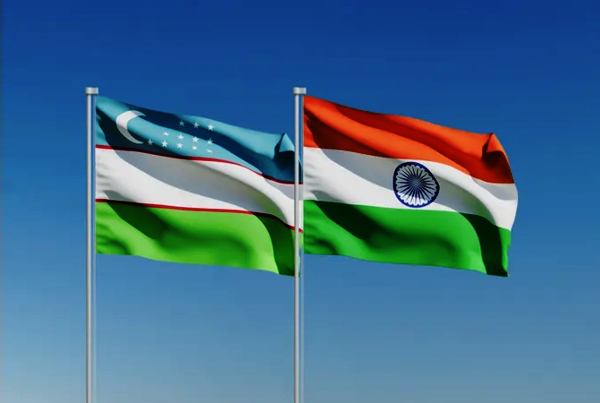
India has called for a major expansion of its economic partnership with Uzbekistan, with both countries being encouraged to jointly invest, manufacture and develop new technologies across sectors ranging from mining and textiles to healthcare, agriculture and digital infrastructure.
Addressing the India-Uzbekistan Business Forum in New Delhi on August 3, 2026, Union Minister of Commerce and Industry Piyush Goyal urged businesses from the two countries to work towards doubling bilateral trade over the next three years.
He said the strategic partnership between India and Uzbekistan was built on mutual trust, respect and a shared commitment to prosperity. However, the economic relationship had yet to achieve its full potential.
Bilateral trade has crossed approximately USD 1.5 billion, but the Minister observed that this represented only a small portion of the opportunities available to the two economies.
Businesses Asked to Co-invest and Co-manufacture
Goyal invited Indian and Uzbek enterprises to develop long-term partnerships based on co-investment, joint production and innovation.
India, he said, offers Uzbekistan access to a large and expanding consumer market, a skilled and youthful workforce and an ecosystem capable of supporting innovation-led growth.
Uzbekistan, meanwhile, offers Indian businesses opportunities in natural resources, manufacturing and regional markets.
The Minister said deeper business engagement could help companies in both countries achieve greater scale, strengthen supply-chain resilience and create employment.
He urged industry leaders to move beyond conventional trade and establish partnerships involving local manufacturing, technology sharing and participation in global value chains.
Investment Treaty Expected to Improve Confidence
The recently concluded Bilateral Investment Treaty between India and Uzbekistan is expected to provide greater confidence to investors and encourage companies to establish long-term operations in each other’s markets.
The agreement is intended to create a more predictable framework for investment while supporting the protection and promotion of legitimate business interests.
Goyal said the treaty could serve as a foundation for stronger commercial partnerships and greater movement of capital between the two countries.
Both governments are also working towards a more structured, time-bound and outcome-oriented economic partnership.
Mining Offers Major Scope for Indian Investment
Mining was identified as one of the sectors offering substantial opportunities for Indian companies in Uzbekistan.
Cooperation could include investment in mineral exploration, resource development, processing and value-added manufacturing.
Indian companies with experience in engineering, mining technologies and industrial processing could participate in projects that allow minerals to be converted into higher-value products rather than exported only as raw materials.
Such partnerships could support Uzbekistan’s industrial development while securing reliable material and manufacturing linkages for Indian businesses.
Cotton Strength Creates Textile Partnership Opportunities
Textiles represent another area where the two economies possess complementary strengths.
Uzbekistan is a major cotton-producing country, while India has a large and diversified textile industry covering spinning, weaving, garment manufacturing, design and exports.
Goyal said the two countries could move beyond raw cotton trade and work together in garment production, textile design and international marketing.
Joint manufacturing could combine Uzbek cotton resources with Indian technical capability, skilled manpower and established access to global markets.
This could help companies from both sides develop integrated textile value chains and produce finished garments for domestic and international customers.
India Offers Support for Healthcare Modernisation
The pharmaceutical and healthcare sectors were highlighted as important pillars of future cooperation.
India, widely recognised for its large pharmaceutical manufacturing capacity, can support Uzbekistan by supplying affordable medicines, diagnostics and medical equipment.
Potential areas of collaboration include:
- Pharmaceutical manufacturing and supply
- Medical devices and diagnostic technologies
- Telemedicine and digital healthcare
- Training for doctors, nurses and paramedical personnel
- Hospital and healthcare-management services
- Affordable treatment and specialised medical care
Indian healthcare institutions and companies could also participate in Uzbekistan’s efforts to modernise its medical infrastructure and improve the accessibility of quality services.
The Minister additionally proposed renewing cooperation in Ayurveda, Yoga and Unani. These traditional systems of medicine have historical cultural connections with the Central Asian region and could support wellness, education and medical tourism partnerships.
Agriculture and Food Processing Can Build Global Value Chains
Agriculture and food processing offer another major area for collaboration.
India and Uzbekistan can work together in food processing, packaging, cold-storage systems and agricultural technologies. Cooperation in these areas could reduce post-harvest losses, improve product quality and help farmers obtain better market access.
Joint investments could also create value chains linking production, storage, processing and exports.
The complementary agricultural strengths of the two countries could be used to supply both their domestic markets and international customers.
Cold-chain facilities and modern packaging systems would be particularly important for transporting fruits, vegetables and processed food products over long distances while maintaining quality.
Digital Public Infrastructure and Technology Cooperation
India expressed readiness to support Uzbekistan in developing Digital Public Infrastructure and expanding its digital economy.
Possible areas of partnership include financial technology, agricultural technology and medical technology.
Indian companies have experience in building population-scale digital platforms, online payment systems and technology-enabled public services. This experience could support Uzbekistan’s efforts to improve digital connectivity and service delivery.
Technology partnerships could also involve software development, cybersecurity, data systems, start-up cooperation and digital-skills training.
The Minister said digital collaboration should be designed to create practical solutions for citizens, businesses and public institutions.
Advanced Manufacturing and Automotive Cooperation
Engineering components, advanced manufacturing, automobiles and automotive parts were identified as promising sectors for future investment.
Indian manufacturers could explore opportunities to establish production facilities, component-supply networks and engineering partnerships in Uzbekistan.
Joint manufacturing could enable companies to serve the Uzbek market while also accessing markets in Central Asia and surrounding regions.
Uzbek companies could similarly use India as a manufacturing and innovation base for products intended for South Asian and global markets.
Such cooperation would help diversify bilateral trade beyond traditional commodities and create more technology-intensive economic ties.
Removing Barriers to Bilateral Commerce
Goyal emphasised that trade should become a leading force in the bilateral relationship.
He called for practical measures to reduce barriers and make cross-border commerce faster and less expensive.
These measures include the mutual recognition of standards, product approvals, testing procedures and certification systems.
Greater cooperation between regulators and standard-setting agencies could prevent companies from having to repeat the same compliance procedures in both countries.
The Minister also advocated closer integration of customs systems through digitalisation. Digitised documentation, information sharing and simplified customs procedures could reduce delays and improve the movement of goods.
More efficient transport and trade routes would also be necessary to support a significant increase in commercial activity.
Political Leadership Gives Momentum to Partnership
Goyal said Prime Minister Narendra Modi and Uzbekistan President Shavkat Mirziyoyev had brought new dynamism to bilateral relations and provided clear political direction for closer cooperation.
India and Uzbekistan share historical and cultural ties, but their modern relationship is increasingly focused on trade, investment, connectivity and technology.
The Minister said the full potential of the partnership could be realised only through active participation by businesses.
Private companies, investors and industry associations would need to convert political goodwill into manufacturing projects, commercial agreements and employment-generating investments.
Building an Enduring Economic Partnership
India’s call to double bilateral trade reflects an effort to transform the relationship from a limited exchange of goods into a broad economic partnership.
Mining and textiles provide opportunities based on natural resources and established industrial strengths. Healthcare and pharmaceuticals can address essential public needs, while agriculture and food processing can improve farmer incomes and export competitiveness.
Digital technologies, engineering and advanced manufacturing could provide the next generation of India-Uzbekistan commercial partnerships.
The success of this effort will depend on businesses identifying viable projects, governments removing regulatory obstacles and both countries improving connectivity and trade facilitation.
By combining India’s market size, manufacturing expertise and technology ecosystem with Uzbekistan’s resources and strategic position in Central Asia, the two countries can create a more resilient and mutually beneficial economic relationship.
Reference
Press Information Bureau, Government of India. “Shri Piyush Goyal Invites Indian and Uzbek Businesses to Co-invest and Co-manufacture; Calls for Doubling Bilateral Trade at India-Uzbekistan Business Forum.” Ministry of Commerce and Industry, published on 3 August 2026 at 2:11 PM, PIB Delhi.
You may also like
-
US Hosts 91% of Overseas Unicorns Built by Founders Who Grew Up in India, Prosus-Dealroom Report Finds
-
India Approves Pioxaniliprole, Indigenous Insecticide Molecule Developed by PI Industries
-
India Overtakes Hong Kong to Become Asia’s Fourth-Largest REIT Market
-
Banaras Langda Aam — Kashi’s Green-Skinned Summer Treasure and the Mango Heritage of the Gangetic Plain
-
ONGC Strikes Gas in Mahanadi Deepwater Basin Off Odisha Under Samudra Manthan Campaign
