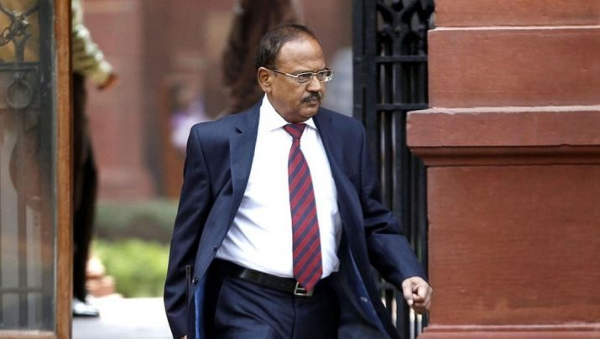
National Security Advisor Ajit Doval was presented with the Lokmanya Tilak National Award 2026 in Pune in recognition of his contribution to strengthening India’s national-security architecture and shaping the country’s strategic response to internal and external threats.
Union Home Minister Amit Shah presented the award during a ceremony held on August 1, coinciding with the 106th death anniversary of freedom fighter and nationalist leader Lokmanya Bal Gangadhar Tilak. The event was organised by the Lokmanya Tilak Smarak Trust at the Kataria High School ground in Mukundnagar.
Maharashtra Chief Minister Devendra Fadnavis, Deputy Chief Ministers Eknath Shinde and Sunetra Pawar, senior political leaders, members of the Trust and other dignitaries attended the programme.
Accepting the honour, Doval expressed gratitude to the organisers and said he received the award with humility because it carried the name of one of the foremost leaders of India’s freedom movement.
Addressing the younger generation, the NSA urged them to rise above personal ambitions and devote their abilities to the larger national interest. He said India currently possessed an important window of opportunity to emerge as a stronger and more influential nation, but the country’s progress would depend on the commitment, discipline and sense of responsibility demonstrated by its youth.
Doval also cautioned against interpreting freedom merely as the right to act without restraint. Genuine freedom, he indicated, must be accompanied by responsibility towards society and the nation. He called upon young Indians to make purposeful use of their education, energy and opportunities to contribute to India’s development and security.
Amit Shah Credits Doval with Transforming India’s Security Capabilities
Speaking after presenting the award, Amit Shah credited Doval with playing a pivotal role in the transformation of India’s defence and security capabilities over the past 12 years.
Shah said that the Narendra Modi government had strengthened both the defensive preparedness and offensive capabilities of the Armed Forces and that Doval had made a major contribution to this change.
He recalled that one of Prime Minister Narendra Modi’s earliest important appointments after assuming office in 2014 was the selection of Ajit Doval as National Security Advisor. According to Shah, Doval subsequently became closely involved in major decisions concerning national security and also contributed to the strengthening of India’s foreign-policy approach.
The Home Minister said Doval had provided strategic advice on crucial security matters and helped translate long-standing ideas concerning internal and external security into operational policy.
Shah added that when the history of the Modi government’s tenure was written, Doval’s contribution to India’s national-security architecture would occupy an important chapter.
Ajit Doval is India’s longest-serving National Security Advisor. Over the years, he has been associated with the shaping of India’s security strategy and the country’s response to terrorism, cross-border threats and emerging forms of warfare.
His tenure has coincided with major security operations and policy shifts, including the surgical strikes, the Balakot air strike and Operation Sindoor. However, much of the work carried out by intelligence and national-security officials cannot be publicly disclosed because of its sensitive nature.
Contribution to Intelligence Coordination
Shah also highlighted Doval’s long career in the Intelligence Bureau and his contribution to improving cooperation among India’s security and intelligence agencies.
He credited Doval with helping lay the foundation for the Multi-Agency Centre, an intelligence-sharing platform that enables different agencies to coordinate information concerning terrorism and internal-security threats.
The Home Minister recalled his own association with Doval during his tenure as Gujarat Home Minister. He said that then Gujarat Chief Minister Narendra Modi had introduced him to Doval following the serial bomb blasts in the state in 2008.
According to Shah, intelligence inputs and guidance provided by Doval assisted the Gujarat Police in investigating the attacks and also contributed to the resolution of several other bomb-blast cases across the country.
He said Doval had spent the years before 2014 studying and writing extensively about the measures required to improve India’s internal and external security. After his appointment as NSA, many of those strategic ideas were converted into government policy and operational action.
Tilak’s Nationalist Legacy Remembered
The ceremony also highlighted Lokmanya Bal Gangadhar Tilak’s contribution to India’s freedom struggle, political awakening and cultural nationalism.
Shah described Tilak as one of the principal architects of the national movement and said his ideas concerning self-rule, national pride and public mobilisation remained relevant to contemporary India.
He recalled Tilak’s famous declaration, “Swarajya is my birthright, and I shall have it,” saying that the slogan changed the direction of the freedom struggle by making Indians realise that self-government was a right rather than a concession granted by a colonial power.
Shah also referred to Tilak’s use of the public Ganesh festival as a means of bringing people together and connecting ordinary citizens with the freedom movement. By transforming religious and cultural gatherings into platforms for national awakening, Tilak helped expand political consciousness beyond elite circles.
The Home Minister urged young Indians to read Tilak’s writings, particularly Gita Rahasya, which interprets the Bhagavad Gita as a call to disciplined and purposeful action.
He said Tilak’s writings possessed enduring relevance and could continue to guide generations in matters of duty, courage, nationalism and public service.
Shah further stated that India was moving along the path of cultural nationalism envisioned by Tilak and that the nationalist awakening initiated during the freedom movement continued to influence the country’s nation-building journey.
Award Recognises Distinguished National Service
The Lokmanya Tilak National Award was instituted in 1983 by the Lokmanya Tilak Smarak Trust to recognise individuals who have made outstanding contributions to the country.
Veteran socialist leader S. M. Joshi was the first recipient. Over the years, the award has been presented to several prominent national figures, including former Presidents, Prime Ministers, public intellectuals and leaders from different fields.
Previous recipients include Atal Bihari Vajpayee, Manmohan Singh, Pranab Mukherjee and Narendra Modi. Union Minister Nitin Gadkari received the award in 2025.
By selecting Ajit Doval for the 2026 honour, the Trust recognised his long service in intelligence, internal security and strategic policymaking.
The ceremony brought together two connected themes: the continuing relevance of Lokmanya Tilak’s call for national duty and the modern challenges involved in protecting India’s sovereignty and security.
Doval’s message to the youth reflected this connection. He urged the younger generation to recognise that national progress requires more than individual success. It demands discipline, sacrifice and a willingness to place the country’s long-term interests above narrow personal gains.
You may also like
-
PRAHAAR: India’s First National Counter-Terrorism Policy and Strategy
-
Takshak Heavyweight Torpedo: How India’s Indigenous Submarine Weapon Compares With the World’s Leading Torpedoes
-
Embraer Builds Dual Aerospace Strategy in India Through C-390 Military and E175 Regional Aircraft Programmes
-
NextLeap Tests Indigenous Jet Engine for Long-Range Stryker Kamikaze UAV
-
Côte d’Ivoire Military Delegation Visits HAL, Shows Interest in India’s Indigenous Aerospace Platforms
