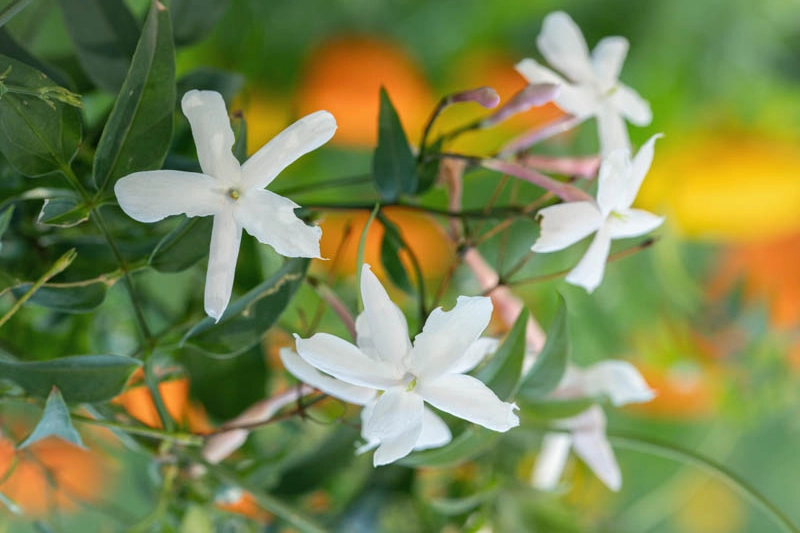
Jati, commonly known as jasmine or Chameli, is a fragrant flowering climber valued in Ayurveda for its action on the skin, wounds, oral cavity and sensory well-being. Its white blossoms are celebrated for their sweet perfume, while its leaves occupy a more prominent place in classical medicinal preparations.
The Ayurvedic Pharmacopoeia of India lists Jati leaf as Jasminum officinale L., belonging to the Oleaceae family. The National Medicinal Plants Board also records Jasminum officinale under the names Jati and Ban Chameli.
Botanical spelling: The accepted spelling is Jasminum officinale L. The spelling “Jasminum officianale” occasionally seen in secondary material is incorrect.
Botanical Identity
Sanskrit name: Jati
Common names: Jasmine, Common Jasmine, Poet’s Jasmine, True Jasmine
Hindi: Chameli, Ban Chameli
Botanical name: Jasminum officinale L.
Family: Oleaceae
Principal parts used: Leaves, flowers and, less commonly, roots
Jasminum officinale is an accepted botanical species in the genus Jasminum. It is generally seen as a woody climber or scrambling shrub bearing opposite, pinnately arranged leaves and clusters of intensely fragrant white flowers. The plant is cultivated widely in gardens, medicinal-plant collections and perfume-producing regions.
Identification of Jati in Ayurveda
Some modern Ayurvedic publications use the names Jasminum officinale, Jasminum officinale var. grandiflorum and Jasminum grandiflorum in discussions of Jati. However, the Ayurvedic Pharmacopoeia of India specifically lists Jati leaf under Jasminum officinale L. Correct botanical authentication is therefore important, particularly when preparing medicines intended for wounds, the oral cavity or internal administration.
Ayurvedic Properties of Jati
The commonly described Ayurvedic pharmacological profile of Jati is:
Rasa – taste: Tikta or bitter and Kashaya or astringent
Guna – qualities: Laghu or light, Snigdha or unctuous and Mridu or soft
Virya – potency: Ushna or heating
Vipaka – post-digestive effect: Katu or pungent
Dosha action: Traditionally described as Tridoshahara when appropriately used
Important karmas: Vranashodhana, Vranaropana, Kushthaghna, Kandughna, Krimighna and Mukharogahara
This combination helps explain the traditional preference for Jati in conditions involving excessive moisture, itching, microbial contamination, unhealthy wound surfaces and disorders of the mouth. Its bitter and astringent tastes are associated with cleansing and contracting actions, while its unctuous and soft qualities prevent its activity from becoming excessively drying.
Jati for Wounds and Ulcers
Jati is especially respected as a Vranaropana dravya, or a substance that supports the restoration of injured tissue. Its leaves are traditionally incorporated into medicated oils and ghee preparations intended for wounds, ulcers, inflammatory lesions and damaged skin.
Jati is also considered Vranashodhana, indicating its traditional role in cleansing unhealthy wounds before supporting tissue repair. Rather than being used indiscriminately as a raw household paste, it is generally more appropriate in properly prepared formulations such as Jatyadi Taila or Jatyadi Ghrita.
The Ayurvedic Formulary describes Jatyadi preparations containing Jati leaves along with ingredients such as neem, Patola, Daruharidra, Haridra, Sariva, Manjistha, Yashtimadhu, Karanja and beeswax. These combinations are designed to unite cleansing, soothing, antimicrobial and tissue-supporting actions.
Oral and Dental Health
The tender leaves of Jati have traditionally been associated with the management of:
- Mouth ulcers and stomatitis
- Inflamed or weak gums
- Gingivitis
- Unpleasant oral secretions
- Local discomfort associated with dental caries
Its Tikta and Kashaya rasa give the leaves a cleansing and astringent character. Traditional practice includes the use of properly prepared leaf decoctions as a mouth rinse and the incorporation of Jati into oral gels or medicated formulations.
Modern studies on different Jati botanical materials have begun examining this traditional application. A small pilot clinical trial involving Jasminum grandiflorum oral gel reported encouraging results when it was added to standard care for radiation-induced oral mucositis. Since that study used a related jasmine species rather than authenticated Jasminum officinale, its results should not automatically be transferred to every Jati preparation.
Skin Health and Itching
Jati is traditionally classified as Kushthaghna and Kandughna—supportive in skin disorders and itching. The leaves may be included in classical oils, ghee preparations, washes and external applications for:
- Irritated or itchy skin
- Chronic ulcers
- Minor inflammatory lesions
- Cracked or damaged skin
- Localised fungal or microbial skin complaints
- Unhealthy wound margins
These applications arise from classical Ayurvedic usage rather than conclusive clinical evidence. Broken skin, infected wounds, diabetic ulcers and deep burns require professional examination before herbal substances are applied.
The Fragrant Flowers of Jati
While the leaves are particularly important medicinally, Jati flowers possess a distinct aromatic and cultural role. Their fragrance is traditionally regarded as pleasant to the mind and senses. Fresh blossoms have been used in garlands, hair adornments, temple offerings, perfumery, aromatic oils and delicately scented foods.
The flowers contain volatile aromatic substances responsible for their characteristic perfume. Research across the Jasminum genus has identified compounds belonging to groups such as volatile terpenes, aromatic compounds, flavonoids, phenols and iridoid glycosides. Laboratory studies have reported antioxidant and antimicrobial activity in several jasmine species, although much of this evidence remains preclinical.
Jati in Sugandhit Ksheera – Aroma-Infused Milk
An interesting culinary use of Jati appears in Sugandhit Ksheera, or aroma-infused milk, described as recipe 14.6 in Pakadarpanam.
The recipe uses Mahishi Ksheera—buffalo milk—as its principal ingredient, with fragrant and nourishing substances added in suitable quantities. These include:
Ketaki flower, honey, ginger, sugar, banana, clarified butter, mango, Jati flower, pomegranate flower, Punnaga flower, rice and dates.
Jati is included in the form of its flowers and marked Q.S.—quantity sufficient. Its principal contribution is the imparting of a refined floral aroma to the milk preparation. The combination of milk, ghee, fruits, rice, dates, honey and fragrant blossoms transforms ordinary milk into an elaborate aromatic and nourishing preparation.
Only correctly identified, fresh, food-grade and pesticide-free jasmine flowers should be used in culinary preparations. Commercial jasmine perfume, synthetic fragrance and concentrated essential oil must never be substituted for edible flowers. The complete preparation method should be followed from the original Pakadarpanam passage, as the supplied ingredient table alone does not contain all procedural instructions.
Important Ayurvedic Formulations Containing Jati
Jati leaves occur in several traditional compound preparations. The best-known include:
Jatyadi Taila: A medicated oil traditionally used externally for wounds, ulcers, cracks and damaged skin.
Jatyadi Ghrita: A medicated ghee preparation used under professional supervision for wound-related and inflammatory conditions.
Malatyadi Taila: A classical hair and scalp oil in which jasmine-related materials may be included with other herbs.
The exact composition can vary according to the classical text and authorised formulary followed. Consequently, medicines bearing similar names should not be assumed to contain identical ingredients.
Modern Scientific Perspective
Research involving Jasminum officinale and related jasmine species has reported the presence of flavonoids, tannins, phenolic compounds, alkaloids, saponins, sterols and aromatic constituents. These chemical groups may contribute to the antioxidant, antimicrobial, anti-inflammatory and tissue-protective activity observed in laboratory investigations.
However, evidence from cell and animal studies cannot by itself establish clinical effectiveness in human disease. The medicinal potential of Jati remains promising, particularly in wound care, oral health and topical formulations, but authenticated plant material, standardised preparations and larger human trials are still required.
Cultivation and Collection
Jati grows well in warm climates with adequate sunlight, fertile soil and good drainage. Since it is a climbing or scrambling plant, it benefits from a trellis, fence or other support. Regular pruning encourages branching and flowering.
Flowers intended for food or traditional preparations should be collected when fresh and fully aromatic. Leaves intended for medicine must be healthy, clean and free from fungal spots, pesticide residue and roadside pollution. Botanical authentication is particularly important because several jasmine species are cultivated under similar regional names.
Safety and Precautions
Jati should not be treated as an unrestricted substitute for professional medical care.
Concentrated jasmine essential oil should not be swallowed or added directly to food. External oils should be patch-tested before wider application, particularly on sensitive skin. Homemade preparations should not be placed in the eyes, deep wounds or infected ulcers. Internal medicinal use during pregnancy, breastfeeding, childhood or alongside long-term medication should occur only under the direction of a qualified Ayurvedic physician.
Conclusion
Jati represents the union of fragrance, nourishment and healing within the Ayurvedic tradition. Its leaves are particularly associated with wound cleansing, tissue repair, oral care, itching and skin disorders, while its flowers enrich food, perfumery and sensory therapies with their unmistakable aroma.
Its inclusion in Sugandhit Ksheera demonstrates that Ayurveda did not view fragrance merely as decoration. Aroma was also employed to improve the appeal, experience and refinement of nourishing preparations. Used with correct botanical identification and appropriate professional guidance, Jasminum officinale remains one of Ayurveda’s most graceful and versatile fragrant plants.
References
- Government of India. The Ayurvedic Pharmacopoeia of India, Part I, Volume III. Monograph: Jati Leaf — Jasminum officinale Linn., pp. 71–72.
- National Medicinal Plants Board, Ministry of AYUSH, Government of India. Medicinal Plants Marketing and Trade Database: Jasminum officinale — Jati/Ban Chameli.
- Kew Science. Medicinal Plant Names Services and Plants of the World Online: Jasminum officinale L., Family Oleaceae.
- Pakadarpanam. Recipe 14.6: Sugandhit Ksheera—Aroma-Infused Milk, 10/11–21, pp. 109–110.
- Balkrishna A, Rohela A, Kumar A, et al. Mechanistic Insight into Antimicrobial and Antioxidant Potential of Jasminum Species: A Herbal Approach for Disease Management. Plants. 2021;10(6):1089. DOI: 10.3390/plants10061089.
- Mehatre D. Pharmacognostical and Preliminary Phytochemical Evaluation of Jati Patra. International Journal of Ayurvedic Medicine. 2013;4(4). DOI: 10.47552/ijam.v4i4.352.
- Anuja AR, et al. Jasminum grandiflorum Oral Gel as an Add-on to Standard Care in Radiation-Induced Grade 2 Oral Mucositis: An Open-Label Pilot Clinical Trial. Journal of Ayurveda and Integrative Medicine. 2024;15(4):100925. DOI: 10.1016/j.jaim.2024.100925.
Ayurvedic health disclaimer: This article presents traditional Ayurvedic knowledge for educational purposes. It does not provide a diagnosis or replace treatment from a qualified Ayurvedic physician or registered medical practitioner.
You may also like
-
Robotics, AI and Nanoscience Set to Transform Precision Medicine in India
-
Why Ayurveda Recommends Eating Only When Hungry
-
Ayurveda on Eating at the Right Time: How Food Timing Supports Balance and Health
-
Ayurveda and Late-Night Living: What Irregular Sleep Does to the Body
-
India’s Ayush Services Economy Reaches $36.92 Billion, RIS Study Projects Strong Growth to 2047
:%20The%20Fragrant%20Jasmine%20of%20Ayurveda)