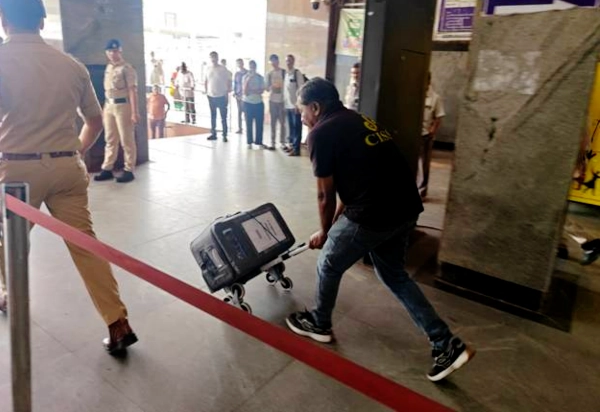
Indian Railways has transported a donor heart by train for the first time in India, using the Mumbai Central–Gandhinagar Capital Vande Bharat Express to move the life-saving organ from Surat to Ahmedabad.
The heart was carried aboard Train No. 20901 and delivered for transplantation at the U.N. Mehta Institute of Cardiology and Research Centre in Ahmedabad. The operation was completed through close coordination among railway authorities, the Railway Protection Force, Gujarat Police and medical teams.
The mission marked an important expansion of Indian Railways’ role beyond passenger and freight services, demonstrating how modern rail connectivity can support emergency healthcare and time-sensitive organ transplantation.
A Race Against Time
Donor organs must be transported within a limited viability period, making speed, punctuality and precise coordination essential.
Every stage of the journey was planned in advance, from the handover of the organ in Surat to its arrival at Ahmedabad Railway Station and onward movement to the transplant hospital. Railway officials, security personnel and medical coordinators synchronised their responsibilities to prevent delays.
The Vande Bharat Express was selected because of its high-speed connectivity, reliable operations and scheduled travel time between the two Gujarat cities.
The successful transfer showed that fast intercity trains can serve as an additional transport option for organs when suitable routes, timings and medical arrangements are available.
Green Corridor Created in Ahmedabad
After the train reached Ahmedabad, the Railway Protection Force and Gujarat State Police created a dedicated green corridor from Platform No. 1 of Ahmedabad Railway Station to the U.N. Mehta Institute of Cardiology and Research Centre.
The corridor enabled the medical team carrying the donor heart to travel without interruption through city traffic. This ensured that the organ reached the hospital quickly and that preparations for transplantation could proceed without delay.
Green corridors are designed to provide priority movement to ambulances and medical vehicles carrying organs. Their success depends on coordinated traffic management, route clearance and continuous communication between police and healthcare teams.
Railways’ Growing Healthcare Role
Ahmedabad Divisional Railway Manager Ved Prakash described the mission as a moment of pride for Indian Railways.
He said the successful operation demonstrated the Railways’ commitment to serving society beyond its conventional transportation responsibilities. He also acknowledged the contribution of railway personnel, security agencies and medical teams who worked together to complete the transfer within the required time.
The operation illustrates how India’s expanding high-speed and semi-high-speed rail network can support critical public services. Railways may be particularly useful for organ transport between cities that are well connected by frequent and punctual trains.
In some situations, rail transport can provide a dependable alternative to road travel, especially when highways are congested or when railway stations are located close to donor and recipient hospitals.
Vande Bharat’s Operational Reliability
Vande Bharat trains are designed for faster intercity travel, improved acceleration and reduced journey times. Their operational reliability and priority scheduling can make them suitable for carefully planned emergency movements.
For organ transportation, however, the train journey is only one part of a larger logistical chain. The process also requires rapid hospital-to-station transfers, secure handling, temperature-controlled storage and immediate onward movement after arrival.
The Surat–Ahmedabad mission succeeded because each of these elements was coordinated as part of a single operation.
Cooperation Across Multiple Agencies
Indian Railways credited the Railway Protection Force, Gujarat State Police, doctors, organ-transplant coordinators and railway officials for the success of the mission.
Security personnel ensured clear movement within stations and along the road corridor, while medical teams remained responsible for preserving and monitoring the organ during transit.
The operation demonstrated how coordination among public institutions can turn existing transport infrastructure into a life-saving resource.
A New Possibility for Organ Transport
India has previously used ambulances, aircraft and green corridors to transport donated organs over long distances. The use of a scheduled passenger train introduces another option for selected intercity routes.
Rail transport may be especially valuable where cities are connected by fast trains with predictable arrival times. Future organ-transfer missions could benefit from standard operating procedures covering priority boarding, secure storage, station access and coordination with local police.
The successful movement of the donor heart from Surat to Ahmedabad therefore represents more than a transport milestone. It shows how India’s railway network can contribute directly to emergency medicine, organ transplantation and humanitarian service when every minute matters.
Source: PIB
You may also like
-
Robotics, AI and Nanoscience Set to Transform Precision Medicine in India
-
Why Ayurveda Recommends Eating Only When Hungry
-
Ayurveda on Eating at the Right Time: How Food Timing Supports Balance and Health
-
Ayurveda and Late-Night Living: What Irregular Sleep Does to the Body
-
India’s Ayush Services Economy Reaches $36.92 Billion, RIS Study Projects Strong Growth to 2047
