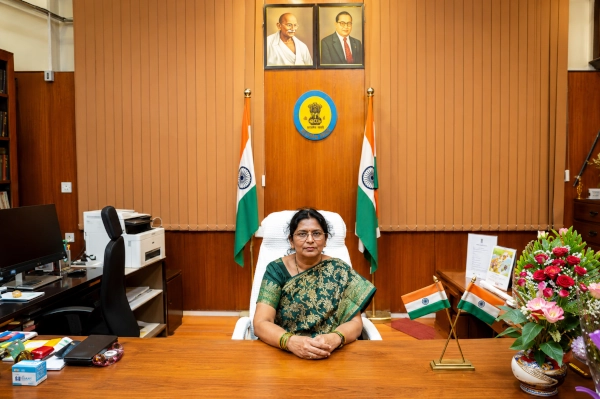
Varsha Ashok Aglawe has taken charge as the 54th Director General of the Geological Survey of India, becoming the first woman to head the organisation in its 176-year history.
She assumed office on July 31, 2026, succeeding Asit Saha, who served as Director General from July 27, 2024, until the end of July 2026. Her appointment marks a significant milestone for one of India’s oldest scientific institutions and reflects the growing leadership role of women in the country’s geoscience sector.
More Than Three Decades in Geoscience
Aglawe brings over three decades of scientific, administrative and field experience to the position. She joined the Geological Survey of India in 1992 after initially serving with the Indian Bureau of Mines.
During her career, she worked across GSI’s Central, Northern and Eastern Regions, as well as at its Central Headquarters. She held several senior scientific and administrative responsibilities involving regional programmes, laboratory development, research coordination and institutional management.
Before her appointment as Director General, she served as Additional Director General and Head of Department of GSI’s Eastern Region in Kolkata.
Specialist in Palaeontology and Palynology
Aglawe is a specialist in palaeontology and palynology, the study of fossils and microscopic organic remains such as pollen and spores.
Her scientific work has focused on Late Cretaceous–Palaeocene sedimentary formations, the Cretaceous–Palaeogene boundary and the Satpura-Gondwana basins. These areas are important for understanding India’s geological evolution, ancient ecosystems and major changes in life on Earth.
One of her notable contributions was the identification of the Salbardi–Ghorpend area as a new dinosaur nesting site in Central India. The discovery added to scientific knowledge about dinosaur distribution and reproductive activity in the Indian subcontinent.
She also participated in international collaborative research, including palaeontological studies conducted with the University of Michigan Museum of Paleontology in the United States.
Aglawe represented the Geological Survey of India as part of the Indian delegation to the Prospectors and Developers Association of Canada convention held in Toronto in 2023.
Strengthening Scientific Infrastructure
Alongside her research work, Aglawe played an important role in improving GSI’s institutional and laboratory capabilities.
She was associated with the establishment of an advanced palynology laboratory at GSI’s Northern Region office in Lucknow. Such facilities support the analysis of microfossils and sedimentary formations and are valuable for geological mapping, mineral exploration and the reconstruction of ancient environments.
She has also led multidisciplinary geoscientific programmes involving teams working in different regions and specialised fields.
Her experience in both scientific research and institutional administration is expected to support GSI as it expands the use of modern exploration technologies and addresses emerging national resource priorities.
Focus on Critical Minerals and Mineral Security
After assuming charge, Aglawe said GSI’s programmes would remain aligned with the Government of India’s priorities in critical mineral exploration and mineral security.
Critical minerals are essential for industries including renewable energy, electric mobility, electronics, telecommunications, aerospace and defence. Rising demand for these resources has increased the strategic importance of domestic exploration and reliable supply chains.
Aglawe emphasised the need to accelerate the identification of deep-seated and concealed mineral deposits. Such deposits are often located beneath soil, rock cover or younger geological formations and may not be visible through conventional surface surveys.
She called for greater use of advanced geophysical investigations, faster exploration programmes and stronger laboratory infrastructure to improve the discovery and assessment of mineral resources.
Expanding Offshore Exploration
The new Director General also highlighted offshore mineral exploration as an important area for future growth.
India’s vast maritime zone may contain mineral deposits with potential economic and strategic value. Systematic geological and geophysical surveys of offshore regions can improve knowledge of seabed resources and support long-term mineral planning.
Expanding this work will require specialised survey vessels, marine geoscience expertise, advanced sensors and detailed environmental assessment.
Natural Hazards, Glaciology and Public-Good Geoscience
Aglawe stressed that GSI’s responsibilities extend beyond mineral exploration. The organisation also carries out public-good geoscientific programmes that support disaster preparedness, infrastructure planning and environmental management.
These include studies of landslides, earthquakes, glaciers and other geological hazards. In the Himalayan region, glaciological research is particularly important for understanding glacier behaviour, water resources and the risks associated with glacial lakes.
Strengthening these programmes can provide valuable scientific inputs to governments, planners, engineers and disaster-management agencies.
Building the Next Generation of Geoscientists
Aglawe also identified scientific publication, training and capacity building as priorities.
She underlined the importance of encouraging young geoscientists to develop expertise in emerging technologies and advanced exploration methods. Modern geoscience increasingly relies on remote sensing, geophysical imaging, geochemical analysis, data modelling and digital mapping.
Greater investment in training and research can help GSI strengthen its scientific workforce while improving the quality and speed of geological investigations.
A Historic Leadership Milestone
Aglawe expressed confidence that GSI’s scientific expertise and expanding technological capabilities would enable the organisation to meet India’s growing demand for critical and strategic minerals.
Her appointment comes at a time when mineral security, sustainable resource development and advanced geoscientific research have become increasingly important to India’s economic and technological ambitions.
As the first woman to lead the Geological Survey of India, Varsha Ashok Aglawe assumes charge with a mandate that combines mineral exploration, public-interestPIB science, institutional modernisation and the development of future geoscientific talent.
Source: PIB
You may also like
-
IIT Hyderabad Develops Lung-Derived Bioink for 3D Bioprinting and Regenerative Medicine
-
Indian Scientists Discover Molecular Switch That Can Regulate Cellular Autophagy
-
Scientists Map Earliest Glow of Hydrogen, Opening A New Window to the Universe
-
Indian Researchers Study RAD51 DNA-Repair Gene Variant in Prostate Cancer
-
TDB Backs Multi Nano Sense With ₹37.51 Crore to Build Indigenous Multi-Gas Sensor Platform
