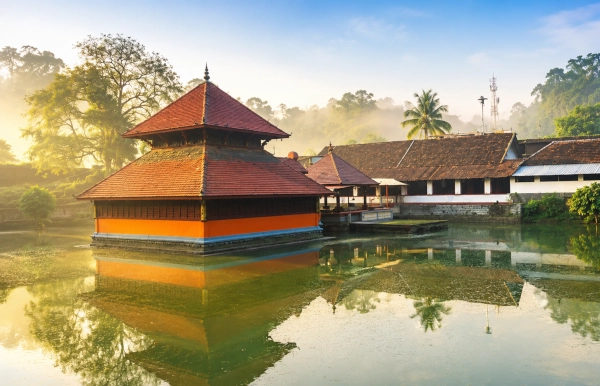
Ananthapura Lake Temple, situated near Kumbla in Kasaragod district, is one of Kerala’s most unusual and visually memorable places of worship. The principal shrine rises from the centre of a rectangular spring-fed lake, reached through a narrow covered bridge from the eastern bank. Official tourism sources describe it as Kerala’s only lake temple and identify it as the moolasthanam, or original sacred seat, of Lord Ananthapadmanabha worshipped at the Sree Padmanabhaswamy Temple in Thiruvananthapuram.
The temple stands in Ananthapura village, around five to six kilometres south-east of Kumbla, within the culturally diverse northern region where Kerala and Tulu traditions meet. Unlike many Kerala temples surrounded by dense groves or settlement streets, Ananthapura occupies a rocky laterite landscape, with the still water around its sanctum creating the impression of a shrine separated from the ordinary world.
Lord Ananthapadmanabha in a Seated Form
The presiding deity is Mahavishnu as Ananthapadmanabha, seated upon the serpent king Anantha or Adishesha. Bhudevi, representing the Earth, and Mahalakshmi or Sreedevi, representing prosperity and divine grace, accompany him. This seated representation differs from the reclining Ananthashayana form most famously associated with the Sree Padmanabhaswamy Temple in Thiruvananthapuram.
Garuda and Hanuman are represented before the principal deity in attitudes of devotion. The composition presents Vishnu as the sovereign of a sacred aquatic realm, with the surrounding lake reinforcing the association between Narayana, cosmic waters and the endless serpent Anantha.
The temple’s traditional image is formed through Kadu Sarkara Yogam, a specialised Kerala method that uses medicinal and natural materials layered over an internal framework. The Kerala Archaeology Department records that the Ananthapadmanabha image was reinstalled using this traditional technique, while the temple’s own account describes an elaborate preparation involving plant gums, coconut fibre, powdered minerals, conch and silk.
The Legend of Vilwamangalam and the Divine Child
Ananthapura’s most important sacred legend centres on the sage Divakara Muni, also identified in local traditions with Vilwamangalam Swamiyar. The sage is believed to have performed worship and austerities in the area when Lord Narayana appeared before him as a radiant young child.
The child agreed to remain with the sage on the condition that he would never be treated with anger or humiliation. For a time they lived together peacefully, but the boy’s playful behaviour eventually tested the sage’s patience. When Vilwamangalam reacted harshly, the child declared that the sage could find him again only at Ananthankat—the forest of the serpent Anantha—and disappeared through a nearby cave.
Realising that the child was Lord Vishnu, the remorseful sage followed the path southwards. Temple tradition relates that he eventually witnessed the child merge into an enormous illippa tree, which fell and assumed the vast reclining form of Vishnu upon Anantha. That later manifestation is associated with the foundation of the Padmanabhaswamy shrine in Thiruvananthapuram, while Ananthapura is remembered as the place where the divine encounter began.
A cave on the northern side of the lake remains connected with this narrative. The Kerala Archaeology Department records its traditional association with Vilwamangalam, while Kerala Tourism notes a small perennial water-filled pit near the cave.
The Original Seat of Sree Padmanabhaswamy
The spiritual link between Ananthapura and Thiruvananthapuram is central to the temple’s identity. Kasaragod district administration, Kerala Tourism and the temple authorities consistently describe Ananthapura as the moolasthanam of Lord Padmanabha, meaning the original place of manifestation or worship from which the southern tradition developed.
This association creates a sacred axis extending across the entire length of Kerala—from Kasaragod near the Karnataka border to Thiruvananthapuram at the southern end of the State. The northern shrine presents the Lord seated upon Anantha, while the later and larger temple in the capital enshrines him in the celebrated reclining posture.
The connection belongs primarily to temple tradition and sacred geography rather than to a fully documented sequence of historical construction. Its importance lies in how generations of devotees have understood Ananthapura as the beginning of the Padmanabha tradition.
A Temple Built into a Lake
The lake is approximately 302 feet long and of similar width, according to the Kerala Archaeology Department. The sanctum, namaskara mandapam, kitchen, Jala Durga shrine and entrance to the sacred cave are situated within or beside the water, with a bridge forming the main route from the eastern bank.
The square, two-storeyed sanctum follows the sandhara plan, meaning that it includes an internal circumambulatory passage. Its basement rests upon granite pillars fixed within the tank, while dressed laterite stone forms the walls and granite is used for the floor. The copper-sheeted roof protects the shrine from the heavy seasonal rainfall of northern Kerala.
The absence of a conventional drainage outlet from the sanctum is another architectural peculiarity recorded by the Archaeology Department. The placement of the structure over water demanded careful adaptation of familiar Kerala temple-building principles to an uncommon site.
The shrine appears almost to float when its tiled roofs and painted walls are reflected in the lake. Yet its foundation is a complex arrangement of stone supports and laterite construction, demonstrating the ability of traditional builders to combine ritual symbolism with practical engineering.
Carvings, Murals and Tulu Heritage
Ananthapura preserves significant artistic work in wood, stucco and mural painting. The ceiling of the mandapam contains carvings illustrating the Dashavatara, the ten principal incarnations of Vishnu. Representations of the Navagrahas, guardian figures, animals, birds and floral patterns enrich other areas of the complex.
The inner corridor contains two identified layers of mural paintings. The Kerala Archaeology Department attributes the older layer to approximately the period of the temple’s early construction and the second to a later renovation, possibly in the seventeenth century. The paintings are believed to have been executed by artists belonging to the Tulu cultural region and have undergone scientific conservation.
An inscription near the Ganapathy shrine is written in the Tulu language using Malayalam script. This feature reflects Kasaragod’s historical position between Malayalam- and Tulu-speaking cultural zones and shows how temple traditions crossed present-day linguistic and state boundaries.
The subsidiary Ganapathy shrine is built of laterite, while the complex also includes shrines for Jala Durga and Sree Krishna. The Krishna image is represented in a seated posture, further distinguishing Ananthapura’s iconographic programme.
The Question of the Temple’s Age
Different official sources give different dates for Ananthapura. Kerala Tourism describes it as a ninth-century temple, while the Kerala State Archaeology Department places the original construction of the surviving monument in the fourteenth century and associates the oldest mural layer with that period.
The most responsible interpretation is that Ananthapura’s religious tradition may be older than the physical fabric presently visible. Temples frequently undergo rebuilding, expansion and reconsecration, particularly where timber, tiles and laterite are exposed to a humid tropical climate.
The structure was renovated in the 1970s, with the eastern gateway constructed in 1976. Later conservation sought to recover aspects of its earlier appearance while protecting the sanctum, mandapams, murals and surroundings.
Babiya and the Guardian-Crocodile Tradition
For decades, Ananthapura was widely known for Babiya, the crocodile that lived in its lake and was revered as the temple’s guardian. Local tradition held that only one crocodile occupied the lake at a time and that another mysteriously appeared after its predecessor died.
Babiya became famous because temple authorities described the animal as harmless and said it accepted rice-based temple offerings rather than attacking people or the fish in the water. The crocodile’s presence was interpreted through Vaishnava symbolism, particularly the story of Gajendra Moksha, in which Vishnu rescues an elephant seized by a crocodile.
The well-known Babiya died in 2022. The temple’s official website subsequently reported the appearance of a younger crocodile popularly called “Kunju Babiya” in 2024, continuing the local guardian tradition.
The temple schedule continues to list Babiya Naivedya at 8 a.m. and noon. The crocodile story remains one of Ananthapura’s most recognisable traditions, though claims regarding its diet and mysterious arrival belong to devotional belief and popular memory rather than verified zoological research.
Annual Festival and Teppotsavam
Ananthapura does not possess a traditional temple flagstaff, and its annual festival follows a distinctive local pattern centred on the balikkal, or sacrificial stone. The principal annual observance is held on the fourteenth day of the Malayalam month of Kumbham.
The festival includes the ceremonial decoration of the processional deity and Nrithabali, a ritual offering involving movement outside the lake shrine. Its most visually striking element is the Teppotsavam, or float festival. Two boats are joined, illuminated and used to carry the decorated festival image around the lake.
Other important observances include Navaanna on the first day of the Malayalam month of Thulam, Krishna Ashtami bhajans, full-moon devotional programmes and the concluding ceremony of Ramayana Month during Karkidakam.
The temple also provides daily prasada bhojanam, reflecting the continuing importance of shared food and hospitality within its devotional life.
Temple Timings and Customs
The temple’s published darshan hours are 5:30 a.m. to 12:30 p.m. and 5:30 p.m. to 7:30 p.m. daily. As ritual schedules can change during renovation, festivals or special observances, visitors should confirm current timings through the temple office before travelling.
Male devotees are expected to remove shirts and vests before entering for darshan. The temple also publishes specific rules concerning traditional clothing and ritual purity, and visitors should follow instructions provided by the authorities at the entrance.
Photography may be restricted within the sacred interior. The lake, bridge and temple exterior offer clear views from the surrounding pathways, but the spiritual and ecological character of the site requires quiet conduct and care around the water.
How to Reach Ananthapura Lake Temple
Ananthapura lies near Naikkap on the Kumbla–Badiyadka road. The temple is approximately five to six kilometres from Kumbla and around 14 kilometres from Kasaragod town. Visitors travelling by road should take the Ananthapura deviation near Naikkap.
Kumbla is the nearest railway station, although more long-distance trains stop at Kasaragod. Taxis, autorickshaws and local buses are available from Kumbla and Kasaragod for the final journey.
Mangaluru International Airport is the closest major airport, roughly 55 kilometres away depending on the route. Kannur International Airport provides another option for travellers approaching from central and southern Kerala.
The temple can be combined with visits to Bekal Fort, Madhur Temple, the historic town of Kasaragod and other heritage sites in the northern district. Its rural setting is best experienced during the quieter morning hours, when the tiled shrine, surrounding trees and still lake are reflected in the soft light.
A Shrine Where Water, Art and Legend Meet
Ananthapura Lake Temple is remarkable not merely because it stands within a lake, but because every aspect of its identity flows from that setting. The water separates the deity from the outer world, supports the temple’s architecture, sustains the guardian-crocodile tradition and evokes the cosmic ocean upon which Vishnu rests.
Its seated Ananthapadmanabha, Tulu inscriptions, medicinally composed image, conserved murals and association with Vilwamangalam give the shrine historical and religious depth. The contrast between the quiet northern temple and the monumental Padmanabhaswamy Temple of Thiruvananthapuram further enriches its place within Kerala’s sacred geography.
For devotees, Ananthapura is the first seat of Lord Padmanabha. For the heritage traveller, it is an exceptional meeting point of Kerala and Tulu culture. For everyone who approaches across the narrow bridge, it offers the rare experience of a temple appearing from the stillness of water.
References
Kerala State Archaeology Department. “Ananthapuram Temple — The Lake Temple of Kerala.” Protected Monuments of Kerala.
Kerala Tourism, Government of Kerala. “Ananthapura Lake Temple, Kasaragod.”
Kasaragod District Administration, Government of Kerala. “Places of Interest: Ananthapura Lake Temple.”
You may also like
-
Mushika — The Northern Malabar Kingdom Beneath Ezhimala and Beside the Arabian Sea
-
Tosala — The Ancient Heartland of the Daya, Mahanadi and Odisha’s Coastal Plain
-
Odra — The Mahanadi Country of Forested Hills and River Valleys
-
Utkala — The River-Bound Eastern Land Between the Highlands and the Sea
-
Kalinga — The Eastern Kingdom Between Mahendra and the Sea
