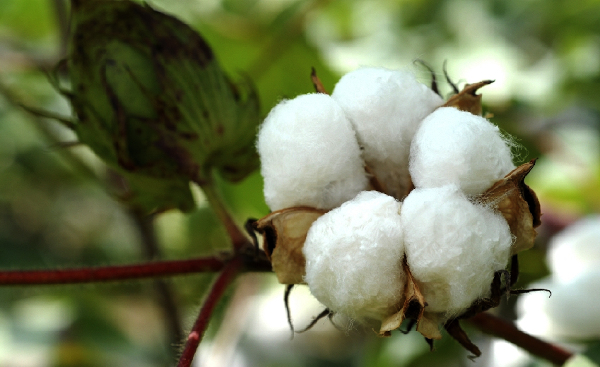
India’s cotton production is provisionally estimated at 290.91 lakh bales of 170 kilograms each during the 2025–26 cotton season, compared with 352.48 lakh bales in 2020–21. The Government has attributed the variation largely to a decline in the area under cotton as some farmers shifted towards other remunerative crops.
The area under cotton cultivation declined from 132.85 lakh hectares in 2020–21 to 114.82 lakh hectares in 2025–26. Cotton productivity, however, remained comparatively stable, ranging between 428 and 451 kilograms per hectare during the six-year period. Productivity for 2025–26 is provisionally estimated at 431 kilograms per hectare.
Cotton production stood at 311.17 lakh bales in 2021–22 before recovering to 336.60 lakh bales in 2022–23. It subsequently declined to 325.22 lakh bales in 2023–24 and 297.24 lakh bales in 2024–25. The figures indicate that changes in cultivated acreage have played a larger role in production fluctuations than changes in yield per hectare.
Cotton Prices Rise with Global Market Conditions
Domestic cotton prices have broadly followed international market movements. International cotton prices increased by approximately 19 per cent during the recent period, while domestic prices for the widely traded Shankar-6, or S-6, variety rose by around 18 per cent.
The Government said that the country’s overall cotton availability, including domestic production, carry-over stocks and imports, is sufficient to meet the projected requirements of the textile industry. Cotton supply and consumption are being continuously monitored to maintain adequate availability for spinning mills and other textile manufacturers.
Cotton is a crucial raw material for India’s textile and garment industry, supporting farmers, ginning and pressing units, spinning mills, fabric manufacturers, exporters and millions of workers across the textile value chain. Its price and availability directly influence production costs and the international competitiveness of Indian textile products.
Import Duty Waived to Improve Domestic Supply
To ensure that the textile industry has access to raw cotton at competitive prices, the Government has exempted cotton imports from the existing 11 per cent import duty for the period from June 1 to October 31, 2026.
The temporary exemption is intended to augment domestic availability during a period of lower production and rising cotton prices. Imported cotton can help spinning mills bridge supply gaps and moderate raw-material costs, particularly when domestic prices remain elevated in relation to competing textile-producing countries.
The Government has also continued the import-duty exemption on Extra Long Staple cotton under ITC HS Code 52010025. The exemption has been in effect since February 20, 2024, and is intended to improve the availability of specialised, high-quality cotton required for manufacturing premium yarn and fine textiles.
Extra Long Staple cotton has longer and finer fibres than conventional varieties and is used to manufacture high-count yarn, luxury fabrics and premium garments. Improving its availability can reduce dependence on expensive raw materials and strengthen India’s capacity to manufacture value-added textile products.
Raw Cotton Imports Rise Sharply in 2025–26
India imported approximately 10.13 lakh tonnes of raw cotton during 2025–26, representing an increase of 80.26 per cent over the 5.62 lakh tonnes imported during 2024–25.
Cotton-yarn imports also increased from 7,564.61 tonnes in 2024–25 to 9,074.13 tonnes in 2025–26, recording growth of 19.96 per cent. The figures were compiled from the Monthly Statistics of the Foreign Trade of India prepared by the Directorate General of Commercial Intelligence and Statistics.
However, imports were lower during April 2026 than in the corresponding month of the previous year. Raw-cotton imports declined by 15.12 per cent, from 45,564.09 tonnes in April 2025 to 38,674.34 tonnes in April 2026. Cotton-yarn imports fell by 11.12 per cent, from 954.51 tonnes to 848.37 tonnes during the same period.
₹5,659-Crore Mission for Cotton Productivity
The Government has approved a five-year Mission for Cotton Productivity, known as Kapas Kanti, with an allocation of ₹5,659.22 crore. The mission will be implemented from 2026–27 to 2030–31 and will focus on improving cotton productivity and fibre quality.
The programme assumes significance because India has one of the world’s largest areas under cotton cultivation, while average yields remain an important area for improvement. Raising productivity can enable farmers to generate more cotton from existing farmland, reduce pressure to expand acreage and improve resilience against fluctuating prices and weather conditions.
Better-quality cotton can also strengthen the competitiveness of Indian spinning, weaving, apparel and home-textile industries. Consistent fibre length, strength and cleanliness allow mills to manufacture higher-quality yarn while reducing wastage and processing difficulties.
The combination of productivity enhancement, quality improvement and temporary import facilitation is intended to balance the interests of cotton farmers and the domestic textile industry. While the Kapas Kanti mission will address medium- and long-term production challenges, the import-duty measures seek to ensure immediate access to raw materials at internationally competitive prices.
The cotton production estimates were finalised by the Committee on Cotton Production and Consumption at its meeting on April 16, 2026. The information was provided by Minister of State for Textiles Pabitra Margherita in a written reply to a question in the Rajya Sabha on July 24, 2026.
You may also like
-
India’s First Port-Based e-Methanol Plant at Kandla to Supply Green Fuel to Global Shipping
-
India’s Recent Oil and Gas Discoveries: New Finds, Offshore Frontiers and How Much Crude India Produces at Home
-
India’s Hidden Gold Mountain: How Households Came to Own an Estimated 31,000 Tonnes of Gold
-
India–Afghanistan Air Cargo Corridor Returns to Focus as Both Sides Push for Stronger Trade Connectivity
-
India’s Defence Shipyards Build Common Indigenous Supply Chain for Specialised Naval Cables
