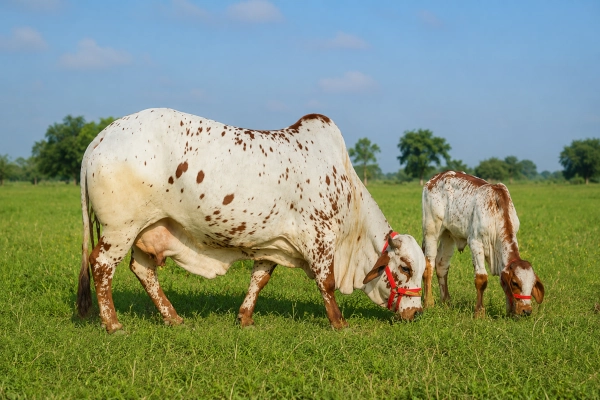
Rathi cattle are among India’s important indigenous dairy breeds, shaped by generations of pastoral selection in the dry north-western plains of Rajasthan. The breed combines useful milk production with the heat tolerance, walking ability and feed efficiency required in arid and semi-arid farming systems. These qualities have made Rathi cattle especially valuable to small farmers and pastoral households living along the margins of the Thar Desert, where high temperatures, limited grazing and uncertain rainfall place heavy demands on livestock.
The National Bureau of Animal Genetic Resources recognises Rathi as a distinct Indian cattle breed originating in Rajasthan, while the National Dairy Development Board classifies it primarily as a milch breed. Its recognised home tract includes Bikaner, Sri Ganganagar and Jaisalmer districts, with a particularly strong concentration around Lunkaransar in Bikaner. Rathi cattle are also reared in Hanumangarh and adjoining parts of north-western Rajasthan.
Origin and Development of the Breed
Rathi cattle developed within a pastoral landscape where livestock had to survive long summers, scarce water and seasonal variations in fodder. The breed is traditionally associated with the Raths, a pastoral community that maintained cattle herds across the desert region and selected animals for milk production, fertility, endurance and adaptability.
The breed is believed to carry the influence of several north-western Indian cattle populations, including Sahiwal, Red Sindhi, Tharparkar and Dhanni, with a strong dairy character similar to Sahiwal. Over many generations, local herders stabilised a distinct cattle type suited to Rajasthan’s harsh ecology.
This history reflects the practical intelligence of traditional animal breeding. Pastoral families selected animals capable of producing milk while walking considerable distances, digesting coarse vegetation and maintaining body condition during hot and dry periods. The resulting breed became an important livelihood resource rather than merely a source of milk.
The Native Tract
The heartland of Rathi cattle lies across the dry districts of northern and western Rajasthan. Bikaner, Sri Ganganagar and Jaisalmer form the officially recognised native tract, while important populations are also found in Hanumangarh and neighbouring areas.
The Lunkaransar region of Bikaner is often regarded as the centre of the breed. The landscape includes sandy plains, scrub vegetation, irrigated agricultural pockets and extensive grazing areas. Rainfall is low and highly variable, while summer temperatures can become extreme.
Under these conditions, dairy farming depends upon animals capable of using crop residues, dry grasses and locally available fodder. Rathi cattle are therefore closely linked with mixed farming systems based on pearl millet, wheat, sorghum, pulses and livestock.
Physical Appearance
Rathi cattle are medium-sized, well-balanced animals with a compact and generally symmetrical body. Their frame is large enough to support useful milk production while remaining efficient under limited feed conditions.
The most characteristic coat pattern consists of brown or reddish-brown patches distributed over a white background. Some animals appear predominantly brown, while others carry black or dark patches mixed with white. The lower portions of the body are often lighter than the upper body.
The head is proportionate and moderately broad between the eyes. The forehead may appear slightly dished or gently curved. The ears are medium-sized and usually hang outward or downward. The horns are short to medium in length and generally curve outward, upward and inward.
The skin is loose and flexible, while the hair coat is short and smooth. These features support heat dissipation in a hot climate. The dewlap is usually well developed, and the naval flap may be prominent.
The tail is long and fine, extending towards or below the hock and ending in a dark or occasionally pale switch. Cows possess a well-developed udder, evenly placed teats and a visible milk vein, reflecting their dairy character.
Bulls are stronger through the shoulders and forequarters, with a more developed hump and muscular neck. Cows have a comparatively refined body, deeper abdomen and more pronounced dairy form.
Milk-Producing Ability
Rathi is primarily valued as a dairy breed. According to the National Dairy Development Board, the average lactation yield is about 1,560 kilograms, with recorded yields commonly ranging from 1,062 to 2,810 kilograms per lactation. Individual performance varies according to genetics, feeding, health care, lactation number and farm management.
The breed’s importance lies in the balance between production and environmental resilience. Exotic dairy breeds may produce more milk under intensive feeding and climate-controlled management, while Rathi cattle can maintain useful production under the demanding conditions of Rajasthan.
Milk yield generally rises after calving, reaches a peak during early lactation and then declines gradually. Adequate green fodder, dry roughage, mineral supplementation, clean water and proper milking practices can significantly improve total lactation performance.
Research conducted on organised Rathi herds in Rajasthan has shown that production and reproductive traits are influenced by season, parity, management and other environmental factors. Long-term studies at livestock research stations in Bikaner and Nohar have therefore emphasised the importance of combining genetic selection with improved feeding and herd management.
Milk Quality
Rathi milk is suited to household consumption and the preparation of curd, buttermilk, butter, ghee, khoa and other traditional dairy foods. Milk composition varies between animals and across stages of lactation, influenced by nutrition, age, health and management.
The breed’s milk generally contains a useful proportion of fat and solids, making it attractive in milk-pricing systems that reward fat and solid-not-fat content. This can improve the economic value of Rathi cows even where their total milk volume remains moderate compared with specialised exotic breeds.
Studies involving Rathi cattle have examined milk composition, udder health and genetic markers associated with milk production, reflecting growing scientific interest in improving the breed through selection while retaining its indigenous adaptability.
Claims that milk from every indigenous cow automatically possesses a particular protein type require animal-level testing. Milk characteristics can vary within a breed, and accurate classification depends upon genetic or laboratory analysis.
Adaptation to Arid Conditions
The greatest strength of Rathi cattle is their ability to perform in a climate marked by intense heat, dry winds and limited fodder. Their short coat, loose skin and functional body structure assist in regulating body temperature.
These cattle can make effective use of fibrous feeds and agricultural residues. Traditional feeding systems may include sewan grass, pearl millet stalks, sorghum stover, wheat straw, tree leaves and seasonal pasture. Lactating cows are commonly given concentrate feed according to milk production and availability of household resources.
Rathi cattle can also walk considerable distances in search of grazing and water. This quality remains valuable in pastoral and semi-pastoral systems where animals move between village commons, harvested fields and seasonal grazing grounds.
Their resilience reduces dependence on expensive housing and intensive cooling. Shade, unrestricted clean drinking water and protection during the hottest hours still remain essential for maintaining welfare and milk production.
Role in Desert-Edge Farming
Rathi cattle fit naturally into mixed crop–livestock agriculture. Farmers use crop residues as cattle feed, while dung supports soil fertility, compost production and household energy systems.
Milk provides a regular source of food and income between crop harvests. Calves contribute to herd replacement, while surplus animals may be sold to meet household expenses. This makes the breed particularly valuable in regions where crop income fluctuates with rainfall.
The breed also offers a degree of economic security. An animal that can remain productive on locally available resources carries lower risk than one requiring constant access to high-cost concentrate feeds, specialised housing and intensive veterinary support.
Rathi cattle therefore represent a farming system rather than an isolated genetic resource. Their continued survival depends upon grazing access, fodder availability, veterinary services, functioning milk markets and the knowledge of local livestock keepers.
Temperament and Handling
Rathi cows are generally regarded as manageable and suitable for routine dairy work. Animals that receive calm and regular handling from a young age usually adapt well to hand milking and household farm environments.
Temperament varies between individuals. Bulls require experienced handling, secure enclosures and appropriate restraint, especially after sexual maturity. Cows may also become protective around newly born calves.
Consistent routines, gentle movement and avoidance of rough treatment improve milking behaviour and reduce stress. Clean, shaded and well-ventilated housing further supports animal comfort.
Reproductive Performance
Reproductive efficiency determines the long-term profitability of any dairy herd. Rathi heifers generally mature more slowly than intensively managed exotic dairy cattle, especially where nutrition during growth is limited.
Studies of organised herds have reported that age at first calving and calving interval vary considerably with feeding, season, health and farm management. One long-term study of Rathi cattle recorded an average age at first calving of about 1,470 days and an average calving interval of approximately 464 days in the population studied. These values represent a particular managed herd and should be interpreted as research observations rather than fixed standards for every Rathi cow.
Improved heifer nutrition, timely heat detection, access to quality semen, pregnancy diagnosis and postpartum health care can shorten unproductive periods. Selection should also consider fertility, calving ease, udder structure and productive life alongside milk yield.
Calf and Heifer Management
The future of the breed depends upon the quality of calves retained for breeding. Newborn calves require a clean calving area, immediate attention to breathing, proper care of the navel and adequate colostrum soon after birth.
Colostrum supplies energy, nutrients and maternal antibodies essential for early immunity. Delayed or insufficient feeding can increase vulnerability to disease.
Growing heifers need balanced nutrition to develop into healthy cows. Poor feeding during the first years of life delays maturity, reduces body development and may limit later milk production. Regular deworming, vaccination and veterinary monitoring should follow local animal-health recommendations.
Farmers should retain female calves from cows with reliable milk records, sound udders, regular calving and good adaptation. Male calves intended for breeding require careful selection based on the performance and pedigree of their dams and close female relatives.
Feeding and Nutrition
A practical Rathi feeding programme should combine dry roughage, green fodder, concentrate feed, minerals and clean water. Dry fodder may include wheat straw, pearl millet stover and sorghum stalks. Green fodders may include lucerne, berseem, bajra, maize, sorghum and locally adapted grasses where irrigation permits.
Lactating cows require additional energy and protein according to their milk output and body condition. Mineral mixtures and common salt support reproductive health, bone strength and milk production.
Sudden dietary changes should be avoided. Feed transitions work best when introduced gradually, particularly when moving between dry and green fodder or increasing concentrates after calving.
Water availability is especially important in Rajasthan. A lactating cow’s requirement rises sharply during summer and with increasing milk production. Restricted water intake directly affects feed consumption, health and yield.
Housing Requirements
Rathi cattle are hardy, yet suitable housing improves performance. Sheds should provide shade, ventilation, dry flooring and enough space for animals to stand, lie down and move comfortably.
Open housing systems work well in dry regions when combined with a covered resting area. Roof height and airflow help remove accumulated heat. Trees, shade structures and cool drinking water can reduce heat stress.
Flooring should prevent slipping and allow drainage. Udder hygiene becomes especially important during the rainy season and in irrigated farming areas where mud and moisture may increase the risk of mastitis.
Separate arrangements are advisable for calves, pregnant cows, recently calved animals and breeding bulls. Clean feeding troughs and regular manure removal contribute to herd health.
Health and Disease Management
Indigenous breeds often display useful tolerance to local climatic and disease pressures, though they still require systematic preventive care. Vaccination against diseases prevalent in the region should follow veterinary schedules issued by state animal-husbandry authorities.
Regular deworming, tick control, clean water and quarantine of newly purchased animals reduce herd-level risk. Farmers should watch for changes in appetite, milk yield, movement, rumination, body temperature and dung consistency.
Udder health deserves special attention in dairy herds. Clean hands, washed udders, hygienic milking vessels and complete milking help reduce mastitis. Any swelling, heat, pain or change in milk should receive prompt veterinary examination.
Heat stress can appear through rapid breathing, reduced feed intake, shade-seeking and falling milk yield. Shade, water, airflow and feeding during cooler hours provide practical protection.
Rathi Bulls and Draught Use
Although Rathi is primarily recognised as a milch breed, bulls possess useful strength and endurance. They have historically been used for light to moderate agricultural work and transport within mixed farming systems.
Mechanisation has reduced the economic demand for draught bullocks in many areas. This change can reduce incentives to rear male calves and may indirectly affect breed conservation.
Breeding bulls retain high genetic importance. A single superior bull or semen donor can influence many future animals. Selection must therefore be based on reliable pedigree, breed characteristics, health status and the production performance of close female relatives.
Economic Importance
Rathi cattle are valuable because they can produce milk without demanding the most intensive production system. Their ability to use local fodder resources helps control feeding expenses, which form the largest component of dairy-farm costs.
For smallholders, profitability depends upon more than maximum daily yield. It includes fertility, disease resistance, longevity, feed efficiency, calf survival and the ability to maintain production through climatic stress.
A Rathi cow that calves regularly, remains healthy and produces moderate milk over several lactations may deliver greater lifetime value than a higher-yielding animal poorly adapted to the local environment.
Access to milk cooperatives, village collection centres, chilling facilities and transparent fat-based pricing can substantially improve returns for Rathi owners.
Genetic Improvement and Conservation
The conservation of Rathi cattle requires productive herds rather than preservation in name alone. Farmers are more likely to retain purebred animals when they provide dependable income.
The National Dairy Development Board has supported genetic-improvement programmes for indigenous cattle, including a progeny-testing programme for Rathi cattle implemented with the URMUL Trust in Rajasthan. Such programmes aim to identify superior bulls by evaluating the milk performance of their daughters.
Scientific breeding programmes can improve milk yield while protecting fertility, adaptation and breed identity. Useful measures include milk recording, pedigree registration, artificial insemination using tested Rathi semen, genomic evaluation and farmer-based field performance recording.
Unplanned crossbreeding can gradually dilute the breed’s distinctive characteristics. Conservation programmes therefore need accessible purebred semen, trained inseminators and incentives for farmers maintaining valuable females.
Selecting a Good Rathi Cow
A healthy dairy cow should display alert behaviour, sound legs, regular movement, a broad muzzle, adequate body depth and a well-attached udder. The teats should be functional and suitably placed for milking.
Selection based purely on appearance carries risk. Farmers should examine actual milk records, stage of lactation, calving history, age, pregnancy status and previous health problems.
The animal should be observed during milking. A veterinary examination can help detect reproductive disorders, mastitis, lameness and other hidden concerns before purchase.
Breed purity is best assessed through pedigree records, recognised breed characteristics and registration rather than coat colour alone, since Rathi animals display several colour patterns.
Challenges Facing the Breed
Rathi cattle face pressures from shrinking grazing land, changing village economies, indiscriminate breeding and competition from higher-yielding crossbred animals. The decline of pastoral mobility can also weaken the traditional systems that shaped and sustained the breed.
Poor milk recording makes it difficult to identify superior cows and breeding bulls. Limited access to quality semen may encourage mating with unselected or unrelated breeds. Rising fodder costs can further reduce the profitability of small dairy herds.
Conservation must therefore be linked with economic development. Breed societies, milk cooperatives, research institutions and state agencies can support farmers through recording programmes, veterinary care, fodder development and premium marketing of traceable indigenous-breed milk.
A Breed Built for Rajasthan
Rathi cattle embody the relationship between livestock, landscape and rural knowledge. Their milk production gives them economic value, while their endurance allows them to remain productive in one of India’s most challenging agricultural environments.
They are especially suited to farmers seeking a native dairy breed capable of handling heat, variable fodder and dry conditions. Their future depends upon careful selection, scientific breeding, reliable milk markets and continued recognition of the pastoral communities that developed them.
As climate stress becomes a larger concern for livestock farming, breeds such as Rathi gain renewed importance. Their ability to combine moderate dairy performance with resilience, longevity and efficient use of local resources makes them a valuable part of India’s animal genetic heritage and a practical asset for sustainable dairy farming in arid regions.
You may also like
-
Tiny 3.3-mm Parasitic Wasp Discovered in Assam Marks First Record of Its Genus in India
-
How India Brought the Greater One-Horned Rhinoceros Back From the Brink
-
From Periyar to Thuruthi, New Surveys Reveal the Remarkable Diversity of Kerala’s Dragonflies, Birds and Butterflies
-
Delhi Biodiversity Survey Records Two Dragonfly and Damselfly Species for the First Time
-
Rare Leafless Orchid Gastrodia keyiensis Discovered in Arunachal Pradesh’s Keyi Valley
