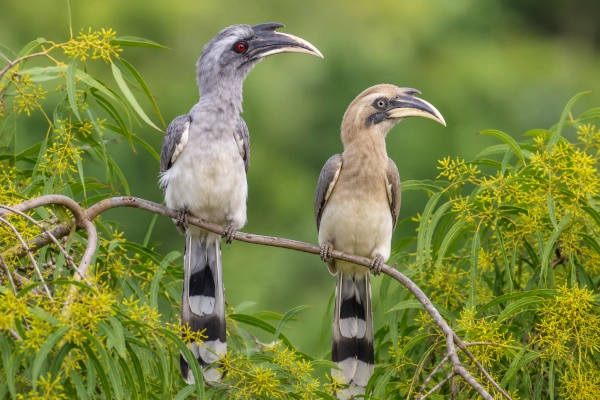
The return of the Indian Grey Hornbill to Gujarat’s Gir landscape has developed from an experimental reintroduction into one of India’s most encouraging bird-restoration programmes. Birds released by the Gujarat Forest Department have established territories, formed breeding pairs and produced offspring in the wild, signalling that a species absent from Gir for more than six decades is gradually reclaiming its former habitat. The project has recorded successful breeding across four consecutive years, strengthening prospects for the emergence of a self-sustaining population.
The Indian Grey Hornbill, scientifically known as Ocyceros birostris, was once a familiar part of the Gir landscape. Historical records indicate that the species remained common in the region until the mid-1930s, particularly during winter, before its presence declined during the following decades. The last documented direct sighting in Gir was recorded around 1950, and the species was considered locally extinct in the landscape by the 1950s or 1960s. Healthy populations continued to survive in other parts of Gujarat, creating an opportunity for carefully planned translocation once ecological conditions in Gir improved.
The reintroduction programme began in 2021 after extensive habitat assessments concluded that Gir once again possessed the vegetation, food resources and nesting conditions required by the hornbills. The birds were sourced from healthy populations in Gujarat’s Aravalli forests and released in two phases. Twenty-eight hornbills were introduced between 2021 and 2022, followed by another 12 birds in 2023, taking the total number released to 40. The phased approach allowed conservationists to study the response of the initial group and apply those observations during the second release.
Eleven males were fitted with satellite transmitters to track their movements, habitat preferences and breeding behaviour. Five transmitter-equipped birds formed part of the first phase, while six were monitored during the second. This technology gave researchers a detailed picture of how the hornbills responded after being placed in an unfamiliar landscape and helped officials understand whether the birds were merely surviving or genuinely adapting to Gir.
The tracking data revealed a clear transition from exploration to settlement. During the initial phase, the released birds travelled widely as they searched for food, suitable trees and secure territories. Their average home range covered nearly 61 square kilometres during this period. As the birds became familiar with the environment and established stable territories, their average range declined to approximately 5.7 square kilometres. Average daily movement also fell from about 4.3 kilometres during the exploratory stage to around 1.4 kilometres after settlement. Researchers consider these shrinking ranges and more stable movement patterns strong evidence that the hornbills have adapted to the Gir ecosystem.
Breeding provided the most important confirmation of the programme’s success. One pair nested successfully during the first year following release. Three additional breeding pairs were recorded during the subsequent year, demonstrating that the birds were forming pair bonds, locating suitable nesting cavities and raising young under natural conditions. The scientific assessment documented four breeding pairs and concluded that the combination of successful nesting, stable habitat use and territorial establishment represented meaningful progress towards rebuilding a viable population.
The findings were detailed in the research paper “Reintroduction of Indian Grey Hornbills in Gir, India: Insights into Ranging, Habitat Use, Nesting and Behavioural Patterns,” published in the peer-reviewed journal Birds. The study provides the first comprehensive scientific assessment of the Gir reintroduction and examines the birds’ ranging behaviour, habitat associations, nesting preferences and adjustment after release. Its results offer practical guidance for future conservation programmes involving birds that have disappeared from parts of their historical range.
Within Gir, the hornbills showed a strong preference for dry mixed deciduous forest and teak-dominated woodland. Birds moving beyond the protected area also used orchards, water bodies and locations close to human settlements, revealing a degree of ecological flexibility. This adaptability could help the population expand across the wider Gir landscape, provided mature trees, food resources and safe movement routes remain available.
Nesting pairs consistently selected tall, mature trees with broad trunks. Trees such as Sterculia urens and Terminalia bellirica were particularly important because their size and structure provided cavities suitable for breeding. The findings highlight the value of preserving old-growth trees, which serve as irreplaceable nesting infrastructure for hornbills and many other cavity-dependent birds. Forest management focused only on increasing tree cover would provide an incomplete solution; the age, size and species composition of trees also shape whether a habitat can support a breeding hornbill population. This broader conservation implication follows directly from the study’s recorded relationship between nest selection, tree height and trunk girth.
Researchers observed adults feeding their chicks with fruits from banyan, peepal, karamda and dhraman trees, supplemented by insects and other invertebrates. This diverse diet reflects the hornbill’s role within the forest food web and its close relationship with fruit-bearing trees. As the birds move across large areas, they consume fruits and disperse seeds away from the parent trees, helping vegetation spread and regenerate across the landscape.
This seed-dispersal function gives the hornbill’s return importance beyond the recovery of a single species. Indian Grey Hornbills can transport seeds over considerable distances, linking separated patches of forest and supporting the natural renewal of native vegetation. A stable population could therefore contribute to the ecological health of Gir by strengthening plant diversity and assisting the regeneration of fruiting trees that support numerous birds and mammals. Gujarat forest officials have described the species as an important long-distance seed disperser whose restoration can benefit the wider ecosystem.
The exact historical causes of the hornbill’s disappearance from Gir remain uncertain. Gujarat’s Chief Wildlife Warden has indicated that hunting pressure probably played a greater role than habitat loss. The declaration of Gir Wildlife Sanctuary in 1965 and Gir National Park in 1975 strengthened protection across the landscape and gradually created conditions suitable for the species’ return. Improved protection, habitat management and reduced disturbance provided the foundation upon which the reintroduction could be attempted decades later.
The programme demonstrates the difference between releasing animals and restoring a population. A successful conservation translocation requires the birds to survive, locate food, establish territories, form pairs, find nesting sites and raise offspring. Each stage carries its own risks, and failure at any point can prevent the creation of a lasting wild population. The Gir hornbills have progressed through these critical stages, while satellite monitoring and field observations have allowed researchers to measure that progress scientifically.
Continued protection will remain essential as the population develops. Mature nesting trees, fruit-bearing vegetation and connections between protected forests and surrounding habitats will shape the long-term outcome. Monitoring can also reveal whether offspring born in Gir survive, disperse and establish territories of their own—the next major indicator that the population is becoming naturally self-sustaining.
The revival of the Indian Grey Hornbill adds a new dimension to Gir’s conservation identity. The landscape is globally known as the last natural stronghold of the Asiatic lion, yet its ecological significance extends across a wide range of plants, birds and other wildlife. Restoring a locally extinct seed-dispersing bird shows how protected landscapes can recover lost ecological relationships alongside protecting their most famous species.
After an absence spanning more than sixty years, the calls and wingbeats of the Indian Grey Hornbill have returned to Gir. Four years of breeding, shrinking home ranges and stable use of the habitat show that the birds are beginning to treat the landscape as home. The project offers a valuable model for restoring locally extinct species through habitat assessment, scientific monitoring and sustained protection, while demonstrating that a lost part of an ecosystem can return when conservation is guided by patience, evidence and long-term commitment.
REFERENCES
- DD News. “Gir’s Lost Hornbill Takes Flight Again: Gujarat’s Reintroduction Project Records Four Years of Successful Breeding.” Published July 14, 2026.
https://ddnews.gov.in/en/girs-lost-hornbill-takes-flight-again-gujarats-reintroduction-project-records-4-years-of-successful-breeding/ - Ram, Mohan; Gadhavi, Devesh; Sahu, Aradhana; Srivastava, Nityanand; Rather, Tahir Ali; Dagur, Tanisha; Modi, Vidhi; Jhala, Lahar; Zala, Yashpal; and Jhala, Dushyantsinh. “Reintroduction of Indian Grey Hornbills in Gir, India: Insights into Ranging, Habitat Use, Nesting and Behavioural Patterns.” Birds, Volume 6, Issue 4, Article 58, 2025.
https://www.mdpi.com/2673-6004/6/4/58 - DOI for the scientific study:
https://doi.org/10.3390/birds6040058
You may also like
-
New X-Ray Clues from Blazars could Provide Insights on Powering of Active Galaxies
-
A Powerful Punch by Black Hole Jets Shapes the Fate of Galaxies
-
IIT Delhi Develops India’s First Indigenous Micro-GPU for Embedded Graphics Systems
-
Beyond one: Indian Researchers’ Experiment Could Lead to A New Tool for Quantum Measurement
-
DRDO Backs Indigenous 20 mK Dilution Refrigerator in First High-Value Deep-Tech TDF Project
