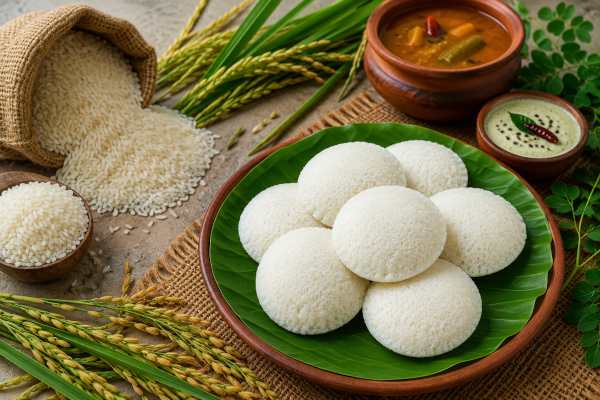
Rice has shaped the food culture, agriculture and ritual life of India for thousands of years. In Ayurveda, rice is studied as a diverse family of grains whose effects change according to variety, age, soil, season, polishing, cooking method and the digestive capacity of the person consuming it.
The rice species identified in the classical recipe is Oryza sativa L., belonging to the Poaceae family. Royal Botanic Gardens, Kew recognises Oryza sativa L. as the accepted botanical name for Asian cultivated rice.
Ayurvedic literature uses several words connected with rice. Vrihi and Shali refer to classes of rice, Dhanya may indicate the harvested grain or paddy, Tandula refers to the dehusked rice grain ready for cooking, and Odana refers to cooked rice. These distinctions reveal the depth with which Ayurveda examined rice from cultivation to digestion.
Names and Botanical Identity
| Category | Name |
|---|---|
| Sanskrit | Shali, Vrihi, Tandula, Dhanya |
| English | Rice, Asian cultivated rice |
| Hindi | Chawal, Dhan |
| Malayalam | Ari, Nellari, Nellu |
| Tamil | Arisi, Nel |
| Kannada | Akki, Bhatta |
| Telugu | Biyyam, Vari |
| Bengali | Chal, Dhan |
| Botanical name | Oryza sativa L. |
| Family | Poaceae |
| Principal part used | Mature grain or seed |
How to Identify the Rice Plant
Rice is an annual, tuft-forming grass with a fibrous root system. Its stems, known as culms, are slender, upright and divided by clearly visible nodes. Depending on the variety and growing conditions, the plants may range from compact field varieties to tall forms adapted to deeper water.
The leaves are long, narrow and blade-like, with parallel veins and pointed tips. They arise alternately from the stem and possess a sheath that partially surrounds the culm.
As the plant matures, a loose, branching flower cluster called a panicle appears at the top of the stem. Numerous small spikelets hang from these branches. Each fertile spikelet develops into a single rice grain enclosed within a firm outer husk. The mature panicle commonly bends under the weight of the filled grains.
The colour, length, fragrance and shape of rice grains vary widely. Traditional Indian varieties include white, red, brown, black, aromatic, short-grained and long-grained forms.
Rice in Ayurvedic Dietetics
Ayurveda places rice within Dhanya Varga, the category of cereals and cultivated grains. Its properties depend greatly upon the variety.
Well-matured Shali rice is generally valued as a wholesome staple capable of providing nourishment, satisfaction and physical strength. Freshly harvested rice, heavily polished rice, red rice, aromatic rice and sixty-day rice each possess different qualities.
A broad Ayurvedic profile of Shali rice may be expressed as follows:
| Ayurvedic attribute | Traditional description |
|---|---|
| Rasa — taste | Madhura: sweet |
| Vipaka — post-digestive effect | Madhura: sweet |
| Virya — potency | Generally Sheeta: cooling |
| Guna — qualities | Nourishing and soft; lightness or heaviness varies with age, variety and preparation |
| Dosha influence | Commonly supportive for Vata and Pitta; fresh, sticky or excessive rice may increase Kapha |
| Traditional actions | Balya, Brimhana, Tarpana and Vrishya |
These qualities apply broadly to preferred Shali varieties. Ayurveda evaluates each type separately rather than treating every rice grain as identical.
The Importance of Rice Variety
Shali Rice
Shali refers to a highly regarded group of cultivated rice varieties traditionally harvested during the cooler season. Classical texts describe several forms of Shali and often place red Shali among the finest.
Shali rice is valued for nourishment, palatability and compatibility with many vegetable, pulse, milk and meat preparations.
Rakta Shali
Rakta Shali is naturally red rice whose outer bran layers carry a red or reddish-brown colour. Classical Ayurvedic dietetics holds high-quality red Shali in special esteem.
Its firm texture and earthy flavour make it suitable for gruels, cooked rice dishes and strengthening preparations.
Shashtika Shali
Shashtika refers to varieties that mature rapidly, traditionally within approximately sixty days. Njavara or Navara rice of Kerala is frequently associated with this category.
Shashtika rice appears in food preparations and external Ayurvedic procedures such as Shashtika Shali Pinda Sweda. Its reputation centres on nourishment, strength and restoration.
Vrihi
Vrihi represents another broad group of rice varieties, often associated with cultivation during the rainy season. Its qualities vary according to the specific variety, growing environment and age of the harvested grain.
Old Rice and Newly Harvested Rice
Ayurvedic dietetics pays close attention to the age of grain.
Rice stored under suitable conditions for a year is traditionally considered drier and lighter than freshly harvested rice. It separates more readily during cooking and may suit people seeking a less heavy meal.
New rice contains greater natural moisture and commonly produces a softer, stickier preparation. It is regarded as more nourishing and heavier, with a stronger tendency to increase Kapha when consumed frequently or in large quantities.
Selection therefore depends on purpose. New rice may suit strengthening preparations, while aged rice may suit routine meals for people with moderate digestion.
Processing Changes the Qualities of Rice
The same rice can produce several different Ayurvedic foods through changes in water, heat, grinding, roasting and fermentation.
Odana
Odana is ordinary cooked rice. Its digestibility depends upon the rice variety, quantity of water, degree of cooking and accompaniments.
Manda
Manda is the thin liquid portion obtained from well-cooked rice. It is light, fluid and traditionally used during recovery, reduced appetite or delicate digestion.
Peya
Peya is a thin rice gruel containing a small quantity of softened grain. It provides more substance than Manda while retaining a fluid consistency.
Vilepi
Vilepi is a thicker rice gruel with a greater proportion of cooked grain. It is more nourishing and sustaining than Peya.
Laja
Laja is puffed or parched rice. Roasting introduces dryness and lightness, changing its effect upon digestion.
Pishta
Rice flour is produced by grinding the grain. It forms the basis of cakes, dumplings, pancakes and steamed preparations.
Fermented Rice Batter
Fermentation transforms the taste, aroma and texture of rice. When combined with black gram, it produces a soft batter capable of rising during steaming. Indarika is one such classical preparation.
Rice as a Daily Food
Rice possesses a mild flavour that accepts the qualities of accompanying foods. It may be combined with:
- Mudga or green gram for a gentle meal
- Ghee for unctuousness and nourishment
- Buttermilk for a lighter sour accompaniment
- Milk in strengthening preparations
- Vegetables and spices according to season
- Pulse soups for a more complete and sustaining meal
Ayurveda considers the entire meal rather than judging a grain in isolation. Rice accompanied by suitable pulses, vegetables, fats and spices produces a different digestive effect from rice eaten alone in a large quantity.
Classical Recipe: Indarika
Fermented Steamed Rice and Black-Gram Cake
Indarika is a steamed preparation made from rice and black gram. Its composition and method closely resemble the food now widely known as idli.
The supplied formulation cites Ayurveda Mahodadhi, Pakvannavarga, sixteenth Varga, Shloka 11. It is classified as Ashita, an eatable preparation.
Ingredients
| Ingredient | Common or botanical identity | Part used | Ratio |
|---|---|---|---|
| Tandula | Rice, Oryza sativa L. | Seed | 2 parts |
| Masha | Black gram, Vigna mungo or the older name Phaseolus mungo L. | Seed | 1 part |
| Saindhava Lavana | Rock salt | — | As required |
| Jala | Water | — | As required |
The official Ayurveda Aahara documentation records Indarika as a steamed rice cake prepared from rice and black gram and connects it with the Pakvannavarga of Ayurveda Mahodadhi.
Classical Method of Preparation
Take two parts of rice flour and one part of black-gram flour.
Add sufficient water and mix thoroughly to form a smooth batter. The consistency should remain moderate, flowing easily while retaining enough body to hold its shape during steaming.
Cover the batter and keep it overnight to ferment.
The following morning, add the required quantity of finely powdered Saindhava Lavana and mix gently.
Transfer the fermented batter into lightly prepared steaming cups, an idli mould or another suitable steamer vessel.
Steam until the cakes become fully cooked, soft and firm enough to hold their shape.
Serve them warm and freshly prepared.
Traditional Soaked-Grain Method
A household adaptation may use whole grains in the same proportion.
Wash two parts of rice and one part of black gram separately. Soak them in clean water for several hours. Grind the black gram into a smooth, aerated paste and the rice into a fine or slightly granular batter.
Combine both batters, add enough water to create a moderate consistency and leave the mixture overnight in a warm, clean place. Add rock salt after fermentation and steam the batter the following morning.
This version preserves the two-to-one proportion while following the familiar wet-grinding method used for steamed fermented cakes.
Ayurvedic Properties of Indarika
The cited formulation assigns the following qualities to Indarika:
Ruchya
Ruchya means that the preparation enhances taste and makes food pleasing to the palate. Fermentation creates a mild sourness and characteristic aroma, while rock salt contributes balance.
Vrishya
Vrishya describes a food traditionally associated with reproductive nourishment, vitality and the support of healthy body tissues.
Balya
Balya indicates a strength-promoting quality. Rice provides the main body of the preparation, while black gram contributes additional heaviness and nourishment.
Guru
Guru means heavy to digest. Although steaming creates a soft texture, the combination of rice and black gram remains substantial. Portion size should therefore correspond with digestive strength.
Abhishyandi
Abhishyandi describes a food capable of producing heaviness, moisture or sluggishness within the bodily channels when taken excessively or when digestion is weak.
This quality arises particularly from the black gram and the dense fermented combination. Warm serving, moderate portions and suitable accompaniments improve the overall dining experience.
Understanding the Combination
Indarika demonstrates how classical Indian food preparation integrates cereal, pulse, water, time and steam.
Rice supplies sweetness, softness and the structural base of the cake. Black gram gives the batter body, smoothness and its ability to rise. Fermentation changes the aroma and creates air within the mixture. Steaming cooks the preparation without direct contact with flame or frying fat.
The result is a soft, moist food with nourishing and strengthening qualities. Its Ayurvedic heaviness remains relevant when deciding portion size and accompaniments.
Suitable Accompaniments
A warm Indarika meal may be accompanied by preparations that support appetite and balance heaviness, including:
- Lightly spiced vegetable preparations
- Coriander or mint-based chutney
- Ginger-containing accompaniments
- Thin Mudga soup
- Mildly spiced buttermilk for suitable individuals
- A modest quantity of ghee when additional nourishment is desired
Very heavy, oily or excessively sweet accompaniments intensify the substantial nature of the meal.
About the Ayurveda Mahodadhi–Annapana Vidhi Manuscript Tradition
Ayurveda Mahodadhi–Annapana Vidhi is a Sanskrit work devoted to dietetics, cooked foods and beverages. A published edition appeared in Tanjore in 1950 as Tanjore Sarasvati Mahal Series No. 20 and Madras Government Oriental Series LX. It was edited with an introduction by Sri S. Venkatasubrahmanya Sastri and published under the authority of the Government of Madras. WorldCat catalogues the edition under Sushena and S. Venkatasubrahmanya Sastri.
The edition’s preface explains that the text was prepared by comparing three manuscripts whose readings varied slightly. It describes the work as a treatise on dietetics and attributes it traditionally to Sushena. The editor also records uncertainty concerning its precise date and authorship, observing that portions may represent later composition or supplementation. This makes the text an important example of Ayurvedic culinary knowledge preserved through manuscript transmission, editorial comparison and regional food practice.
The work arranges numerous foods into specialised sections and discusses rice dishes, breads, cakes, pulse preparations, sweets, milk products, condiments and beverages. Indarika illustrates its practical approach: familiar grains are processed through fermentation and steaming to create a defined food with clearly recorded dietary properties.
Who May Find Rice Suitable?
Properly cooked rice can form part of the diet of children, adults, older people and those recovering strength, provided the variety and preparation match individual needs.
Soft rice gruels suit delicate digestion. Aged rice may suit people seeking a lighter meal. New rice and milk-based rice preparations provide greater heaviness and nourishment. Fermented rice-and-black-gram foods suit people with an active appetite and adequate digestive capacity.
Ayurveda considers constitution, season, age, physical activity and digestive strength before deciding the ideal type and quantity.
Precautions
Large portions of polished rice may create an unbalanced meal when regularly consumed without pulses, vegetables or other suitable foods.
People managing diabetes or blood-sugar concerns should follow individually prescribed portions and meal combinations.
Indarika contains black gram, which may contribute to gas, abdominal heaviness or sluggish digestion in sensitive individuals.
People with pronounced Kapha heaviness, congestion or a very sedentary routine may prefer smaller servings of the fermented cake.
Anyone following sodium restrictions should regulate the quantity of rock salt.
Fermented batter should possess a clean, mildly sour aroma. Batter showing mould, unusual colouring, foul odour or spoilage should be discarded.
Rice as Food, Medicine and Cultural Memory
Rice expresses the central Ayurvedic principle that food acquires its effect through variety, age, processing and combination. A grain may become Odana, Manda, Peya, Vilepi, Laja or a fermented steamed cake. Each form offers a distinct texture, strength and digestive character.
Indarika preserves this wisdom in a remarkably familiar preparation. Rice and black gram are transformed by water, overnight fermentation and steam into a soft nourishing cake. Its description in Ayurveda Mahodadhi links a widely loved Indian food with the scholarly tradition of Ayurvedic dietetics.
Through Shali and Tandula, rice continues to unite the field, kitchen, household and healing traditions of India.
Health Disclaimer
This article presents Ayurvedic, historical and culinary information for educational and cultural purposes. Traditional qualities such as Balya, Vrishya, Guru and Abhishyandi belong to the Ayurvedic system of dietetics and do not represent guaranteed medical outcomes. People with diabetes, digestive disorders, kidney disease, food allergies or medically prescribed dietary restrictions should consult a qualified healthcare professional before making significant changes to their diet.
You may also like
-
How Much Exercise Is Enough According to Ayurveda?
-
AIIA and 132 ECO Task Force Launch 10,000-Plant Ashwagandha Research Initiative in Delhi’s Aravalli Landscape
-
Dr Reddy’s to Bring India’s First CDSCO-Approved Dengue Vaccine QDENGA to Private Market in 2027
-
The Ayurvedic Approach to Exercise and Physical Activity
-
FSSAI Moves to Reserve ‘Paneer’ Name for Milk-Derived Products
