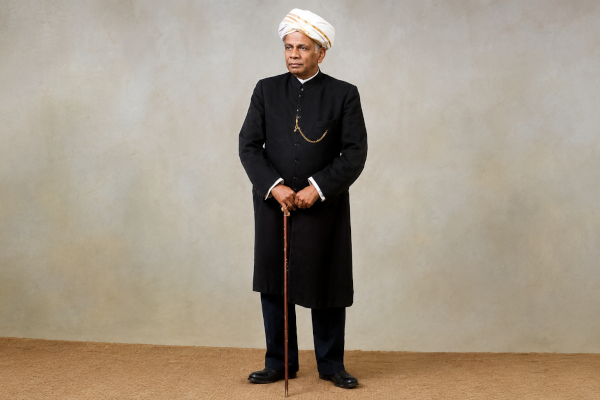
Manaveda Raja occupies a special place in the cultural history of Kerala. He was a ruler of the Samoothiri or Zamorin royal family of Kozhikode, but his memory lives most strongly through art, devotion and literature. In the political history of Malabar, many Zamorins are remembered for power, trade, war and diplomacy. Manaveda Raja is remembered for giving Kerala one of its most refined temple art traditions — Krishnanattam.
Krishnanattam is a classical dance-drama built around the life of Lord Krishna. It is based on the Sanskrit text Krishnageeti, composed by King Manaveda. Through this work, the king transformed bhakti into theatre, poetry into movement, and temple worship into a complete visual experience. His contribution shows how Kerala’s royal courts could act as centres of culture, scholarship and sacred performance.
Manaveda Raja belonged to the Samoothiri Kovilakam, the royal house of the Malabar region. The Zamorins of Kozhikode were among the most powerful rulers of medieval and early modern Kerala. Their influence extended across trade, temple institutions, coastal politics and the cultural life of North Kerala. Within this world, Manaveda emerged as a ruler with a deep literary and devotional temperament.
His devotion was centred on Guruvayurappan, the form of Lord Krishna worshipped at Guruvayur. The tradition around Manaveda says that his longing to experience Krishna shaped the birth of Krishnanattam. The famous legend speaks of a divine vision, a peacock feather, and the king’s desire to preserve Krishna’s leela through art. Whether read as sacred memory or cultural symbolism, the story explains the emotional force behind his creation.
Krishnageeti became the literary foundation of Krishnanattam. The text presents the story of Krishna in a structured dramatic form. The performance tradition is arranged around eight stories from Krishna’s life, beginning with his divine birth and moving through heroic, romantic, devotional and cosmic episodes. These include themes such as Avataram, Kaliyamardanam, Rasakrida, Kamsavadham, Swayamvaram, Banayuddham, Vividavadham and Swargarohanam.
This structure gave Krishnanattam a rare completeness. It was not a single play or a loose collection of devotional scenes. It was a full dramatic cycle. Each night carried a different episode. Each episode had its own rasa, costume mood, movement pattern and spiritual meaning. The life of Krishna became a sequence of sacred theatre.
Manaveda Raja’s achievement lies in the way he united many streams of Kerala’s artistic world. Krishnanattam drew strength from Sanskrit learning, temple ritual, music, dance, costume design, facial expression, percussion and devotional storytelling. It had the discipline of classical theatre and the living energy of temple worship. The king did not simply write a text; he created an artistic system.
The performance style of Krishnanattam is visually powerful. The costumes are elaborate, the colours are striking, the headgear is majestic and the movements carry a ritual dignity. The instruments such as maddalam, chengila, elathalam and edakka create the sonic world of the performance. Singers stand behind the actors and guide the dramatic flow. Some characters use masks, giving the art form a special identity within Kerala’s performance traditions.
Guruvayur became the heart of this tradition. For centuries, Krishnanattam remained closely linked with temple worship and royal patronage. The Zamorin family supported the performers and helped the art form travel across North and Central Kerala. Later, as royal authority declined, the tradition came under the care of Guruvayur temple institutions. This allowed Krishnanattam to survive as a living ritual art rather than remain only a memory from the royal past.
Manaveda Raja’s work also played an important role in the wider evolution of Kerala’s dance-drama culture. Krishnanattam stands near the roots of the artistic world that later gave rise to Ramanattam and Kathakali. Scholars discuss the exact sequence in different ways, but the connection is clear in the shared use of dramatic storytelling, stylised movement, costume grandeur, music, gesture and epic narrative. Through Krishnanattam, Manaveda helped shape the cultural atmosphere from which Kathakali eventually drew strength.
The connection between Krishnanattam and Kathakali is especially important because it shows how one royal creation can influence an entire artistic civilisation. Krishnanattam focused on Krishna and used Sanskrit as its literary base. Ramanattam later turned toward the Ramayana and used a language closer to Kerala’s regional audience. Kathakali then expanded the form into a broader classical theatre of gods, heroes, demons, warriors and moral conflict. In this chain, Manaveda’s contribution remains foundational.
He was also a symbol of the old Kerala model of kingship where political authority and cultural responsibility moved together. A ruler was expected to protect temples, honour scholars, support musicians, maintain ritual systems and encourage literature. Manaveda Raja fulfilled this role through a creation that outlived his kingdom’s political power. His cultural legacy became stronger than royal command.
Krishnanattam also reflects the devotional imagination of Kerala. It presents Krishna as child, lover, warrior, protector and cosmic lord. The audience does not watch only a story; it participates in a ritual offering. The performance is connected with prayers, vows and temple observance. For devotees, each episode carries a particular spiritual purpose. This gives the art form a life inside faith, not only inside aesthetics.
Manaveda Raja’s importance therefore extends beyond biography. He represents the moment when royal patronage, Sanskrit literature, Krishna bhakti and Kerala’s theatre traditions came together. He created a bridge between court and temple, between text and performance, between devotion and disciplined art. Through Krishnanattam, he gave visible form to the inner world of Krishna worship.
Today, the name of Manaveda Raja still lives wherever Krishnanattam is performed. The king’s political age has passed, but his artistic vision continues to breathe through costume, rhythm, gesture and song. In Kerala’s cultural memory, he stands as the Zamorin who did not merely rule territory. He shaped imagination.
Manaveda Raja’s legacy reminds us that the greatness of a king is not always measured by conquest. Sometimes it is measured by the beauty he leaves behind. In Krishnanattam, he left behind a living temple art, a Sanskrit literary treasure and a cultural pathway that helped shape one of Kerala’s greatest classical performance traditions.
You may also like
-
Tamralipta — The Maritime Gateway of the Lower Ganga
-
Suhma — The River-and-Forest Country of Southwestern Bengal
-
Gauda — The Western Bengal Country of the Bhagirathi and the Rise of Karnasuvarna
-
Pundra — The Northern Bengal Kingdom of the Karatoya and the Ancient City of Pundranagara
-
Vanga — The River Kingdom of the Bengal Delta and the Eastern Sea
