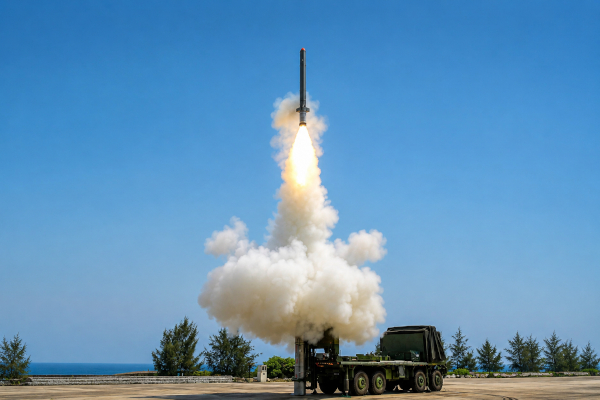
India has taken another major step in indigenous missile development with the successful flight-test of the Long Range Land Attack Cruise Missile, or LRLACM, from Dr A. P. J. Abdul Kalam Island off the coast of Odisha on 15 June 2026. The Defence Research and Development Organisation confirmed that all test objectives were fully met, based on data captured by tracking instruments deployed by the Integrated Test Range, Chandipur.
The test is important because the LRLACM belongs to a category of weapons designed for deep land-attack missions. A land attack cruise missile gives the armed forces the ability to strike fixed land targets with precision from long distances. Such a system strengthens deterrence, supports conventional precision warfare and adds another layer to India’s growing missile inventory.
The missile has been developed indigenously, with all sub-systems created by various DRDO laboratories and Indian industry partners. The Aeronautical Development Establishment, Bengaluru, is the nodal laboratory for the programme. The presence of user representatives from the Indian Navy and the Indian Air Force during the launch shows the operational importance of the system for future service requirements.
The 15 June 2026 test builds on the missile’s earlier development milestone. DRDO had conducted the maiden flight-test of the LRLACM on 12 November 2024 from the Integrated Test Range, Chandipur, using a mobile articulated launcher. During that test, the missile’s sub-systems performed as expected and the primary mission objectives were met.
The LRLACM programme is also significant because it was already described as a Defence Acquisition Council-approved, Acceptance of Necessity-sanctioned Mission Mode Project during the 2024 maiden test. The missile was configured for launch from ground-based mobile articulated launchers and from frontline ships using a universal vertical launch module system. This points to a future where the same missile family can support both land-based and naval strike roles.
For the Indian Navy, a ship-launched land attack cruise missile adds a valuable offensive reach from the sea. Warships equipped with such missiles can hold hostile land targets at risk from stand-off distances. This supports sea control, maritime deterrence and joint operations against coastal or inland targets.
For the Indian Air Force, the system adds to India’s broader long-range precision strike ecosystem. Modern air warfare depends on the ability to hit command centres, logistics nodes, air bases, radar sites, ammunition depots and hardened infrastructure from outside dense threat zones. A reliable indigenous cruise missile gives India more sovereign control over such options.
The LRLACM also strengthens India’s defence-industrial ecosystem. A complex cruise missile requires propulsion, guidance, navigation, control systems, mission software, seeker-related technologies, airframe design, launch integration, warhead compatibility and testing infrastructure. Each successful test validates a chain of laboratories, public-sector units, private industry partners and specialised suppliers.
The role of the Integrated Test Range at Chandipur is central to this process. The 2026 test was evaluated through tracking instruments deployed by ITR, while the 2024 maiden test used range sensors such as radar, electro-optical tracking systems and telemetry to cover the missile’s flight path. Such instrumentation allows DRDO to study flight behaviour, trajectory, control response, subsystem performance and mission accuracy.
Defence Minister Rajnath Singh congratulated DRDO and industry partners after the successful 2026 test. Defence Secretary and DRDO Chairman Rajesh Kumar Singh monitored the launch activities and also congratulated the teams involved.
The larger message is clear. India is steadily building an indigenous family of long-range precision weapons that can serve multiple military branches. The LRLACM gives India a stronger conventional strike option, reduces dependence on imported systems and supports the larger goal of self-reliance in critical defence technology.
This test is therefore more than a single missile launch. It represents progress in mission-mode defence development, joint service capability, industry participation and long-range precision warfare. As the LRLACM moves through further trials and service evaluation, it can become an important part of India’s future deep-strike architecture.
Source: PIB
You may also like
-
Sigma Advanced Systems Secures Fresh ₹973 Crore NATO Artillery Ammunition Order
-
India Advances Indigenous Defence and Space Technologies Through Naval Innovation, Drones and Advanced Electronics
-
Thales Seeks Indian Partnerships for Next-Generation Missiles, Radars and Electronic Warfare Systems
-
Indian and Australian Armies Conduct Jungle and Coastal Warfare Drills in AUSTRAHIND 2026
-
Sagar Defence Unveils Autonomous Vessel at SWAVLAMBAN 2026, Expands Manufacturing
