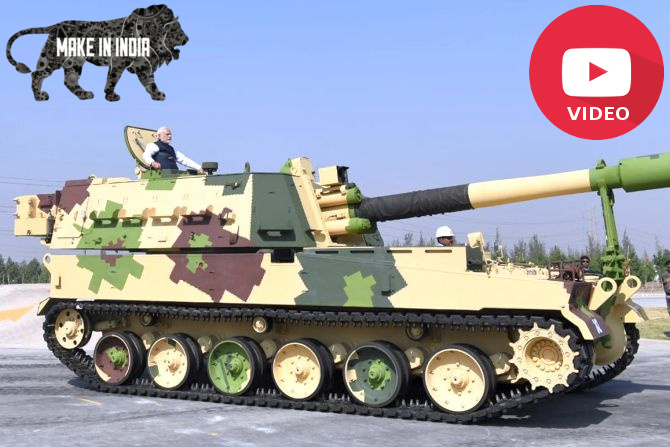
The K9 Vajra-T has become one of the most important artillery systems in the Indian Army’s modernisation journey. It represents a clear shift from older static artillery thinking to fast-moving, protected and highly mobile firepower. In modern warfare, artillery is no longer only a weapon of bombardment. It is a battlefield system that shapes movement, breaks enemy concentration, supports manoeuvre formations, destroys supply nodes, punishes hostile build-ups and creates pressure across depth. The K9 Vajra-T fits directly into this new artillery logic.
The name “Vajra” carries strong meaning in the Indian military imagination. Vajra means thunderbolt. It suggests speed, shock, force and decisive impact. The K9 Vajra-T lives up to that name because it combines heavy 155 mm firepower with tracked mobility, armour protection and rapid firing capability. It is not a towed gun that waits for a tractor and deployment crew. It is a self-propelled artillery platform that moves, halts, fires and relocates with speed.
The platform is based on South Korea’s K9 Thunder, one of the world’s most successful self-propelled howitzers. India’s version was developed through cooperation between Larsen & Toubro and Hanwha Aerospace. The Indian variant was adapted for the requirements of the Indian Army and for operation across deserts, plains and high-altitude regions. This adaptation is important because India’s artillery must operate across very different battlefields. The same force may need to fight in Rajasthan’s heat, Punjab’s plains, Ladakh’s altitude and semi-mountainous terrain along sensitive borders.
The K9 Vajra-T is a 155 mm/52 calibre tracked self-propelled howitzer. The 155 mm calibre gives it heavy destructive power, while the 52 calibre barrel gives it long-range performance. This combination allows the gun to strike targets far behind the immediate frontline. In battlefield terms, that means it can engage enemy artillery positions, troop concentrations, logistics points, command nodes, bridges, staging areas and forward supply dumps. Such deep fire support is central to modern land warfare.
The real strength of the K9 Vajra-T lies in the combination of firepower and mobility. A traditional towed artillery gun needs time to move into position, deploy, fire and then pack up. A self-propelled gun reduces this cycle. The K9 Vajra-T can arrive at a firing position, deliver a powerful fire mission and shift quickly. This is the famous “shoot and scoot” concept. It matters because enemy counter-battery radars and drones can detect artillery firing positions quickly. A gun that stays in one place after firing becomes vulnerable. A gun that moves quickly survives.
Modern artillery battles are shaped by speed. The gun that fires first gains advantage. The gun that relocates first survives. The K9 Vajra-T supports this requirement because it is mounted on a tracked armoured chassis. Tracks give it better cross-country movement than ordinary wheeled vehicles in many combat conditions. It can move with armoured and mechanised formations, support advancing troops and keep pace with fast battlefield manoeuvres.
The K9 Vajra-T also gives the crew better protection. Artillery crews are exposed to enemy shells, drones, splinters and small arms when they operate open or semi-open systems. A tracked armoured self-propelled gun gives the crew a protected fighting compartment. This improves survivability and allows the system to operate closer to active combat zones. Protection has become a major factor in artillery design because drone warfare has made every rear area more visible and more vulnerable.
The system’s fire rate adds another layer of value. A high rate of fire allows a battery of K9 Vajra-T guns to deliver heavy punishment in a short time. This creates sudden shock on enemy positions. It also reduces the time the gun needs to remain exposed at the firing point. In modern combat, concentrated fire delivered quickly can create stronger effect than slow fire delivered over a longer period. The Vajra’s ability to deliver rapid fire makes it suitable for intense and time-sensitive missions.
The K9 Vajra-T has special relevance for India’s western sector. In desert and semi-desert terrain, mobility is everything. Armoured columns, mechanised infantry and logistics convoys move across wide spaces. Fire support must keep pace with them. A tracked self-propelled gun is ideal for this role because it can accompany fast-moving formations and provide immediate artillery support. In desert warfare, the side that combines armour, artillery, air support and logistics most effectively gains operational advantage. The Vajra strengthens this combined-arms structure.
The system also gained importance along the northern borders after India’s security focus expanded strongly toward high-altitude readiness. The original Vajra induction was largely associated with desert operations, but its successful high-altitude trials and further orders show how the platform has been adapted for colder and more demanding terrain. This is a major development because high-altitude warfare requires guns that can operate in thin air, freezing temperatures and difficult mobility conditions. Artillery in mountains is not only about range; it is about reliability, engine performance, crew endurance and the ability to sustain fire missions under extreme weather.
The K9 Vajra-T also contributes to deterrence. Deterrence is built by visible capability. When an adversary knows that India can deploy mobile, protected and long-range artillery quickly, it must factor that into its own planning. Forward build-ups, staging points and supply concentrations become riskier. Artillery with range and mobility creates uncertainty for the enemy. It forces the adversary to disperse, conceal and spend more resources on protection.
The system is also important from the perspective of counter-battery warfare. Counter-battery operations involve locating and neutralising enemy artillery. The K9 Vajra-T’s mobility allows it to participate in a fast artillery duel. It can fire on detected enemy gun positions and shift before enemy return fire arrives. When linked with modern surveillance systems, drones, battlefield radars and command networks, such guns become part of a larger kill chain. Sensors detect the target, command systems process the data, artillery fires, and the gun relocates. This sensor-to-shooter cycle is becoming central to future warfare.
The K9 Vajra-T is not just a weapon platform. It is also an industrial success story. The first batch of 100 guns was produced with major Indian participation through Larsen & Toubro’s defence manufacturing ecosystem. The project showed that a private Indian company could build a complex tracked artillery platform with high quality, integration capability and delivery discipline. This is important because India’s defence industry has often been judged by its ability to produce complex platforms, not only simple components.
L&T’s Armoured Systems Complex at Hazira has become central to the Vajra story. The facility supports heavy engineering, fabrication, integration, testing and delivery of armoured platforms. Such facilities create long-term national capability. Defence manufacturing is not built only through contracts. It is built through machine tools, trained welders, electronics integration teams, quality inspectors, supply chains, testing ranges, documentation systems and maintenance support. The Vajra programme has helped strengthen this ecosystem.
The Make in India dimension is especially important. The K9 Vajra-T began as a foreign-origin platform adapted for Indian needs, but its production in India built domestic experience in tracked artillery manufacturing. This matters for future programmes. Once a country learns to manufacture, integrate and maintain such systems, it gains confidence for upgrades, variants and new indigenous platforms. The Vajra programme can support future work in armoured vehicles, self-propelled guns, ammunition handling systems, fire-control integration and battlefield mobility platforms.
The programme also helps Indian MSMEs. Large defence systems require thousands of parts, sub-systems and support services. When Indian suppliers participate in such programmes, they gain quality certification, manufacturing discipline and defence-grade production experience. This expands India’s industrial base. A self-reliant defence sector needs such supplier depth because no single company can build a modern military platform alone.
The K9 Vajra-T also supports India’s artillery rationalisation. For decades, Indian artillery modernisation moved slowly after the Bofors era. The Army needed a balanced mix of towed guns, ultra-light howitzers, mounted gun systems, rocket artillery and self-propelled platforms. The Vajra fills the tracked self-propelled artillery slot. It complements systems such as the M777 ultra-light howitzer, Dhanush, ATAGS and rocket artillery. Each system serves a different battlefield need. The Vajra’s specific role is mobile, protected and heavy fire support for mechanised and high-readiness formations.
The system’s battlefield value increases when paired with modern ammunition. A 155 mm platform becomes more powerful when it can use improved shells, base-bleed ammunition, precision-guided rounds and extended-range projectiles. The gun is the launcher, but ammunition decides the final effect. India’s long-term artillery strength will therefore depend on both the gun platform and the domestic ammunition ecosystem. A strong 155 mm ammunition base will multiply the value of every Vajra regiment.
The K9 Vajra-T also has psychological impact. Heavy artillery creates battlefield fear because it can destroy positions before direct contact begins. A mobile 155 mm platform sends a message that Indian formations can bring strong firepower wherever the battle develops. For soldiers on the ground, such artillery is a morale booster. Infantry and armoured units fight with greater confidence when they know heavy guns can support them quickly. Fire support is not only technical; it is emotional, psychological and operational.
The reported plan to procure 300 more K9 Vajra-T guns shows the Army’s trust in the platform. If such a large expansion moves forward, India would create a very substantial fleet of tracked self-propelled howitzers. This would give the Regiment of Artillery greater density, better sectoral coverage and stronger ability to support multiple theatres. Large-scale induction also reduces logistics complexity because units can train, maintain and operate a common platform across formations.
The proposed expansion also reflects lessons from recent wars. The Russia-Ukraine war has shown that artillery remains central even in an age of drones, missiles and cyber warfare. Drones locate targets, but artillery often delivers the destruction. Precision weapons are valuable, but massed and sustained firepower still shapes the battlefield. Mobile artillery survives better than static systems when surveillance is constant. The K9 Vajra-T fits directly into these lessons because it combines firepower, protection and movement.
For India, the K9 Vajra-T is relevant across both Pakistan and China contingencies. Along the western front, it supports desert and plains warfare with fast-moving formations. Along the northern front, it provides heavy firepower in difficult terrain after suitable adaptation. In both cases, it strengthens the Army’s ability to respond quickly and deliver concentrated punishment. This multi-theatre relevance makes the platform valuable beyond a single border or terrain type.
The Vajra also supports India’s larger doctrine of rapid mobilisation and integrated battle groups. Future land warfare will depend on smaller, faster and better-networked formations that can move quickly and strike with precision. Such formations need artillery that moves with them. A slow gun reduces tempo. A mobile gun increases tempo. The K9 Vajra-T gives commanders a tool that can support fast manoeuvre and sustain pressure during offensive or defensive operations.
Maintenance and lifecycle support will be crucial. A self-propelled gun is a complex machine with engine, transmission, tracks, turret systems, electronics, hydraulics, fire-control systems and communication equipment. Its success depends on spare parts, trained technicians, recovery vehicles, ammunition supply and workshop support. The long-term effectiveness of the Vajra fleet will therefore depend on maintenance planning as much as battlefield performance. The Indian production ecosystem gives the Army an advantage because local support can reduce dependence on foreign supply chains.
The export potential of the K9 Vajra-T also deserves attention. The global K9 family has already found buyers in several countries because it offers a balance of performance, cost and production reliability. India’s version, built with domestic industrial participation, could become attractive to friendly countries that need rugged self-propelled artillery. Export opportunities would depend on policy approval, partner agreements and customer requirements, but the foundation exists. A successful Indian-built artillery platform can strengthen defence diplomacy and industrial credibility.
The K9 Vajra-T is also a symbol of the maturing India-South Korea defence partnership. South Korea has become an important global defence manufacturer with strong capability in artillery, armoured vehicles, shipbuilding and aerospace systems. India brings scale, operational experience, industrial ambition and a large defence market. The Vajra programme shows how international cooperation can support Indian self-reliance when technology, manufacturing and localisation are built into the model.
The future of the Vajra could include upgraded fire-control systems, better battlefield networking, improved communications, advanced ammunition compatibility, higher levels of localisation and enhanced cold-weather packages. As warfare becomes more sensor-driven, artillery platforms will need to communicate seamlessly with drones, radars, satellites and command networks. The gun that receives target data faster and fires more accurately will dominate the artillery duel.
The K9 Vajra-T’s story is therefore larger than one weapon system. It is about India’s transition from legacy artillery to mobile firepower. It is about private-sector defence manufacturing. It is about joint development with a trusted partner. It is about building industrial depth. It is about preparing for high-tempo warfare across deserts, plains and mountains. It is about giving the Indian Army the ability to strike hard, move fast and survive in a battlefield filled with drones and counter-battery threats.
In the coming years, the Vajra may become one of the pillars of India’s artillery power. Its combination of 155 mm firepower, tracked mobility, crew protection and domestic production gives it a strong place in the Army’s modernisation roadmap. As India expands its artillery capability, the K9 Vajra-T stands as a thunderbolt of modern land warfare: fast, protected, precise and built for the demands of future battlefields.
You may also like
-
Indian Army Special Forces Depart for Indonesia for Exercise Garuda Shakti 2026
-
India to Train 600 Nigerian Army Soldiers in Specialised Jungle and Mountain Warfare
-
India Moves Towards Five-Year Assured Orders for Defence Startups Under New Procurement Reforms
-
Zen Technologies Introduces Indigenous Hyper-Strike Falcon AI-Guided Counter-Drone Interceptor
-
L&T and Germany’s SCHOTTEL Expand Partnership for Controllable Pitch Propeller Systems in Indian Shipbuilding
