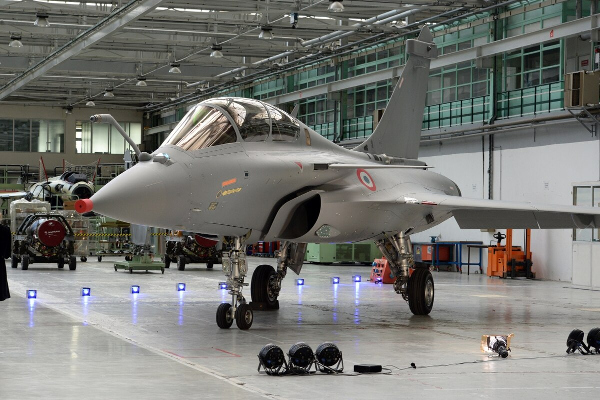
India’s Rafale programme is entering a deeper industrial phase as New Delhi pushes France for greater local manufacturing, higher domestic value addition and stronger participation of Indian companies in future defence platforms. The latest remarks by Foreign Secretary Vikram Misri show that India wants the Rafale track to move beyond aircraft acquisition and become a long-term pillar of defence production under the Make in India framework.
The message from India is clear. Future defence cooperation with France must focus on co-development, co-design, co-production and co-manufacturing. This means India wants a larger share of work inside the country, from structural manufacturing and components to maintenance, repair, overhaul and possible integration of Indian systems. Rafale is now becoming a test case for the next stage of India-France defence ties.
Foreign Secretary Vikram Misri said that discussions on Rafale have progressed between the governments and air forces of both countries because the Indian Air Force already operates the aircraft. He also underlined that the Prime Minister has consistently emphasised India’s desire to advance Make in India in the defence sector. The broader principle is simple: any major platform under discussion should maximise local content and local manufacturing.
This comes at a time when India-France defence relations are moving through a major reset. During Prime Minister Narendra Modi’s talks with French President Emmanuel Macron in Nice, both leaders expressed satisfaction at the depth of defence cooperation across all domains and agreed to intensify it through co-design, co-development and co-production of advanced defence platforms and technologies. The Rafale discussion sits inside this larger strategic framework.
Rafale already has a strong operational footprint in India. The Indian Air Force inducted 36 Rafale fighter aircraft under the earlier inter-governmental agreement, giving India a modern multirole platform with long-range strike, air superiority and precision engagement capability. The Indian Navy has also moved into the Rafale ecosystem through the 26 Rafale-Marine aircraft deal signed with France in April 2025. The naval variant is meant to operate from India’s aircraft carriers and strengthen maritime air power in the Indian Ocean.
The proposed future Rafale acquisition for the Indian Air Force is therefore much larger than another fighter jet purchase. It is connected to India’s need to strengthen squadron strength, modernise air combat capability and reduce dependence on ageing platforms. At the same time, India wants such a large programme to create domestic industrial depth. A multi-billion-dollar fighter deal carries the ability to build skills, factories, supply chains and high-value aerospace employment inside India.
Dassault Aviation has already taken an important step in this direction by partnering with Tata Advanced Systems to manufacture Rafale fighter aircraft fuselages in India. The agreement covers production transfer for key structural sections of the Rafale, including the lateral shells of the rear fuselage, the complete rear section, the central fuselage and the front section. A dedicated facility is being set up in Hyderabad, and the first fuselage sections are expected to roll out in FY2028.
This is significant because it marks the first time Rafale fuselages will be produced outside France. It places India inside the global Rafale supply chain rather than keeping it only as a buyer. If executed well, the Hyderabad line can support Indian requirements and global Rafale production. It also gives Indian industry experience in precision aerospace manufacturing, quality control and advanced defence supply-chain standards.
The engine side is equally important. Safran, which manufactures the M88 engine used by Rafale, has indicated readiness to build an engine assembly line in India if the larger Rafale programme moves forward. Safran has also spoken about sourcing parts from Indian suppliers. This matters because engines are among the most critical and difficult parts of fighter aircraft ecosystems. Even partial engine assembly, servicing and component sourcing can raise India’s aerospace capability.
India is also pushing for stronger maintenance, repair and overhaul capability. Defence Minister Rajnath Singh earlier urged higher Make in India content in the Rafale deal and also sought MRO facilities in India for aero engines. Local MRO is strategically valuable because it reduces turnaround time, lowers dependence on foreign facilities and improves fleet availability during crises. For a country operating a growing mix of advanced aircraft, engine and sensor MRO capacity is a national security asset.
The broader Rafale discussion also connects with India’s desire to integrate domestic weapons and systems wherever possible. India has already built strong missile, electronic warfare, avionics and precision weapons capabilities. A future fighter partnership becomes more valuable when Indian weapons, sensors and communication systems can be integrated into the platform. This gives the armed forces flexibility and strengthens Indian industry.
France has become one of India’s most trusted defence partners because the relationship has survived political change, sanctions-era pressures and shifting global alignments. Mirage 2000 aircraft, Scorpene submarines, Rafale fighters and cooperation in space and nuclear energy have created a durable strategic base. The new phase seeks to convert this trust into manufacturing and technology depth.
The timing is also important. India’s security environment demands stronger air power, maritime reach and resilient defence supply chains. China’s military expansion, Pakistan’s continuing threat posture and the growing importance of the Indian Ocean make advanced aircraft and local sustainment capacity essential. A fighter platform is not only a machine; it is an ecosystem of weapons, spares, engines, simulators, software, training, repair networks and industrial support.
India’s negotiating position is shaped by the scale of the opportunity. A future Rafale order for the Air Force would be one of India’s largest fighter acquisition programmes. Such a programme gives New Delhi leverage to demand higher local content and deeper technology partnerships. France, for its part, gains a long-term production partner, a major defence market and a stronger role in India’s military modernisation.
The Rafale programme also supports India’s ambition to become a global aerospace manufacturing hub. India already has private-sector players building aircraft structures, helicopter components, missile systems, UAVs, radars and electronic systems. A high-end fighter manufacturing chain can help Indian companies climb further up the value ladder. It can also create a supplier base that supports future indigenous programmes such as AMCA, TEDBF and next-generation combat systems.
The key challenge will be the depth of technology transfer. Assembly and component production are useful, but India’s long-term goal is design knowledge, system integration capability, engine ecosystem growth and software-level autonomy. The real value of the future Rafale arrangement will depend on how much Indian industry learns, manufactures and sustains independently over time.
There is also a strategic lesson here. India is moving away from the old buyer-seller model in defence procurement. The new model seeks partnership, production, local jobs, export potential and sovereign capability. Foreign platforms are being judged not only by their battlefield strength, but also by the industrial ecosystem they bring to India.
The Rafale programme can become a major example of this shift. If the next phase brings fuselage manufacturing, engine assembly, Indian suppliers, MRO facilities, weapon integration and stronger technology collaboration, it will deepen India’s aerospace base. It will also strengthen the India-France strategic partnership in a practical and measurable way.
The latest comments by Foreign Secretary Vikram Misri therefore carry a wider message. India is ready to work with France on advanced defence platforms, but the centre of gravity must move toward Indian manufacturing. Rafale is no longer only a fighter aircraft in India’s inventory. It is becoming a platform for industrial policy, strategic autonomy and future aerospace capability.
You may also like
-
Rajnath Singh Calls for Aatmanirbharta 2.0 in Defence at SWAVLAMBAN 2026
-
Defence Acquisition Council Clears ₹2.12 Lakh Crore Proposals, 82% Earmarked for Indian Industry
-
Indian Army Special Forces Depart for Indonesia for Exercise Garuda Shakti 2026
-
India to Train 600 Nigerian Army Soldiers in Specialised Jungle and Mountain Warfare
-
India Moves Towards Five-Year Assured Orders for Defence Startups Under New Procurement Reforms
