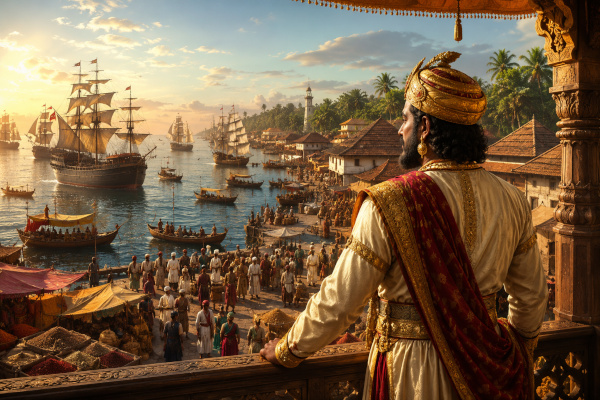
Manavikraman Zamorin belongs to the great royal memory of Kozhikode, the medieval port city that carried the name of Kerala across the seas. The Zamorins of Calicut were among the most powerful rulers of the Malabar Coast. They turned Kozhikode into a centre of pepper, cardamom, textiles, ship movement, merchant wealth, temple culture and maritime diplomacy. Among this line, the name Manavikraman stands with special importance because it represents the Zamorin age when Calicut reached global prominence.
A careful reading of Kerala history shows that Manavikraman was more than a personal name. Among the Zamorins, royal names and titles often repeated across generations. The ruler was known through the dignity of the office, the house he represented and the power he exercised. For this reason, Manavikraman should be understood both as a kingly figure and as a royal name associated with the wider greatness of the Zamorin state.
The Zamorins belonged to the Nediyiruppu Swaroopam of Eranad. Their early base was inland, away from the coast. This was a major limitation because Kerala’s wealth moved through ports. The rulers of Eranad understood that access to the sea was the key to political expansion. They fought the Porlathiri rulers of Polanad and gradually secured the region around Kozhikode. This gave them the one thing their state needed most: a maritime window.
With Kozhikode in their hands, the Zamorins transformed a coastal settlement into a port kingdom. Calicut became one of the great trading centres of the Indian Ocean. Arab merchants, Chinese traders, Jewish traders, Persian networks and later European visitors came to this coast because the city offered spices, security and commercial freedom. Pepper from the hills, cardamom from the interior, forest produce, textiles, coconuts, rice and imported goods moved through its markets.
This was the world inherited and strengthened by Manavikraman Zamorin. His importance lies in the fact that the Zamorin throne stood at the meeting point of land power and sea power. Inland, the ruler needed Nair military strength, temple legitimacy, control over routes and alliances with local chiefs. On the coast, he needed ships, merchants, brokers, warehouses and diplomatic skill. Calicut’s greatness came from joining these two worlds.
The Zamorin’s rule was built on a practical understanding of trade. Calicut prospered because merchants were given freedom and protection. The ruler understood that commerce grows when traders feel secure. The Arab and Chinese merchants preferred Kozhikode because they could work under a system that protected their goods and allowed them to trade freely. This policy turned Calicut into a cosmopolitan city. Different languages, religions and trading customs met under the authority of the Zamorin.
Manavikraman’s Calicut was therefore not merely a royal capital. It was a world port. Ships came with the monsoon winds. Merchants brought gold, silver, horses, silk, porcelain and luxury goods. They carried back pepper, spices, textiles and coastal products. The bazaar became the heartbeat of the kingdom. The port became the face of Kerala to the wider world.
The greatness of the Zamorin rested partly on his alliance with the Mappila Muslim merchant and seafaring communities. These groups had long experience in oceanic trade. They knew the routes to Arabia, the Red Sea, the Persian Gulf and Southeast Asia. The Zamorin gave them space, patronage and protection. In return, they strengthened Calicut’s trade and later its naval resistance. This partnership between a Hindu ruler and maritime Muslim merchants became one of the defining features of Calicut’s political culture.
This is one reason Calicut was different from many other medieval ports. The Zamorin did not build power by closing the sea. He built power by opening it under his authority. His kingdom welcomed merchants while ensuring that the final political sovereignty belonged to the throne. This balance made Calicut attractive and powerful.
Manavikraman is also remembered in connection with the cultural and temple life of Kozhikode. The Tali Mahadeva Temple stood near the royal centre and became one of the great sacred landmarks of the city. The Zamorins were patrons of temple culture, Sanskrit learning and scholarly assemblies. Revathi Pattathanam, the famous annual gathering of scholars at the Tali Temple, became one of Kerala’s most respected intellectual traditions. Scholars came for debate, recognition and honour. The awarding of the title Bhatta gave the event lasting prestige.
The association of Manavikraman with the renovation and royal patronage of Tali Temple shows another side of Zamorin rule. Calicut was a port city, but it was also a dharmic centre. Trade wealth did not remain only in markets. It flowed into temples, festivals, learning, land grants, public culture and royal prestige. This is how the Zamorin state combined maritime power with sacred authority.
The Zamorin’s court represented the political culture of medieval Kerala. The ruler was supported by princes, ministers, Nair commanders, temple functionaries, Brahmin scholars, merchant leaders and local chiefs. The state was not controlled through a modern bureaucracy. It worked through layered authority, custom, military obligation and negotiated loyalty. Such a system required a ruler with patience, firmness and diplomatic intelligence.
The Mamankam at Tirunavaya was another important element in the rise of Zamorin power. Control over this grand regional festival gave the Zamorin ritual prestige and political visibility across Kerala. It connected kingship with sacred assembly, trade fair, military display and public recognition. Through such institutions, the Zamorin projected himself as a ruler whose authority extended beyond Kozhikode.
The kingdom also developed Ponnani as a major base. Ponnani had political, commercial and later naval importance. It connected the Zamorin to the Bharathapuzha region and to the maritime networks of Malabar. Calicut and Ponnani together gave the Zamorin both a port capital and a strategic southern base.
The arrival of Vasco da Gama at Kappad near Calicut in 1498 brought a new challenge to the world of the Zamorins. The Portuguese came in search of direct access to the spice trade. They wanted to remove Arab and other Indian Ocean intermediaries and create a monopoly over pepper and maritime commerce. The Zamorin received the foreign visitors according to the established port culture of Calicut. He was ready to allow trade, but he did not surrender sovereignty over the market.
This moment changed the history of the Indian Ocean. Calicut had long welcomed traders, but the Portuguese came with a different political aim. They came with armed ships, royal backing and a plan to dominate sea routes. The Zamorin’s system was based on open commerce under local authority. The Portuguese system was based on naval pressure, fort control and monopoly. The clash between these two worlds shaped the sixteenth-century history of Malabar.
The Zamorin’s resistance to Portuguese monopoly became one of the earliest Indian responses to European sea power. Calicut did not accept the idea that a foreign navy could decide who traded in the Indian Ocean. The kingdom worked with merchant communities, naval fighters and regional allies to defend its commercial freedom. This resistance later found its strongest expression through the Kunjali Marakkars, the famous naval chiefs of the Zamorin.
The Marakkars brought a new maritime edge to Calicut’s power. They used smaller, faster vessels, coastal knowledge and guerrilla tactics against Portuguese shipping. Their strength came from the same world that had built Calicut’s prosperity: merchant networks, seafaring skill and loyalty to the port economy. The Zamorin’s naval policy showed that Kerala’s coast had its own defence tradition long before modern navies.
Manavikraman’s place in this story is symbolic and historical. He represents the mature phase of Zamorin power when Calicut stood as a gate of the spice world. Under the Zamorin line, Kozhikode was not a passive port waiting for foreign traders. It was a sovereign maritime state that understood commerce, diplomacy and naval strategy.
The prosperity of Calicut also supported cultural refinement. Sanskrit learning, Malayalam literary culture, temple festivals, martial traditions and merchant patronage grew in the shadow of the Zamorin court. The kingdom’s wealth was not only measured in pepper sacks and customs revenue. It was also measured in scholars, rituals, debates, architecture and public memory.
The title Zamorin itself became famous across the world. Arabs, Chinese, Portuguese, Dutch and English sources remembered the ruler of Calicut because his port was important to their own commercial ambitions. The name of Calicut entered global history through spices, maps, travel accounts and European maritime expansion. Behind that fame stood the long labour of the Zamorin rulers.
Manavikraman Zamorin must therefore be seen as a king of transition and confidence. He belonged to a Kerala that was strongly rooted in temple, land and warrior order. At the same time, he ruled a city connected to Arabia, Persia, China and Europe. His world was local and global at once. That is what makes Calicut’s history so powerful.
The Zamorin model of governance offers a major lesson. A small coastal kingdom became internationally important because it protected trade, welcomed skilled communities, invested in ports, honoured learning and defended sovereignty. Geography gave Calicut an opening. Policy turned that opening into power.
Manavikraman’s memory also reminds us that Indian maritime history is not only the story of foreign arrivals. It is the story of Indian ports, Indian rulers, Indian merchants, Indian sailors and Indian political choices. Calicut was already a major city before Vasco da Gama arrived. The Portuguese came to a world that was already wealthy, organised and globally connected.
In Kerala’s civilisational history, the Zamorins stand as rulers of the sea-facing frontier. They linked the Western Ghats to the Arabian Sea. They carried pepper from hill to port. They brought merchants under royal protection. They supported temples and scholarship. They fought for commercial sovereignty when foreign monopolies tried to control the coast.
Manavikraman Zamorin stands within this grand memory as a symbol of Calicut’s golden maritime age. His name evokes the strength of the Samoothiri throne, the dignity of Tali Temple, the debates of Revathi Pattathanam, the spice markets of Kozhikode, the ships of the Arabian Sea and the political intelligence of Kerala’s coastal kingship.
For Dharmakshethra, his story is important because it brings together dharma, trade, kingship and resistance. It shows that a ruler’s greatness is not measured only by conquest. It is measured by the city he builds, the commerce he protects, the learning he patronises and the sovereignty he refuses to surrender.
Manavikraman Zamorin remains one of the great names associated with Calicut’s royal tradition. Through him, we remember the age when Kozhikode was the City of Spices, the court of the Zamorin, the pride of Malabar and one of the most important maritime windows of Bharat.
You may also like
-
GeM’s AABHAR Collection Showcases 294 Indigenous Products, Strengthens Market Access for Indian Artisans
-
Tushara in the Mahabharata: The Lands Beyond the Hindu Kush and the Horsemen Who Faced Arjuna
-
India Creates History with Record 114 Medals at Asian Para Games 2026, Prime Minister Modi Hails Para-Athletes
-
Shaka in the Mahabharata: Central Asia’s Steppe Peoples, Nakula’s Campaign and the Alliance with Duryodhana
-
Yavana in the Mahabharata: Greek Connections, Pandava Campaigns and the Warriors of Kurukshetra
