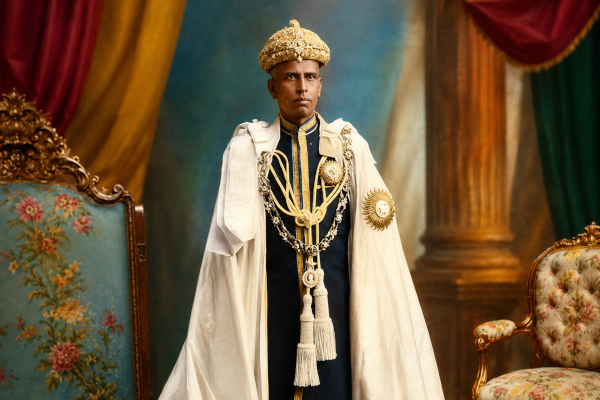
Rama Varma XV occupies a respected place in the later history of the Kingdom of Kochi. He ruled from 1895 to 1914, during the period of British paramountcy, when princely states retained internal authority while operating within the larger shadow of colonial power. In this difficult political world, Rama Varma XV became known as the Rajarshi of Cochin, a ruler remembered for scholarship, administrative discipline, public works, education and a personal style of governance rooted in restraint.
He belonged to the Cochin royal house, the Perumpadappu Swaroopam, one of Kerala’s old ruling lineages. By the time he came to the throne, Kochi was no longer a military kingdom in the older sense. The Portuguese, Dutch and British phases had already changed the political destiny of the region. The Maharaja of Kochi governed under British supremacy, with a Resident and the Madras Government exercising influence over major decisions. This made kingship a delicate office. A ruler had to protect local interests, maintain royal dignity, work with Dewans, manage finances, answer to British officials and still preserve the trust of his people.
Rama Varma XV accepted this challenge with a reforming mind. He was not remembered as a warrior king like Sakthan Thampuran, but as an administrator who worked through institutions. His reign came at a time when modern governance was becoming more important than royal spectacle. Revenue records, education, public health, transport, local administration and legal reform were becoming the new instruments of statecraft. In this sense, Rama Varma XV belongs to the generation of Indian princes who tried to modernise their states while preserving cultural identity.
One of the greatest achievements associated with his reign was the extension of railway connectivity from Shoranur to Kochi. This was not a minor public work. It was a civilisational turn for central Kerala. Shoranur was already a major railway junction. Bringing the line to Kochi meant connecting the port region, inland trade, markets, timber, agricultural produce and passengers to the larger railway network of India. The first trains on this route in the early twentieth century changed the movement of goods and people in the region.
The railway line became a foundation for the later growth of Kochi as a commercial centre. Before rail connectivity, the backwaters and traditional roads carried much of the burden of transport. The railway added speed, scale and predictability. It gave merchants access to wider markets and helped the state earn revenue. It also tied Kochi more firmly to the economic geography of modern India. For this reason, Rama Varma XV is often remembered as one of the rulers who helped open the road to modern Kochi.
The story of how the railway was funded has become part of Kerala’s public memory. Local tradition and later accounts say that the Maharaja raised money for the project by selling valuable royal and temple possessions, including golden caparisons connected with Sree Poornathrayeesa Temple at Tripunithura. Whether every detail is repeated differently in different accounts, the larger message remains powerful: Rama Varma XV placed public infrastructure above personal or ceremonial wealth. In a princely world where splendour often defined status, this choice gave him a different image. He became a ruler willing to sacrifice visible royal grandeur for long-term public benefit.
His reign also saw important reforms in revenue and accounts. These were quiet reforms, but they mattered deeply. A state could build roads, schools and hospitals only when its finances were organised. The old system of complex land tenures, minor imposts and scattered practices needed simplification. The Cochin administration during this period worked toward a more systematic revenue structure, clearer accounts and improved fiscal discipline. This helped the state move from older forms of royal management toward modern administrative governance.
Education received strong attention during his period. The Cochin State Manual records major educational expansion in this era, including the growth of vernacular instruction, schools for boys and girls, grants-in-aid for private schools, scholarships, night schools for working people and improved teacher training. This was an important shift. Education was no longer treated only as a privilege of elites. It was increasingly seen as a public responsibility of the state.
The emphasis on vernacular education was especially important. A society becomes stronger when learning reaches people in their own language. Village-level schools, girls’ education, teacher training and scholarships helped widen access. The state also encouraged Anglo-vernacular and higher education where required, allowing Kochi to balance traditional learning with modern needs. Rama Varma XV understood that a state’s strength came not only from revenue and roads, but also from an educated people.
His interest in Sanskrit learning forms another important part of his legacy. He is associated with the establishment and patronage of Sanskrit education at Tripunithura. This gives his reformist image a distinctly dharmic character. He did not see modern education and traditional learning as enemies. For him, Sanskrit, shastra, public instruction and modern administration could exist within the same civilisational framework. This is why the title Rajarshi suited him. He represented the image of a ruler who valued both governance and wisdom.
The Panchayat Bill and the Tenancy Act are also remembered among the reforms of his period. These measures show a ruler who understood that governance had to reach the village and the cultivator. Panchayat reform pointed toward local participation in administration. Tenancy reform addressed the social and economic realities of land, occupation and agrarian relations. In Kerala, where land relations shaped social life deeply, such reforms carried long-term importance.
The Tenancy Act is often described as one of Rama Varma XV’s major achievements. It reflected an effort to bring fairness, order and legal clarity to relations between landlords and tenants. Such reforms were never simple in a society layered by caste, custom, temple authority, landlordism and royal obligations. Yet the attempt itself shows the direction of his rule. He wanted governance to become more structured, accountable and useful to the people.
Public health and medical administration also developed during this broad phase of reform. Sanitary boards, medical reorganisation and public welfare measures became part of the modernising state. In the old order, charity and temple-linked support had served important roles. In the new order, public health required departments, hospitals, sanitation and trained officials. Kochi’s transition into this form of governance took shape during the larger reform period in which Rama Varma XV played a central role.
He was also a ruler who had to manage the pressures of British authority. British paramountcy placed Indian princes in a complicated position. They were sovereign within their states, yet their sovereignty was supervised. A ruler could not always act freely. Financial decisions, railways, public works, honours, diplomacy and succession matters often required British approval or cooperation. Rama Varma XV worked within this system, yet he did not become merely ornamental. He used the limited space available to him for reform.
His relationship with British officials was marked by both cooperation and tension. He received imperial honours and participated in the formal world of the Raj, but he also carried his own views on administration and royal responsibility. This tension makes his life historically interesting. He was not a revolutionary ruler, but he was also not a passive figure. He belonged to that category of Indian princes who negotiated power, preserved dignity and tried to use the machinery of the princely state for constructive change.
In 1914, Rama Varma XV abdicated the throne. After abdication he became popularly known as Ozhinja Valiya Thampuran, meaning the Abdicated Highness. Abdication itself added to his unusual place in Kochi’s memory. Many rulers clung to power until death. Rama Varma XV stepped away from the throne and lived on as a respected elder. He died in 1932, long after leaving active rule, and remained a remembered figure in public life and royal history.
His personal image is also important. The title Rajarshi suggests a ruler with the qualities of a raja and a rishi. It points to learning, simplicity, restraint and ethical seriousness. Public memory has preserved him as a scholar-ruler, a Sanskrit lover, a reformer and a man of disciplined life. Such titles are meaningful in Kerala’s historical imagination. A Rajarshi is not merely an administrator. He is a ruler who understands that power must be guided by dharma.
Rama Varma XV’s reign helped prepare Kochi for the twentieth century. The railway opened economic movement. Education reforms widened social access. Revenue reforms strengthened administration. Panchayat and tenancy measures pointed toward public participation and agrarian justice. Sanskrit patronage preserved civilisational continuity. His rule showed that modernisation did not require cultural self-erasure. It could be built on the foundation of local identity, dharma and public duty.
His legacy also reminds us that not every great ruler is remembered through conquest. Some rulers build through systems. Some leave behind roads, schools, records, laws and institutions. Rama Varma XV belongs to that quieter but deeply important tradition of kingship. He took a small princely state under colonial pressure and helped it move toward organised governance. He understood that a ruler’s greatness lies in what he creates for the future.
Today, when Kochi is seen as a major urban, commercial and cultural centre of Kerala, the memory of Rama Varma XV deserves renewed attention. The city’s modern story did not begin suddenly. It was shaped by port geography, royal policy, railway ambition, administrative reform and public investment. Among the rulers who contributed to this transformation, Rama Varma XV stands with special dignity.
Rama Varma XV, the Rajarshi of Cochin, was a ruler of transition. He stood between old monarchy and modern administration, between royal ceremony and public infrastructure, between Sanskrit learning and contemporary education, between colonial pressure and local responsibility. His life shows how dharmic kingship adapted to a changing age. He ruled with a reformer’s mind, a scholar’s respect for tradition and a trustee’s sense of public duty.
For Kerala’s history, he remains one of the important builders of modern Kochi.
You may also like
-
India Creates History with Record 114 Medals at Asian Para Games 2026, Prime Minister Modi Hails Para-Athletes
-
Shaka in the Mahabharata: Central Asia’s Steppe Peoples, Nakula’s Campaign and the Alliance with Duryodhana
-
Yavana in the Mahabharata: Greek Connections, Pandava Campaigns and the Warriors of Kurukshetra
-
India and Sri Lanka Launch SAMHiTA Manuscript Digitisation Project to Preserve Ancient Buddhist Heritage
-
ASI Uses Ground-Penetrating Radar to Investigate Ancient Buddhist Stupa at Ujjain After Nearly 90 Years
