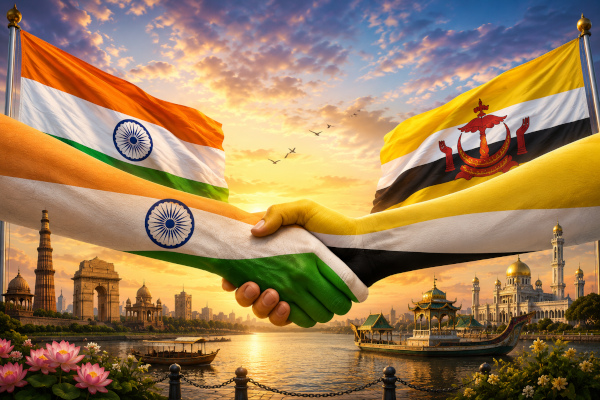
India and Brunei Darussalam have taken another step to strengthen their long-standing relationship, with India’s High Commissioner to Brunei, Ramu Abbagani, meeting the Speaker of Brunei Darussalam’s Legislative Council, Pehin Orang Kaya Seri Lela Dato Seri Setia Haji Abdul Rahman, on 10 June 2026. The meeting focused on deepening bilateral ties and expanding parliamentary engagement between the two countries.
The engagement is important because India-Brunei ties have moved steadily from traditional friendship to a broader partnership covering diplomacy, trade, defence, space, education, health, culture and people-to-people relations. Both countries established diplomatic relations on 10 May 1984, and the relationship has been supported by shared cultural links and common membership of platforms such as the United Nations, Commonwealth, Non-Aligned Movement and ASEAN-linked mechanisms.
Parliamentary diplomacy adds a valuable political layer to this relationship. Government-to-government talks create policy direction, while parliamentary exchanges build wider institutional understanding. When lawmakers, speakers and legislative institutions communicate directly, the relationship becomes more stable, more informed and more connected to public policy priorities. For India and Brunei, this can support cooperation in areas such as education, youth engagement, health systems, trade facilitation, digital governance, cultural outreach and regional security.
The latest meeting also follows a series of recent diplomatic engagements between India’s High Commission in Brunei and key Bruneian institutions. DD News reported that Ramu Abbagani recently handed over books to Universiti Islam Sultan Sharif Ali during the launch of an Indian Book Corner, a cultural and academic initiative aimed at promoting knowledge exchange and educational cooperation. He also held separate meetings with Brunei’s Second Minister of Foreign Affairs and Minister of Culture, Youth and Sports in recent months.
The wider strategic direction was clearly visible during Prime Minister Narendra Modi’s visit to Brunei in September 2024, the first bilateral official visit by an Indian Prime Minister to the country. That visit coincided with the 40th anniversary of diplomatic relations and helped push the partnership into a more active phase.
A joint statement issued during that visit identified a wide range of cooperation areas, including defence, connectivity, trade and investment, renewable energy, space, ICT, health and pharmaceuticals, education, capacity building, culture, tourism, youth exchanges and people-to-people ties. The two sides also underlined the need for regular meetings through mechanisms such as Foreign Office Consultations, Joint Working Groups and the Joint Trade Committee.
Space cooperation remains one of the most distinctive pillars of India-Brunei relations. Brunei hosts an ISRO Telemetry, Tracking and Telecommand station, which has supported India’s space activities for many years. During the 2024 visit, India and Brunei renewed cooperation linked to the TTC station, including relocation from Tungku to Telesai as requested by ISRO.
Defence and maritime cooperation also form a natural area of partnership. India and Brunei signed an MoU on Defence Cooperation in 2016, and both sides have recognised the importance of regular exchanges, training programmes, joint exercises and naval or coast guard ship visits. This has special relevance because Brunei sits in Southeast Asia, a region central to India’s Act East Policy and Indo-Pacific vision.
The relationship also has an economic dimension with room for growth. India offers Brunei a large market, skilled manpower, pharmaceuticals, digital capability, space expertise and education partnerships. Brunei offers India a friendly ASEAN partner, energy links, strategic geography and a gateway for deeper Southeast Asian engagement. The Brunei Ministry of Foreign Affairs notes that the bilateral cooperation framework already covers trade, investment, civil aviation, health and education.
The meeting between India’s High Commissioner and Brunei’s Legislative Council Speaker therefore fits into a larger diplomatic pattern. It is not an isolated courtesy call. It is part of a steady effort to create more channels between the two systems: political, educational, cultural, economic and strategic. India and Brunei have already built a foundation of trust. The next phase is about converting that trust into wider institutional cooperation, stronger parliamentary contact and practical projects that benefit both countries.
You may also like
-
India and Italy Hold First Maritime Security Dialogue in Rome, Strengthen Strategic Maritime Cooperation
-
India and Azerbaijan Agree to Strengthen Security, Trade, Energy and Economic Cooperation
-
Jaishankar Meets Azerbaijan President Ilham Aliyev in Baku, Discusses Trade, Technology and Strategic Cooperation
-
Piyush Goyal Holds High-Level Talks in Berlin to Strengthen India–Germany Trade, Investment and Industrial Cooperation
-
Indian Navy to Host Indo-Pacific Regional Dialogue 2026 with Experts from 18 Countries on Maritime Science and Technology
