Prime Minister Narendra Modi’s visit to Larsen & Toubro’s Hazira manufacturing complex in Gujarat marks an important moment in India’s defence-industrial journey. The visit placed attention on a facility that has become closely linked with heavy engineering, advanced manufacturing and indigenous defence production. At a time when India is pushing strongly for self-reliance in military technology, Hazira represents the kind of industrial base needed to turn national security requirements into Indian-made systems.
The Prime Minister reviewed ongoing manufacturing activities and technologies across multiple sectors, with special focus on defence capabilities. The visit underlined the growing role of Indian private industry in building platforms that were once heavily dependent on imports. Companies such as L&T are now part of a larger national ecosystem that includes DRDO laboratories, the armed forces, public-sector units, startups, MSMEs and specialised component suppliers.
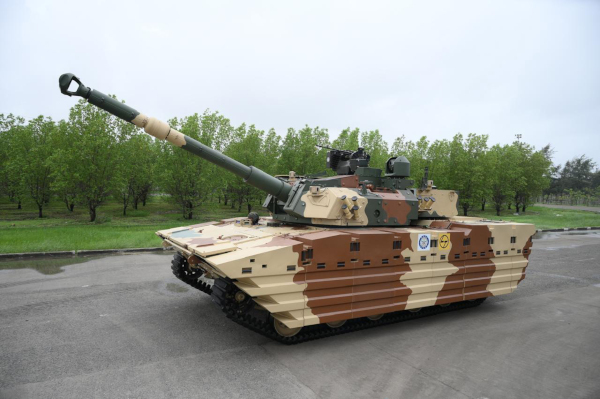
One of the key systems linked with the visit was the Zorawar light tank. Developed by DRDO and L&T Defence, the 25-tonne air-transportable tank is designed for rapid deployment in difficult terrain. Its importance lies in mobility. India’s northern borders require armoured systems that can move quickly across high-altitude areas, support forward troops and respond to fast-changing tactical situations. A lighter tank gives commanders greater flexibility in regions where heavy armour faces movement and logistics challenges.
The Zorawar project also shows how India’s defence priorities are adapting to terrain-specific warfare. The Himalayan frontier demands platforms that combine firepower, protection, speed and transportability. A system built for plains warfare cannot always meet the requirements of mountain combat. A light tank designed with border deployment in mind gives India a stronger option for high-altitude armoured response.
Hazira’s importance goes beyond one platform. The complex represents India’s ability to manufacture large, complex and high-precision systems. Defence manufacturing requires metallurgy, fabrication, electronics integration, testing, quality control, supply-chain discipline and project management. A modern combat platform is not only a weapon. It is an industrial achievement built through thousands of parts, skilled manpower and strict engineering standards.
The visit also reinforces the idea that Make in India in defence must be built through production depth. Designing a system is one step. Manufacturing it at scale, maintaining quality, integrating subsystems and supporting the armed forces through its life cycle form the larger challenge. Facilities like Hazira matter because they connect design ambition with shop-floor execution.
India’s defence self-reliance push has gained urgency due to changing security conditions. The country faces long borders, maritime responsibilities, drone threats, missile challenges, cyber pressure and high-altitude deployment needs. A strong domestic defence industry allows India to respond faster, customise systems for local conditions and reduce dependence on foreign supply chains during crisis periods.
Private-sector participation is becoming central to this transformation. Indian engineering firms bring manufacturing scale, project discipline and innovation capacity into the defence sector. Their role strengthens competition, improves delivery capacity and creates new industrial clusters. When private industry works with DRDO and the armed forces, the result can be faster development cycles and stronger indigenous capability.
The Hazira visit also carries an economic meaning. Defence manufacturing creates skilled jobs, supports MSMEs, strengthens local supply chains and builds export potential. A tank, gun system, armoured vehicle or naval platform creates demand for steel, electronics, optics, software, hydraulics, sensors, engines and specialised materials. Each defence project therefore supports a larger industrial network.
India’s future defence strength will depend on this network. Modern warfare is technology-intensive, and countries with strong manufacturing ecosystems gain strategic confidence. A nation that can build its own platforms can upgrade them faster, repair them during conflict and protect sensitive technologies. Self-reliance in defence is therefore both an economic mission and a security requirement.
The Prime Minister’s appreciation of L&T’s role in defence self-reliance reflects the broader policy direction. India wants its defence sector to move from licensed assembly toward design, development, manufacturing and export. This requires long-term collaboration between government, industry and research institutions. Hazira stands as one example of how such collaboration can produce visible results.
The focus on Zorawar also highlights India’s ability to build systems for specific operational needs. The armed forces require platforms shaped by Indian terrain, Indian doctrine and Indian threat perception. Indigenous development allows greater freedom in design choices and future upgrades. It also gives the military a stronger voice in shaping the equipment it will use in the field.
Hazira’s defence production story fits into India’s larger strategic manufacturing vision. The same industrial culture that builds bridges, ships, reactors, heavy equipment and infrastructure can support the production of armoured platforms, artillery systems and advanced defence technologies. This convergence between civil engineering strength and military manufacturing capacity gives India a powerful industrial advantage.
The visit therefore sends a clear message. India’s defence future will be built inside Indian factories, by Indian engineers, in partnership with Indian research institutions and armed forces. The goal is to create a defence-industrial base that can support national security, generate economic value and project technological confidence.
PM Modi’s Hazira visit is more than a factory inspection. It is a signal that India’s self-reliance mission is moving through real production floors, real platforms and real industrial capability. As systems like Zorawar mature and more private-sector facilities enter the defence chain, India’s armed forces can gain stronger access to platforms designed for the country’s own battlefield realities.
Hazira shows the shape of that future: heavy engineering linked with national security, private industry linked with strategic autonomy, and indigenous manufacturing linked with India’s rise as a defence-capable power.
You may also like
-
Former DRDO Chief Samir Kamat Confirms Akash Missile Exports to Tajikistan and Turkmenistan
-
MoD Signs ₹586 Crore Contract for Indigenous Auxiliary Power Units for T-72 and T-90 Tanks
-
India–Mongolia Joint Military Exercise Nomadic Elephant 2026 Begins in Pithoragarh
-
Agni-5 Heavy Penetrator Concept Emerges as India Studies Long-Range Bunker-Busting Capability
-
DRDO Gives Private Industry Greater Freedom to Refine Secondary Designs and Subsystems
