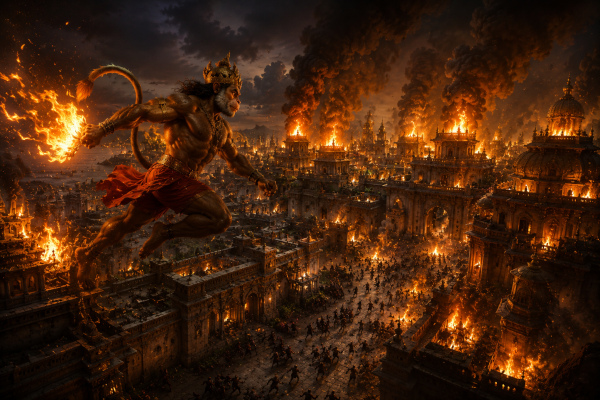
Hanuman’s burning of Lanka is one of the most powerful psychological operations in the Ramayana. The flames that rise from Ravana’s capital carry a message far greater than physical destruction. They announce penetration, reach, courage and divine resolve inside the heart of the enemy’s empire. Lanka had stood as a golden fortress surrounded by the sea, guarded by warriors, ruled by fear and protected by Ravana’s reputation. Hanuman enters it alone, shakes its military pride, burns its royal avenues and leaves behind a city that has seen the first sign of its coming defeat.
The episode begins after Hanuman has already completed the core purpose of his mission. He has found Sita, spoken to her, received her message and confirmed her location. His intelligence objective stands fulfilled. What follows is a deliberate escalation into psychological warfare. He allows himself to be taken into Ravana’s court, speaks directly before the king, measures the arrogance of the enemy leadership and then turns their punishment into his weapon. The Rakshasas wrap his tail in cloth, set it on fire and parade him as an object of mockery. Hanuman transforms that insult into a moving torch of terror.
The burning tail becomes a weapon of morale shock. Hanuman leaps from roof to roof, tower to tower and palace to palace. Fire spreads across mansions, military spaces, royal roads and the homes of Lanka’s powerful chiefs. The city that had watched him as a captive suddenly sees him as an unstoppable raider. The crowd’s laughter turns into panic. Soldiers who believed they were punishing an intruder now run behind the very flame they created. This reversal is the core of psychological warfare: the enemy’s own action becomes the source of its fear.
Lanka’s grandeur makes the shock deeper. Ravana’s capital is described as a city of wealth, height, ornament and disciplined power. Its towers, gateways, golden halls and guarded streets create an image of imperial invincibility. Hanuman’s fire attacks that image. It shows that a fortress can be entered, a palace can be reached and a ruler’s pride can be touched from within. The damage to buildings matters, yet the damage to belief matters more. A city can rebuild walls; an army that has lost confidence in its own security carries fear into every future battle.
Modern warfare treats morale as a battlefield resource. Commanders measure weapons, logistics, terrain and numbers, while psychological strength decides how long a force can absorb pressure. A strike inside a protected zone can have a larger impact than a conventional clash at the frontier. It makes soldiers question their defences, commanders question their assumptions and citizens question the image of power projected by their rulers. Hanuman’s burning of Lanka follows this exact logic. He uses fire as a message system. Every burning rooftop becomes a signal to Ravana’s court that Rama’s side has reach beyond expectation.
A powerful modern Indian parallel appears in the 1971 war through Operation Trident, when the Indian Navy struck Karachi harbour at night and set major enemy assets and oil installations ablaze. The action carried military value through damage to ships, fuel and harbour facilities, while its psychological effect travelled even further. Karachi was the main maritime nerve centre of Pakistan. A strike there showed Indian reach, naval initiative and offensive confidence. The flames over Karachi carried the same strategic language as Hanuman’s fire in Lanka: the enemy’s heartland had been touched, its safe zone had been pierced and its command system had received a direct warning.
Psychological warfare also works through humiliation. Ravana’s court attempts to reduce Hanuman into a spectacle. The burning tail is meant to make him appear defeated before the people of Lanka. Hanuman reverses the theatre. He becomes the director of the spectacle. The same streets prepared for his humiliation become the stage of Lanka’s embarrassment. The same citizens gathered to witness punishment become witnesses to Ravana’s vulnerability. The message travels faster than any formal proclamation: one envoy of Rama has done this, and Rama himself is yet to arrive.
A modern Indian parallel appears in Prime Minister Narendra Modi’s surprise visit to Lahore on 25 December 2015, when he met Pakistan’s then Prime Minister Nawaz Sharif in a gesture of diplomatic goodwill. Within days, on 2 January 2016, terrorists attacked the Pathankot airbase, turning a moment of outreach into a sharp test of India’s patience and resolve. India first demanded firm and immediate action from Pakistan against the organisations and individuals linked to the attack, placing the moral burden clearly before Islamabad. The later Uri attack in September 2016 brought a decisive shift in India’s response posture, with the Indian Army carrying out surgical strikes across the Line of Control on the night of 28–29 September 2016 against terror launch pads. The sequence carries the same strategic lesson seen in Hanuman’s warning to Ravana: peace is offered first, responsibility is placed before the aggressor, and punishment follows when hostile action continues. Diplomacy creates moral clarity; military action then becomes a justified response to repeated provocation.
This kind of humiliation has military value because regimes built on fear depend on the image of control. Ravana’s authority rests on strength, intimidation and the belief that Lanka is secure under his rule. Hanuman’s raid cracks that image before the general war begins. Soldiers begin to imagine future breaches. Ministers begin to sense the scale of the coming danger. Citizens begin to understand that their king has invited a force capable of entering their capital. Psychological warfare prepares the battlefield inside the mind before armies meet outside the gates.
The fire also creates confusion in command. A city under sudden internal attack faces many simultaneous questions. Where is the intruder now? Which quarter is burning? Which guards have fallen? Which palace needs protection? Which route remains open? Which commander holds responsibility? Hanuman’s movement through Lanka multiplies these questions with speed. The Rakshasas chase flames, shadows and rumours. The enemy loses clarity while the raider controls motion. In modern operations, this is the value of shock action inside a defended zone: it floods the opponent’s command system with urgent signals and reduces the time available for calm decision-making.
Hanuman’s psychological warfare also serves Rama’s diplomatic and moral position. Before the war, Ravana receives a warning in his own court. Hanuman speaks as Rama’s envoy and gives Ravana a chance to return Sita. The burning of Lanka follows Ravana’s arrogance. This sequence makes the coming war appear as the result of Ravana’s obstinacy and Rama’s justified response. The enemy capital burns after its ruler rejects wisdom. The event turns military action into moral theatre, where the flames expose the consequence of adharma.
The episode further communicates courage to Rama’s allies. When Hanuman returns, he brings news of Sita along with proof that Lanka can be shaken. The Vanara army receives confidence from his action. A single warrior has crossed the sea, entered the city, met Sita, faced Ravana’s court, battled elite fighters, burned the capital and returned alive. This report energises the coming campaign. Psychological warfare works in two directions: it weakens the enemy and strengthens the friendly side. Hanuman achieves both outcomes in one mission.
Modern militaries understand this dual effect. A successful deep strike lifts national morale, strengthens military confidence and shapes public perception. It tells the friendly population that the armed forces possess reach and initiative. It tells the adversary that distance, walls and political posturing offer limited comfort. Operation Trident created such an effect for India in 1971, giving the Navy a dramatic offensive identity and placing pressure on Pakistan’s maritime confidence. Hanuman’s Lanka raid gives Rama’s campaign the same surge of belief before the main assault.
The burning of Lanka also demonstrates the economy of psychological action. Hanuman arrives alone. He carries limited equipment. His strength, mobility, intelligence and timing produce a strategic effect larger than the size of the force involved. This is the classic value of special operations and deep raids. A small force, used at the right place and at the right psychological moment, can create consequences across an entire theatre. Hanuman turns one flaming tail into a citywide message and a campaign-level signal.
The visual character of the episode is central to its power. Fire at night has a language of its own. It stains the sky, silhouettes towers, sends crowds running and makes fear visible from a distance. The golden city glows under a destructive light. Palace balconies, armour, chariots, banners and domes reflect the same spreading flame. Ravana’s Lanka becomes a theatre of panic. The image remains in the mind because psychological warfare depends on memory. A frightening image carried by thousands of witnesses becomes a weapon long after the flames subside.
In the larger war narrative, Hanuman’s burning of Lanka is the announcement before the siege. It tells Ravana that the war has already entered his city before Rama’s army crosses the sea. It tells the Rakshasas that their enemy possesses courage, intelligence and divine purpose. It tells Sita that Rama’s side is active, near and determined. It tells the Vanaras that Lanka can be reached and shaken. One action speaks to every audience in the war.
That is the greatness of this episode as a defence lesson. Hanuman uses movement, fire, symbolism, timing and enemy arrogance to shape the mental battlefield. He burns structures, breaks confidence, humiliates power and carries home intelligence. The act becomes a fusion of special operations, strategic signalling and psychological warfare. Lanka’s walls still stand after the flames, yet its sense of invulnerability has already begun to fall. The war for the mind begins before the war for the city, and Hanuman wins that first battle alone.
You may also like
-
Former DRDO Chief Samir Kamat Confirms Akash Missile Exports to Tajikistan and Turkmenistan
-
MoD Signs ₹586 Crore Contract for Indigenous Auxiliary Power Units for T-72 and T-90 Tanks
-
India–Mongolia Joint Military Exercise Nomadic Elephant 2026 Begins in Pithoragarh
-
Agni-5 Heavy Penetrator Concept Emerges as India Studies Long-Range Bunker-Busting Capability
-
DRDO Gives Private Industry Greater Freedom to Refine Secondary Designs and Subsystems
