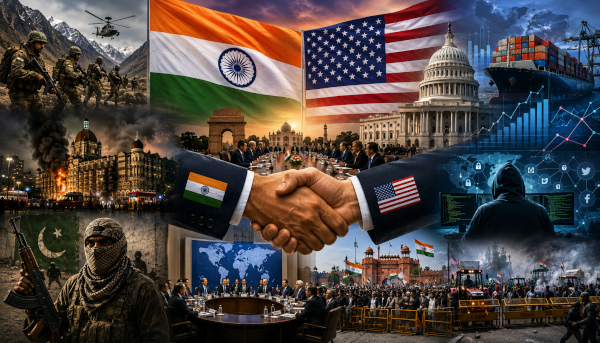
India’s negotiations with the United States rarely take place in a calm strategic environment. From the nuclear dialogue after Pokhran-II to modern talks on trade, defence, technology, energy, visas, tariffs and the Quad, New Delhi has often entered major conversations with Washington while simultaneously facing pressure from terrorism, border crises, domestic unrest, separatist activism, information warfare or geopolitical signalling.
This does not mean every incident was directly planned by the United States. That would require documentary proof. But a clear pattern exists: India’s negotiating atmosphere with Washington has repeatedly been shaped by parallel pressure events. Some were hard-security shocks, especially Pakistan-linked terrorism. Some were domestic unrest episodes. Some involved diaspora activism, digital campaigns or Western media scrutiny. Together, they show that India often negotiates with the world’s most powerful country while also absorbing pressure from several directions.
This is why the phrase “negotiating under pressure” matters. India is not merely discussing trade tariffs, defence agreements or technology partnerships in isolation. It is often negotiating while handling a hostile Pakistan front, cross-border terrorism, diplomatic messaging from Washington, Western commentary on domestic issues, and sometimes social-media controversies that affect the political mood at home.
The earliest major example came after India’s nuclear tests in May 1998. India conducted Pokhran-II on 11 and 13 May 1998, declaring itself a nuclear weapons state. The United States responded with sanctions and pressure, forcing India into a prolonged strategic dialogue. Between 1998 and 2000, External Affairs Minister Jaswant Singh and US Deputy Secretary of State Strobe Talbott held repeated rounds of talks to manage the fallout from India’s nuclear decision. This was one of the most important diplomatic engagements in modern India–US history.
Then came Kargil in 1999. Pakistani intrusions across the Line of Control created a limited war in the mountains of Jammu and Kashmir while India was still under Western nuclear pressure. India had to fight a high-altitude conflict, maintain escalation control, avoid crossing the LoC, prove Pakistan’s role internationally, and keep the United States from equating aggressor and victim. The crisis eventually ended with Pakistan under international pressure, but the lesson was clear: India’s strategic negotiations with Washington could quickly become entangled with Pakistani military adventurism.
The next major phase came after 9/11. The United States needed Pakistan for its Afghanistan campaign, while India wanted Washington to recognise Pakistan-sponsored terrorism as a direct threat to Indian national security. This contradiction shaped India–US relations after the 13 December 2001 Parliament attack, when terrorists struck the heart of Indian democracy. India mobilised its armed forces under Operation Parakram, creating one of the largest India–Pakistan military standoffs. New Delhi had to negotiate with Washington at a time when Washington was heavily dependent on Islamabad for logistics, intelligence and access into Afghanistan.
This produced a familiar diplomatic problem for India. The United States would condemn terrorism, but its strategic requirement in Afghanistan made Pakistan useful. India’s terrorism concerns were acknowledged, yet Pakistan’s military-intelligence establishment continued to remain relevant for US regional policy. India was forced to present its case against Pakistan-backed terrorism inside an American framework shaped by the War on Terror, Afghanistan and US dependence on Pakistani routes.
The 2005–2008 civil nuclear deal showed the same pattern in another form. The India–US nuclear agreement was a historic diplomatic breakthrough. It began with the 18 July 2005 joint statement between Prime Minister Manmohan Singh and President George W. Bush. The IAEA Board approved India’s safeguards agreement on 1 August 2008. The Nuclear Suppliers Group granted India a waiver in September 2008. The US Senate approved the deal on 1 October 2008, and President Bush signed the enabling legislation on 8 October 2008.
Just weeks later, Mumbai was attacked. On 26 November 2008, ten Lashkar-e-Taiba terrorists launched coordinated attacks across India’s financial capital. The attack lasted nearly three days and killed 166 people. The targets included the Taj Mahal Palace Hotel, Oberoi Trident, Chhatrapati Shivaji Terminus, Nariman House and other locations. India blamed Pakistan-based Lashkar-e-Taiba, and the lone surviving terrorist, Ajmal Kasab, became living proof of the Pakistan connection.
The timing was striking. India had just crossed a historic threshold with the United States through the nuclear deal. The diplomatic mood should have been focused on a new strategic partnership. Instead, India was forced into another Pakistan-linked terror crisis. The centre of gravity shifted from nuclear normalisation to counter-terrorism, evidence dossiers, international pressure on Pakistan and the question of Indian military response. Once again, a major India–US strategic moment was followed by a shock that forced India to negotiate from a crisis environment.
The same pattern appeared around the rapid defence deepening of 2015–2016. India and the United States were moving closer on defence logistics, maritime cooperation and military interoperability. On 29 August 2016, India and the United States signed the Logistics Exchange Memorandum of Agreement, or LEMOA, in Washington. The agreement allowed the two militaries to use each other’s facilities for supplies, repairs and logistics support, especially during exercises, humanitarian assistance, disaster relief and other authorised activities.
But 2016 had already opened with the Pathankot attack. On the night of 1–2 January 2016, terrorists attacked the Indian Air Force station at Pathankot in Punjab. The attack targeted a major military installation and exposed the continued threat to India’s defence infrastructure. In September the same year, another major attack took place at Uri. On 18 September 2016, terrorists struck an Indian Army brigade headquarters in Jammu and Kashmir, killing 18 Indian soldiers. India responded with surgical strikes across the Line of Control on 29 September 2016.
This was a crucial year. India was deepening defence ties with the United States through LEMOA, while facing repeated Pakistan-linked attacks on military facilities. These incidents created a battlefield logic behind India’s growing demand for surveillance, intelligence sharing, special forces capability, border response, drones, precision weapons and secure communications. The India–US defence relationship grew in exactly the environment where India’s Pakistan threat was becoming more operationally intense.
The 2018–2019 period added trade friction to this security pressure. On 6 September 2018, India and the United States signed COMCASA during the inaugural 2+2 Ministerial Dialogue. The agreement enabled India to access secure communications equipment and improve interoperability with US-origin platforms. It was a major step in defence cooperation.
But by early 2019, India–US trade tensions had sharpened. The Trump administration announced in March 2019 that it intended to terminate India’s benefits under the Generalized System of Preferences. The GSP programme had allowed several Indian exports to enter the US market duty-free. The decision affected billions of dollars of trade and was justified by Washington on the grounds of market access. India later responded with tariffs on US products.
In the middle of this trade pressure came Pulwama. On 14 February 2019, a suicide bomber attacked a CRPF convoy at Lethpora in Pulwama district of Jammu and Kashmir, killing 40 CRPF personnel. The Pakistan-based Jaish-e-Mohammed claimed responsibility. India launched the Balakot airstrike on 26 February 2019, targeting a Jaish-e-Mohammed facility in Pakistan. The next day saw aerial engagement and the capture of Indian Air Force pilot Wing Commander Abhinandan Varthaman, who was later released.
This moment combined terrorism, military escalation, election-season pressure, trade friction and India–US diplomacy. India needed international support against Pakistan, while the United States was simultaneously pressuring India on trade. Washington backed India’s right to self-defence in broad terms, but the overall environment showed how India could be squeezed between security crisis and economic negotiation at the same time.
The year 2020 brought another layer: defence integration with the United States, China pressure on the border and domestic unrest scrutiny. In February 2020, Delhi witnessed serious riots during the visit of US President Donald Trump to India. The violence caused major loss of life and drew global attention. Later that year, India faced the Galwan crisis and wider Chinese pressure along the Line of Actual Control in eastern Ladakh.
On 27 October 2020, India and the United States signed BECA, the Basic Exchange and Cooperation Agreement, during the third 2+2 Ministerial Dialogue. BECA enabled the sharing of geospatial intelligence and advanced mapping data, improving the accuracy of Indian missiles, drones, aircraft and navigation systems. The agreement came at a time when India was urgently strengthening military readiness against China. The strategic utility was clear: India’s crisis with China made US defence cooperation more valuable, but it also meant India was negotiating from a live border-pressure environment.
The 2021 Red Fort violence showed another kind of pressure. On 26 January 2021, during the farmers’ tractor rally in Delhi, protesters broke through barricades and entered the Red Fort complex. The incident became a major domestic and international story. It generated intense media coverage, social-media polarisation and political debate. India’s domestic governance image came under scrutiny at a time when New Delhi was also trying to project itself as a stable democratic partner in the Quad, pandemic diplomacy and global supply-chain discussions.
This is important because pressure on India during negotiations does not come only through terrorism. It can also come through narratives. Domestic unrest, digital amplification, activist networks, diaspora groups and foreign media coverage can influence the diplomatic atmosphere. The United States often raises democracy, rights, minority concerns, protest rights, internet access or civil liberties in its global language. India therefore has to manage both state-to-state negotiation and perception warfare.
The 2023 period made this even clearer. Prime Minister Narendra Modi’s June 2023 state visit to the United States produced major announcements on defence, technology, semiconductors, critical minerals, space, jet engines and advanced computing. It was one of the most important India–US engagements of the decade. But around the same broader period, Khalistan-linked separatist activism and attacks or threats against Indian diplomatic missions in Western countries became a major irritant.
India repeatedly pressed Western governments to act against extremist elements targeting Indian missions and diplomats. The United States, Canada and other Western countries framed many of these issues through legal process, free speech and local law-enforcement standards. This created another negotiating challenge. India wanted firm action against separatist intimidation and extremist networks abroad, while Western systems treated many activities as protected political expression unless direct criminal conduct could be proved.
The 2024–2025 period became even more complex. India–US ties faced friction over Russian oil, technology controls, visas, tariffs and the case involving an alleged plot against a Sikh separatist figure in North America. These issues created diplomatic discomfort. At the same time, India’s security environment was shaken again by the Pahalgam terror attack.
On 22 April 2025, terrorists attacked civilians in Pahalgam in Jammu and Kashmir. Official Indian accounts later said the attack claimed 26 innocent lives. On 7 May 2025, India launched Operation Sindoor, a tri-services precision response against terror infrastructure in Pakistan and Pakistan-occupied Jammu and Kashmir. Government material described the operation as a calibrated response based on intelligence, jointness and precision.
Operation Sindoor became a defining moment in India’s modern counter-terror doctrine. It signalled that India would respond to major terror attacks with direct strikes against terrorist infrastructure and would reject nuclear blackmail as a shield for Pakistan-sponsored terrorism. The operation also showed India’s growing confidence in integrated military action across services.
The diplomatic effect was significant. India was once again dealing with terrorism, Pakistan, military escalation, global messaging and US attention at the same time. Even when Washington supported de-escalation, India’s core concern remained clear: repeated Pakistan-linked terrorism was creating pressure before and during major international engagements.
The latest example is the 2026 digital-pressure environment around the Cockroach Janta Party controversy and US Secretary of State Marco Rubio’s India visit. Rubio visited India from 23 to 26 May 2026 for talks on energy security, trade, defence cooperation and the Quad. On 26 May 2026, Quad foreign ministers met in New Delhi and discussed critical minerals, energy security and regional cooperation.
Around the same period, India saw the rapid rise of the online satirical movement called the Cockroach Janta Party. It grew into a major social-media phenomenon, especially among young users. The BJP alleged that a large share of its social-media following came from Pakistan, claiming around 49 percent of followers were Pakistan-based and less than 10 percent were from India. The CJP founder disputed such claims and the issue moved into legal and political debate after account restrictions.
This is not the same as a terror attack. It belongs to a different category: digital influence, satire, online mobilisation, platform politics and foreign-origin engagement claims. But it still fits the broader idea of negotiation under pressure. Rubio’s India visit was meant to repair and strengthen India–US ties around trade, energy, tariffs, Quad coordination and strategic cooperation. At the same time, India’s domestic political space was dealing with a viral digital controversy involving allegations of foreign amplification.
This is the new battlefield around diplomacy. Earlier pressure was mostly physical: terror attacks, border crises, military standoffs. Today, pressure can also be informational: social-media storms, foreign bot allegations, diaspora campaigns, censorship disputes, youth anger, memes, satire and narrative warfare. These do not need to be equivalent to terrorism to influence the political mood. They shape the background noise during high-level diplomacy.
The overall pattern from 1998 to 2026 is clear. India’s major talks with the United States have repeatedly coincided with parallel stress events.
In 1998–2000, India negotiated nuclear legitimacy while managing Kargil and sanctions.
In 2001–2002, India dealt with the Parliament attack while the United States depended on Pakistan for Afghanistan.
In 2005–2008, the nuclear deal culminated just before the Mumbai attacks forced India back into counter-terror crisis mode.
In 2016, India signed LEMOA in a year marked by Pathankot, Uri and surgical strikes.
In 2018–2019, COMCASA and trade friction overlapped with Pulwama and Balakot.
In 2020, BECA was signed during the China border crisis and after major domestic unrest in Delhi.
In 2021, Red Fort violence created a domestic and international narrative challenge during India’s Quad and pandemic diplomacy phase.
In 2023, a historic US state visit occurred amid expanding technology cooperation and rising Khalistan-linked concerns abroad.
In 2025, Pahalgam and Operation Sindoor shaped India’s security posture while India–US relations were also managing friction over energy, trade and strategic autonomy.
In 2026, Rubio’s visit and Quad activity took place amid the CJP digital controversy and renewed debate about foreign online influence.
The lesson is not that every incident was controlled by one hand. The lesson is that India’s adversaries, critics and pressure groups understand timing. Terror groups seek visibility during major diplomatic moments. Pakistan-linked networks benefit when India is forced into crisis management. Western pressure grows when India appears internally unstable. Digital campaigns can create perception turbulence during negotiation windows. Trade and technology talks can become harder when India is also fighting narrative battles at home.
For India, the strategic answer is to treat major negotiations as multi-domain events. A trade negotiation is not only about tariffs. A defence agreement is not only about equipment. A technology pact is not only about semiconductors or AI. Every high-level negotiation now takes place inside a wider battlespace of terrorism, media, lawfare, diaspora activism, cyber operations, social-media influence and geopolitical signalling.
This requires a stronger Indian playbook. First, India must separate evidence from suspicion. It should avoid making claims without proof, because credibility is a strategic asset. Second, India must document timing, networks, funding, digital amplification and cross-border linkages where evidence exists. Third, India must enter negotiations with the United States from a position of confidence, making clear that terrorism, separatist intimidation and information warfare are not side issues but core national-security concerns.
India should also build an institutional memory of pressure events around major negotiations. Every summit, ministerial visit, trade round, defence agreement and technology dialogue should be mapped against incidents on the Pakistan front, domestic unrest, cyber activity, diaspora mobilisation and digital manipulation. Patterns matter. Even when they do not prove conspiracy, they reveal how pressure accumulates.
The United States remains an important partner for India in defence, technology, intelligence, education, energy, investment and the Indo-Pacific. But India’s experience shows that partnership with Washington often comes with pressure, bargaining, conditionality and narrative management. The US negotiates hard. It uses market access, sanctions, tariffs, visas, technology controls, human-rights language and alliance structures as tools of leverage. India must therefore negotiate with warmth where interests align and firmness where pressure is applied.
Pakistan remains a recurring variable in this story. Its military-intelligence ecosystem has historically used terrorism as a tool against India. When India’s global profile rises or when India enters major strategic negotiations, terrorism can create disruption, divert attention and internationalise the India–Pakistan question. This does not mean every attack is linked to a specific India–US negotiation. It means Pakistan-backed terrorism repeatedly enters the frame during critical diplomatic phases.
The modern version of this pressure is wider than Pakistan alone. It includes cyber operations, social-media manipulation, activist ecosystems, foreign media narratives, diaspora radicalism and platform politics. India is dealing with a world where the battlefield and the negotiating table are connected. A hashtag can affect perception. A terror attack can shift summit priorities. A court case abroad can complicate a technology pact. A visa dispute can affect talent flows. A sanctions threat can influence energy choices.
This is why India’s diplomatic doctrine must evolve. Negotiation is no longer a closed-room exercise between officials. It is a national resilience exercise. The country must protect internal stability, counter terrorism, secure digital platforms, manage public narratives, track foreign influence, strengthen law enforcement and maintain economic confidence while diplomats sit at the table.
The larger conclusion is straightforward. India’s negotiations with the United States from 1998 to 2026 show a repeated pattern of pressure convergence. The pressure has come through terrorism, trade coercion, sanctions, unrest, border crises, separatist activism, digital campaigns and media narratives. Some of these pressures were generated by adversaries. Some came from domestic political events. Some emerged from the natural hardness of US bargaining. Some remain disputed and require further evidence.
But India’s response must be clear. New Delhi should negotiate with Washington as a major power, not as a crisis-managed state. It should build partnerships without accepting pressure tactics. It should cooperate on defence, technology and trade while demanding equal seriousness on terrorism, separatism, cyber manipulation and anti-India networks. It should recognise that every major negotiation may come with background noise and prepare accordingly.
India’s rise makes pressure inevitable. A country of India’s size, market, military weight and civilisational confidence will face attempts to shape its choices. The answer is not paranoia. The answer is preparedness. India must read the timing, study the pattern, hold its nerve and negotiate from strength.
Copy-pastable reference block:
Sources:
The Diplomat — Behind the Scenes of US Nuclear Diplomacy With India — https://thediplomat.com/2024/10/behind-the-scenes-of-us-nuclear-diplomacy-with-india/
US State Department Archive — India: Civil Nuclear Cooperation — https://2001-2009.state.gov/p/sca/c17361.htm
Council on Foreign Relations — The U.S.-India Nuclear Deal — https://www.cfr.org/backgrounders/us-india-nuclear-deal
Times of India — Chronology of the Indo-US nuclear deal — https://timesofindia.indiatimes.com/world/us/chronology-of-the-indo-us-nuclear-deal/articleshow/3575350.cms
Britannica — Mumbai terrorist attacks of 2008 — https://www.britannica.com/event/Mumbai-terrorist-attacks-of-2008
PIB Archive — India and the United States Sign the Logistics Exchange Memorandum of Agreement — https://archive.pib.gov.in/newsite/PrintRelease.aspx?relid=149322
MEA — Joint Statement on the Inaugural India-U.S. 2+2 Ministerial Dialogue, September 6, 2018 — https://mea.gov.in/bilateral-documents.htm?dtl/30358/Joint+Statement+on+the+Inaugural+IndiaUS+2432+Ministerial+Dialogue
MEA — Joint Statement on the Third India-U.S. 2+2 Ministerial Dialogue, October 27, 2020 — https://mea.gov.in/bilateral-documents.htm?dtl/33145/Joint+Statement+on+the+third+IndiaUS+2432+Ministerial+Dialogue
MEA — Documents announced during the 3rd India-U.S. 2+2 Ministerial Dialogue — https://www.mea.gov.in/bilateral-documents.htm?dtl/33143/documents+announced+during+the+3rd+india++us+2432+ministerial+dialogue
MEA — India strongly condemns the cowardly terrorist attack on security forces in Pulwama — https://www.mea.gov.in/press-releases.htm?dtl/31053/India_strongly_condemns_the_cowardly_terrorist_attack_on_our_security_forces_in_Pulwama_Jammu_amp_Kashmir
MEA — Transcript of Joint Briefing by MEA and MoD on surgical strikes, September 29, 2016 — https://www.mea.gov.in/media-briefings.htm?dtl/27446/Transcript_of_Joint_Briefing_by_MEA_and_MoD_September_29_2016
Reuters — Chaos as Indian farmers enter Delhi’s Red Fort, clash with police — https://www.reuters.com/world/india/within-hours-indian-farm-protests-turned-carnival-violent-clashes-2021-01-27/
PIB — Operation Sindoor: Forging One Force — https://www.pib.gov.in/PressReleasePage.aspx?PRID=2129453
PIB — Operation SINDOOR: India’s Strategic Clarity and Decisive Response — https://www.pib.gov.in/Pressreleaseshare.aspx?PRID=2128748
Reuters — Rubio to visit Sweden for NATO meeting, then India — https://www.reuters.com/world/india/rubio-visit-sweden-nato-meeting-then-india-2026-05-19/
Reuters — Quad foreign ministers meet in New Delhi, May 26, 2026 — https://www.reuters.com/world/china/australia-india-japan-us-quad-seeks-relevance-foreign-ministers-meet-new-delhi-2026-05-26/
Times of India — BJP claims 49 percent of Cockroach Janta Party followers from Pakistan — https://timesofindia.indiatimes.com/india/49-followers-from-pakistan-bjp-claims-cockroach-janta-party-holds-only-9-support-from-india/articleshow/131277705.cms
Reuters — India’s Gen Z ‘Cockroach’ party channels youth anger but faces offline hurdles — https://www.reuters.com/business/media-telecom/indias-gen-z-cockroach-party-channels-youth-anger-faces-offline-hurdles-2026-05-28/
You may also like
-
India and South Korea Deepen Defence Industry and Logistics Cooperation at 10th Joint Committee Meeting
-
India and US Review Defence, Energy and Critical Technology Cooperation
-
India and Saudi Arabia Deepen Strategic Cooperation Across Defence, Energy and Investment
-
INS Sahyadri and Kulish Join ASEAN Navies for AIME 2026 in Philippines
-
India and Italy Expand Tourism Cooperation Ahead of 2027 Culture and Tourism Year
