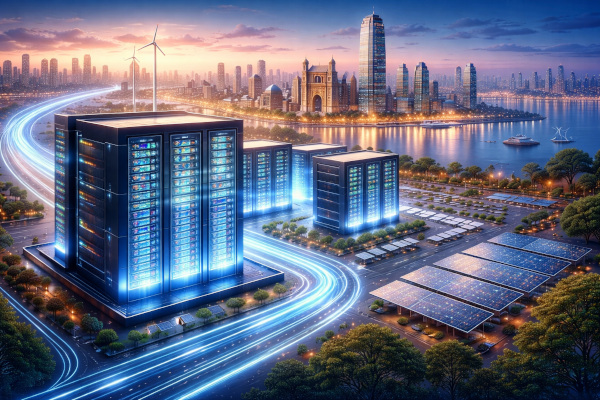
India has entered a decisive new phase in its digital infrastructure story, emerging as the second-largest data centre market in Asia Pacific. With around 1.6 GW of operational capacity, the country is now positioned among the region’s most important digital infrastructure hubs, driven by artificial intelligence, cloud computing, enterprise digitisation, streaming demand, fintech expansion, e-commerce growth and data localisation needs.
This rise is significant because data centres are no longer back-end technology assets hidden behind the digital economy. They are now the physical backbone of artificial intelligence, cloud platforms, digital payments, online education, telemedicine, streaming, gaming, cybersecurity, government platforms, enterprise software and real-time analytics. Every AI query, video call, payment transaction, hospital record, logistics update and digital document depends on servers, power systems, cooling infrastructure, fibre connectivity and secure facilities working continuously in the background.
India’s rise in the Asia Pacific ranking shows how quickly the country’s digital economy has matured. A decade ago, India’s digital infrastructure was largely seen through telecom towers, broadband expansion and software exports. Today, the focus has shifted to hyperscale data centres, sovereign cloud capacity, AI-ready computing clusters and resilient digital infrastructure. The country’s massive internet user base, expanding 5G networks, high mobile data consumption and growing enterprise cloud adoption have created a structural demand for local data storage and processing.
The strongest driver is artificial intelligence. AI workloads require far greater computing density than traditional enterprise applications. Training large models, running inference engines, supporting automation tools and deploying AI services across sectors demand powerful server clusters and high-performance infrastructure. This is why India’s data centre growth is no longer just about storage. It is about compute capacity, latency reduction and the ability to support next-generation digital services at scale.
Hyperscale cloud expansion is the second major force. Global and domestic cloud providers are expanding capacity to serve Indian enterprises, start-ups, government platforms and global capability centres. Microsoft’s largest India data centre is expected to go live in Hyderabad in mid-2026 as part of its wider India expansion, showing how major global technology companies are treating India as a central AI and cloud market.
The scale of the pipeline is even more important than the present capacity. India has around 3.1 GW of data centre capacity under construction or planned, placing it among the top three markets globally by development pipeline. This indicates that investors are preparing for demand far beyond current usage. The pipeline reflects confidence that India’s digital traffic, AI adoption, enterprise cloud migration and consumer internet economy will continue expanding sharply over the next few years.
Another major report from CBRE projects that India’s data centre capacity could cross 3 GW by 2028, supported by hyperscaler demand and AI-led growth. Savills has separately projected India’s data centre capacity to grow at a 23% CAGR and reach about 4 GW IT capacity by 2030, after 162 MW of IT capacity was added in H1 2025 across key markets. These projections show that India’s growth is part of a sustained investment cycle rather than a short-term construction spike.
Mumbai continues to be India’s dominant data centre hub because of its submarine cable connectivity, financial sector demand, cloud ecosystem, enterprise base and strong network density. It serves as a natural landing and exchange point for domestic and international data traffic. For banks, exchanges, fintech firms, cloud companies and global enterprises, Mumbai offers the combination of connectivity, demand and market depth needed for large-scale data infrastructure.
At the same time, India’s data centre geography is expanding beyond one primary hub. Hyderabad, Chennai, Delhi-NCR and Pune are seeing rising investment and development activity. Hyderabad has been highlighted as the top secondary data centre market in Asia Pacific and ninth globally, while Bengaluru is being positioned as a tertiary data centre market in the regional landscape. This decentralisation matters because India needs multiple digital infrastructure clusters to reduce latency, improve resilience and support regional demand.
Hyderabad’s rise is especially important. The city already has a strong base of technology companies, cloud users, global capability centres, skilled talent, land availability and proactive state-level infrastructure support. Its emergence as a major secondary data centre market shows how India’s digital infrastructure growth is beginning to align with its wider technology geography. The same pattern can be seen in Chennai’s cable connectivity advantage, Pune’s enterprise ecosystem and Delhi-NCR’s large consumption and government-linked demand.
Data localisation is another important factor. As more financial, health, government and enterprise data is generated inside India, businesses need secure domestic hosting capacity. Regulatory expectations around data protection, disaster recovery, cybersecurity and business continuity are encouraging companies to keep more digital infrastructure within India. This supports demand for colocation facilities, cloud regions, disaster recovery sites and edge computing nodes.
The economic impact is broad. Data centres require land, power, fibre, cooling systems, electrical equipment, backup systems, security infrastructure, civil construction, water management, skilled engineers and long-term facility management. Their growth creates opportunities for construction companies, electrical equipment manufacturers, HVAC providers, renewable energy developers, network companies, cybersecurity firms and specialised maintenance providers. This makes the data centre boom a manufacturing, infrastructure and services story at the same time.
Power will be the central challenge. Data centres are energy-intensive facilities, and AI workloads increase power density further. India’s ability to build reliable, high-capacity power supply, strengthen transmission infrastructure and integrate renewable energy will determine the quality of this expansion. Globally, limited power availability has become one of the biggest constraints on data centre growth, and India will need careful planning to avoid bottlenecks as demand accelerates.
Cooling is another critical area. India’s climate makes efficient cooling a major design priority. Operators will need advanced cooling architecture, better airflow management, liquid cooling for AI workloads, heat reuse possibilities, water-efficient systems and higher design standards. As server density rises, data centres will have to move beyond conventional cooling models and adopt systems suited to high-performance computing.
Sustainability will define the next phase. Large data centre campuses will be judged not only by capacity, but also by energy source, water use, emissions profile and efficiency ratings. Renewable power procurement, green open access, battery storage, efficient chillers, rainwater harvesting and circular water use will become central to project approvals and customer trust. India’s advantage will grow if it can combine low-cost scale with greener infrastructure.
Cybersecurity and resilience are equally important. As India hosts more critical digital workloads, data centres become strategic infrastructure. They must withstand cyber threats, physical risks, power interruptions, natural disasters and network disruptions. Strong uptime standards, redundancy, disaster recovery architecture and compliance frameworks will become essential for banks, cloud companies, government services, hospitals and enterprises.
The rise of data centres also supports India’s ambition to become a global AI and digital services hub. India already has strong software talent, a large developer base, major global capability centres and a fast-growing start-up ecosystem. The missing layer has often been deep domestic compute infrastructure. As data centre capacity expands, India can host more AI workloads locally, reduce dependence on distant infrastructure and create stronger conditions for domestic AI products.
For ordinary citizens, the impact will be visible in faster apps, smoother digital payments, better streaming, stronger cloud services, improved e-governance platforms and more reliable online services. For businesses, it means lower latency, better compliance, stronger data security and easier cloud migration. For the government, it supports digital public infrastructure, smart cities, health platforms, defence networks and secure public service delivery.
India’s emergence as Asia Pacific’s second-largest data centre market is therefore a major milestone in the country’s digital transformation. It shows that the digital economy is moving from software capability to infrastructure depth. The next challenge is to build this capacity responsibly, with enough power, cooling, land, connectivity, security and sustainability. If India manages that balance, data centres can become one of the strongest pillars of the country’s AI-era economy.
Sources:
Cushman & Wakefield — Global Data Center Market Comparison — https://www.cushmanwakefield.com/en/insights/global-data-center-market-comparison
Fortune India — India emerges as APAC’s second-largest data centre market with 1.6 GW capacity: Report — https://www.fortuneindia.com/amp/story/business-news/india-emerges-as-apacs-second-largest-data-centre-market-with-16-gw-capacity-report/139944
Economic Times — India ranks second-largest market for data center in Asia Pacific — https://m.economictimes.com/industry/cons-products/electronics/india-ranks-second-largest-market-for-data-center-in-asia-pacific/articleshow/131343478.cms
ET Manufacturing — India’s data centre pipeline reaches 3.1 GW, ranks second in APAC market capacity: Report — https://manufacturing.economictimes.indiatimes.com/news/hi-tech/india-emerges-as-asia-pacifics-second-largest-data-centre-market-with-31-gw-pipeline/131344076
Economic Times — India’s data centre capacity to cross 3 GW by 2028 on AI, hyperscaler demand: CBRE — https://m.economictimes.com/industry/services/property-/-cstruction/indias-data-centre-capacity-to-exceed-3-gw-by-2028-fueled-by-ai-demand-and-hyperscale-growth/articleshow/131386729.cms
Savills India — Data Centre Market Watch H1 2025 — https://www.savills.in/research_articles/165611/223883-0
CBRE — Global Data Center Trends 2025 — https://www.cbre.com/insights/reports/global-data-center-trends-2025
Reuters — Microsoft’s biggest India data center on track to go live in mid-2026 — https://www.reuters.com/world/asia-pacific/microsofts-biggest-india-data-center-track-go-live-mid-2026-executive-says-2026-05-19/
You may also like
-
EON Space Labs and Dhruva Space Advance Indian Space Hardware on Transporter-18 Mission
-
SatLeo Labs’ TAPAS-1 Reaches Orbit, Advancing India’s Private Thermal-Imaging Capability
-
TakeMe2Space’s MOI-1A Reaches Space on Falcon 9 Transporter-18 Mission
-
Bank of Baroda Enters Pension Fund Management After PFRDA Appointment
-
SCI and India’s Push for a Larger Indigenous Maritime Fleet
