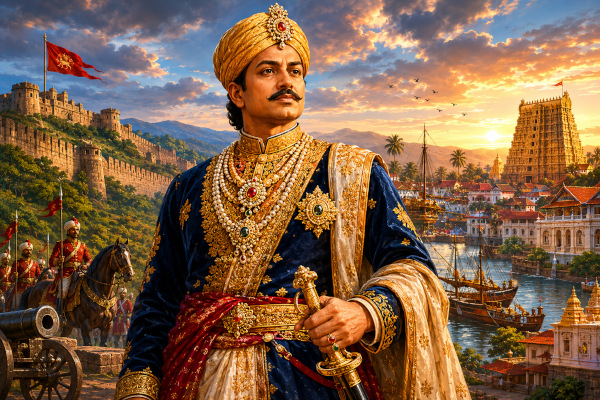
Karthika Thirunal Rama Varma, remembered in Kerala’s history as Dharma Raja, was one of the most important rulers of Travancore after Anizham Thirunal Marthanda Varma. If Marthanda Varma built modern Travancore through conquest, centralisation and military discipline, Dharma Raja preserved it during one of the most dangerous periods in South Indian history. He ruled Travancore from 1758 to 1798, a long reign of nearly four decades, and his period coincided with the rise of Mysore under Hyder Ali and Tipu Sultan, the shifting power of the Dutch and the British, the decline of older Kerala principalities, and the transformation of Travancore from a regional kingdom into a disciplined southern state.
Dharma Raja inherited a kingdom that had already been dramatically reshaped by Marthanda Varma. The Travancore he received was no longer a small Venad principality struggling against local nobles and rival chieftains. It had become a centralised monarchy dedicated to Sree Padmanabha, defended by a standing army, supported by revenue reforms, and strengthened by the military experience of men such as Eustachius De Lannoy. The challenge before Dharma Raja was different from that of his predecessor. He did not have to create Travancore from fragments; he had to keep Travancore alive when a far larger power from Mysore began pushing into Malabar and threatening the southern coast.
His reign is remembered first for firmness. Hyder Ali’s expansion into Malabar created panic among Kerala’s old ruling houses. The Mysorean military machine was large, mobile and aggressive. Malabar’s political order began to collapse under pressure. Travancore, however, stood behind its northern defensive belt, diplomatic caution and military preparedness. Dharma Raja refused to behave like a frightened vassal. He understood that Travancore’s survival depended on three things: keeping its army ready, protecting the northern frontier, and using diplomacy without surrendering sovereignty.
The central symbol of that strategy was Nedumkotta, also called the Travancore Lines. This was not merely a wall; it was a defensive system. It used earthworks, forts, natural barriers, rivers, lakes, hills, trenches and military camps to create a shield across Travancore’s vulnerable northern side. A study published in Heritage: Journal of Multidisciplinary Studies in Archaeology describes Nedumkotta as a rare frontier fortification in Indian history, comparing its defensive purpose to a “Great Wall” and noting that it protected Travancore from Mysorean invasion. The same study states that the line stretched for about 50 km and became a decisive structure in Travancore’s military history.
Dharma Raja’s defensive policy also showed political intelligence. Travancore’s security was linked to Cochin’s survival. If Mysore or any northern power fully dominated Cochin, Travancore’s frontier would become far more exposed. During Dharma Raja’s reign, Cochin increasingly depended on Travancore’s protection, and the construction and strengthening of the northern bulwark became part of this wider security logic. The Nedumkotta study records that Cochin recognised Travancore’s supremacy during this period and that Travancore took responsibility for protecting Cochin from northern threats.
The greatest test came when Tipu Sultan moved against Travancore. Britannica notes that Tipu’s attack on the Raja of Travancore in 1789 provoked British intervention and opened the Third Anglo-Mysore War, which lasted from 1790 to 1792. This is why Dharma Raja’s reign has importance far beyond Kerala. Travancore was not simply defending a local border; it became the trigger point in a major South Indian war involving Mysore, the British East India Company and other regional powers.
The clash at Nedumkotta became one of the most dramatic episodes in Kerala’s military memory. Tipu’s forces advanced towards the Travancore Lines in late 1789. The fortification slowed the Mysorean attack, caused confusion in the invading army, and gave Travancore the time and terrain advantage it needed. The archaeological study records the Mysorean advance towards Nedumkotta, the crossing attempt near Cheruputhumala on 28 December 1789, the unexpected Travancore counterattack, the damage caused to Mysorean forces, and the later Mysorean return with heavier artillery and infantry in 1790. The larger historical result was clear: Travancore was not absorbed by Mysore. Dharma Raja’s kingdom survived.
Dharma Raja’s greatness, however, was not only military. His title itself points to his image as a ruler of justice and protection. He became known as Dharma Raja because he was remembered as a king who gave refuge to people fleeing the upheavals in Malabar during the Mysorean campaigns. Later tradition especially remembers him as a protector of displaced Hindu and Christian families from the north. While the details of this period are often narrated with strong political and religious emotion, the broad historical image is consistent: Travancore under Dharma Raja became a place of asylum during one of Kerala’s most disturbed centuries.
His administration also strengthened Travancore’s internal economy. One of the most important figures of his reign was Raja Kesava Das, the Diwan of Travancore. Under Dharma Raja’s rule, Kesava Das helped develop Alappuzha into a major port town. The official Alappuzha district history says that during Dharma Raja’s reign the district improved “by all means” and that Raja Kesava Das, known as the Maker of modern Alleppey, built roads, canals and warehouses, gave facilities to merchants and traders, and turned Alappuzha into a premier port town of Travancore. This was statecraft in the practical sense: defence required revenue, revenue required trade, and trade required ports, canals, roads and storage.
This port-building vision was not a small matter. Kerala’s economy had long depended on maritime trade, pepper, coir, timber, spices and coastal exchange. By developing Alappuzha, Travancore reduced dependence on rival ports and gave itself a stronger commercial base. In modern strategic language, Dharma Raja’s Travancore was creating economic depth behind a defensive frontier. A kingdom that could trade, tax, move goods and support merchants could also maintain soldiers, repair forts, manufacture supplies and survive war pressure.
Dharma Raja also presided over an important cultural and political shift: the gradual movement of Travancore’s capital from Padmanabhapuram to Thiruvananthapuram. A Kerala Government archaeology document records that Karthika Thirunal Rama Varma, also known as Dharma Raja, gradually shifted the capital from Padmanabhapuram to Thiruvananthapuram in the 1790s. This was a turning point in the history of Travancore. Thiruvananthapuram would later become the enduring political and cultural centre of the state, closely tied to Sree Padmanabhaswamy Temple, royal administration, learning, music and public institutions.
Dharma Raja was also a patron of art and literature. He is associated with Balarama Bharatam, a Sanskrit treatise on natyam and performance traditions, and is remembered as a ruler with deep interest in music, dance and Kathakali. Modern discussions of Kerala’s classical performance traditions often mention Balarama Bharatam as an important text connected with Kerala’s dance grammar and stage practice. This makes him unusual among warrior-kings: he was a ruler of forts and armies, but also a ruler of aesthetics, theatre and temple-centred culture.
His reign therefore had three faces. The first was the guardian of the frontier, who resisted Mysorean expansion and preserved Travancore’s sovereignty. The second was the administrator, who supported trade, ports, roads and internal communication through capable ministers like Raja Kesava Das. The third was the dharmic ruler, remembered for sheltering the distressed and supporting the cultural life of his kingdom.
Dharma Raja’s place in Kerala history is sometimes overshadowed by Marthanda Varma’s larger-than-life reputation. That is unfair. Marthanda Varma was the architect; Dharma Raja was the protector. Marthanda Varma broke the power of rebellious nobles and rival kingdoms; Dharma Raja stood against the storm from Mysore. Marthanda Varma created the military state; Dharma Raja tested whether that state could survive a regional superpower. It did.
His legacy is not the legacy of a conqueror chasing glory. It is the legacy of a ruler who understood that sovereignty is preserved by patience, preparedness, diplomacy and moral courage. He did not allow Travancore to become reckless, but he also did not allow it to become submissive. He built walls where walls were needed, opened ports where wealth was needed, welcomed refugees where compassion was needed, and shifted the capital where the future required it.
In the history of Kerala, Dharma Raja / Karthika Thirunal Rama Varma stands as the king who held the line. He inherited a strong Travancore, but he made sure it survived its most dangerous test. He proved that dharma in kingship was not mere temple ritual or royal title. It meant protecting the land, defending the weak, preserving order, rewarding talent, supporting culture and refusing to surrender the dignity of the state. That is why his name remained Dharma Raja — not merely Rama Varma of Travancore, but the king whose rule became a shield.
You may also like
-
Rare Stone Features Emerge as Kerala Archaeology Department Restores Megalithic Kudakkals at Karivellur
-
Vidarbha in the Mahabharata: The Ancient Kingdom of Damayanti in Eastern Maharashtra
-
Abhira in the Mahabharata: The Pastoral People of Western India and the Northern Deccan
-
Nasikya in the Mahabharata World: The Ancient Nashik Region on the Upper Godavari
-
Bharukachchha in the Mahabharata: The Ancient Port of Bharuch at the Mouth of the Narmada
