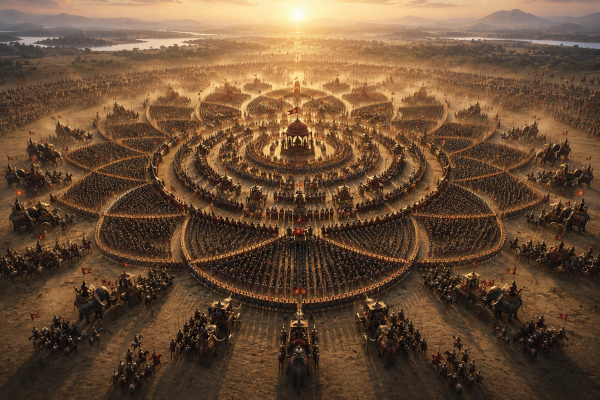
At Kurukshetra, an army did not simply march as a crowd of warriors. It moved as a designed battlefield organism. Chariots formed striking lines, elephants gave mass and fear, cavalry flowed along the flanks, infantry held the body of the formation, and commanders arranged the whole force into shapes that carried tactical meaning. These formations were called Vyuhas — deliberate military arrays meant to direct force, protect key leaders, deceive the enemy, concentrate pressure, absorb attack or create a trap. The Mahabharata preserves many such battlefield arrangements, while Kautilya’s Arthashastra later gives systematic discussion of arrays, wings, flanks, fronts, reserves and specialised battlefield roles.
Modern armies use different weapons, sensors and command systems, but the core logic feels familiar. A modern commander still thinks in terms of main effort, supporting effort, reserve, penetration, envelopment, defensive depth, all-round protection, deception and protected high-value targets. U.S. Army doctrine describes warfighting functions as groups of tasks and systems that commanders integrate and synchronize to generate combat power, and it specifically stresses combined-arms employment by task, purpose and time. The Mahabharata’s Vyuhas can therefore be read as ancient battlefield geometry performing the role that modern doctrine now expresses through maps, formations, sectors, fire plans, ISR grids, armour thrusts and layered defences.
What a Vyuha Really Was
A Vyuha was more than a beautiful shape. It was a command arrangement. Each part of the formation had a role: the mouth or beak could act as the spearhead, the wings could protect flanks or envelop, the centre could hold senior commanders or reserves, the rear could protect continuity, and the tail could preserve depth. The Mahabharata gives vivid examples of commanders placing named warriors in the beak, eyes, head, neck, wings, back and tail of formations such as Garuda, Makara and Krouncha.
In modern language, a Vyuha combined organisation, manoeuvre and psychology. It told every commander where he stood, where the pressure would fall, where the elite warriors were placed, and which part of the army carried the decisive mission. The battlefield shape also sent a message to the enemy: a circular formation warned of entrapment, a needle formation announced penetration, a bird formation displayed wings and beak, and an all-sided formation signalled readiness against threats from every direction.
1. Chakra Vyuha: The Circular Trap and the Problem of Incomplete Knowledge
The Chakra Vyuha is the most famous battlefield formation in Indian memory because of Abhimanyu’s tragedy. In the Drona Parva, the formation is described as an impenetrable circular array created during Drona’s command. Abhimanyu enters it with extraordinary courage, breaks through many layers and causes havoc inside the Kaurava ranks, but he is later surrounded and killed after multiple senior warriors combine against him.
The military logic of the Chakra Vyuha is layered defence with controlled access. The enemy enters through one point, but once inside, the formation closes, redirects movement and isolates the attacker. In modern terms, it resembles a mix of defence in depth, kill zones, encirclement, access denial and command-channel control. A soldier or unit may breach the first layer, yet survival depends on knowing how to move through the next layers, where to turn, when to disengage and how supporting forces will follow.
The Abhimanyu episode is also a lesson in training completeness. He had the knowledge and courage to enter the formation, but the surrounding force failed to maintain the penetration. Modern armies recognise the same danger. A special force, armoured spearhead or infantry assault group can enter a hostile zone, but extraction, reinforcement, fire support, medical evacuation and communications must be planned before entry. Tactical brilliance can create a breach; operational planning keeps the breach alive.
Modern parallel:
In modern warfare, the Chakra Vyuha can be compared with layered defence systems designed to draw an attacker into a controlled battle space. A force may breach the outer line, but deeper defensive rings, overlapping fires, surveillance grids, mines, drones, artillery and mobile reserves can isolate it from support. This is similar to urban traps, fortified defensive belts, anti-access zones and integrated air-defence networks where entry is possible only at high cost. The Abhimanyu episode becomes a timeless lesson in breach planning: entry into a hostile system must be supported by extraction, reinforcement, communication and follow-on forces.
2. Padma Vyuha: The Lotus Formation and Layered Protection of the Centre
The Padma Vyuha, or lotus formation, can be understood as a layered arrangement built around a protected core. The Drona Parva describes a powerful formation in which Drona created a structure partly shaped like a cart and partly as a circle, with another impenetrable lotus-like array in the rear and a needle-shaped formation inside that lotus. Jayadratha was protected deep inside this arrangement.
The lotus metaphor is important. A lotus has layers of petals around the centre. Militarily, this suggests successive defensive layers around a high-value person, objective or command node. The outer petals absorb pressure, the inner petals delay penetration, and the centre remains protected until the attacker spends time, energy and lives moving through the structure.
In modern warfare, the Padma Vyuha resembles layered protection of command headquarters, missile batteries, logistics hubs, leadership shelters or strategic assets. A modern high-value target may be protected by outer surveillance, patrol screens, drones, ground sensors, infantry positions, armour, air defence and electronic warfare. The geometry has changed; the principle remains the same: the attacker must cross many layers before reaching the protected centre.
Modern parallel:
The Padma Vyuha resembles the modern protection model used around high-value military assets such as command headquarters, missile batteries, airbases, naval task groups and strategic leadership sites. The outer layers absorb pressure, the middle layers delay the attacker, and the inner core preserves the critical asset. Modern equivalents include layered base defence with radar, patrols, air defence, electronic warfare, drones, infantry screens and quick reaction teams. The logic is simple: the most valuable target survives because the enemy is forced to spend time, resources and momentum crossing one protective ring after another.
3. Garuda Vyuha: Bird-Shaped Manoeuvre and the Power of Wings
The Garuda Vyuha is one of the clearest examples of battlefield anatomy in the Mahabharata. In the Bhishma Parva, Bhishma forms a mighty array named after Garuda. The text places Bhishma at the beak, Drona and Kritavarman as the eyes, other warriors in the head and neck, Duryodhana on the back, and different tribal and regional forces in the wings and tail.
This formation shows advanced thinking about front, flanks, centre and rear. The beak acts as the striking point. The eyes give battlefield awareness. The wings provide lateral reach. The back gives depth. The tail protects continuity. For a commander, this is a structured way to decide who attacks, who supports, who watches, who protects, and who stabilises the force if the front becomes chaotic.
The modern equivalent is the use of wings and centre in manoeuvre warfare. Armoured and mechanised formations often employ a strong central thrust supported by flank security, reconnaissance, artillery, reserves and follow-on forces. Air forces also think in terms of packages: strike aircraft, escorts, electronic warfare aircraft, refuellers, airborne early warning and suppression elements. Garuda Vyuha expresses the same principle in ancient terms: a successful strike needs eyes, beak, wings and body.
Modern parallel:
The Garuda Vyuha has a strong modern parallel in combined-arms manoeuvre, where a main striking element is supported by flanks, reconnaissance, reserves and rear protection. The beak of Garuda can be compared to the main assault force, while the wings resemble flank guards or enveloping arms that prevent the enemy from escaping or counterattacking freely. Modern armoured formations, mechanised battle groups and even air-strike packages follow similar logic: the strike element needs eyes, protection, mobility and follow-through. A successful modern operation works like Garuda because the centre, wings and rear act together under one design.
4. Vajra Vyuha: Thunderbolt Formation and Concentrated Shock
Vajra means thunderbolt or diamond. The image suggests hardness, focus and impact. Kautilya’s Arthashastra describes Vajra as a form of detached-order array involving five divisions of the army. The deeper military idea is a formation that can strike with concentrated force while retaining internal strength across more than one point.
As a tactical idea, Vajra Vyuha is best understood as shock concentration. It is the formation of warriors meant to smash into an enemy line with compact power. A thunderbolt does not spread gently; it lands with force. On a battlefield, this means elite warriors, mobile units and heavy elements are placed in a way that can create a decisive rupture.
The modern comparison is the armoured spearhead, the wedge formation, or the breakthrough battle group. Tanks, infantry combat vehicles, engineers, artillery and drones may be concentrated for one violent thrust through a weak or selected point. The objective is to break the enemy’s line, disrupt command, create panic and widen the breach before reserves arrive.
Modern parallel:
The Vajra Vyuha closely matches the modern idea of concentrated shock action. In today’s battlefield, this may appear as an armoured spearhead, a mechanised thrust, a breakthrough force or a heavily supported assault group aimed at cracking a selected weak point in the enemy line. Tanks, infantry combat vehicles, engineers, artillery, drones and electronic warfare assets are concentrated along one decisive axis to create rupture. The thunderbolt image remains powerful because modern commanders still seek the same effect: strike hard, break cohesion, widen the breach and create panic before the defender can reorganise.
5. Makara Vyuha: The Crocodile Formation and Controlled Absorption
The Makara Vyuha is described in the Bhishma Parva with impressive detail. Yudhishthira asks Dhrishtadyumna to arrange the Pandava troops in Makara formation. Drupada and Arjuna form the head, Nakula and Sahadeva the eyes, Bhima the beak, Abhimanyu, the sons of Draupadi, Ghatotkacha, Satyaki and Yudhishthira occupy the neck, while other commanders hold the back, wings, feet and tail.
The crocodile image suggests hidden strength, sudden bite and powerful forward grip. A Makara formation could be used to present a strong head, draw an enemy towards the mouth and then press from supporting sides. The beak or jaws carry the immediate offensive role, while the body preserves mass and endurance.
Modern warfare has similar concepts in defensive-offensive traps. A commander may allow the enemy to enter a chosen engagement area, then use artillery, anti-armour weapons, drones, armour reserves and flank fire to destroy the exposed force. The idea is less about passive defence and more about controlled absorption followed by violent reaction.
Modern parallel:
The Makara Vyuha can be compared with a modern defensive trap or counterattack formation. A commander may present a strong front, absorb the enemy’s advance into a chosen engagement area, and then strike from prepared positions using armour, artillery, anti-tank teams, drones and reserves. The crocodile image is useful because the formation appears patient and controlled before delivering a sudden bite. Modern battlefield ambushes, anti-armour kill zones and elastic defence tactics use the same logic of drawing the enemy forward and then closing pressure from multiple points.
6. Krouncha Vyuha: Crane Formation and Focused Breakthrough
The Krouncha Vyuha, often understood as crane or heron formation, appears as another bird-shaped array. The Bhishma Parva describes Bhishma arranging his army in the form of a huge crane in response to the Pandava Makara. Drona is placed at the beak, Ashwatthama and Kripa as the eyes, Kritavarman and others in the head, Duryodhana in the neck, with major forces placed across the breast, wings and rear.
The crane image suggests a long beak, watchful eyes and extended wings. Militarily, this works as a formation for probing, piercing and controlled advance. The beak can test or strike the enemy’s front while the wings prevent the formation from being enveloped. The eyes indicate observation and command awareness, a vital requirement when the formation stretches across a wide frontage.
Modern forces use similar concepts when they combine reconnaissance, lead assault elements and flank security. In mountain warfare, river crossings or defended corridors, the leading force may act as the beak while supporting arms cover the sides. The Krouncha Vyuha therefore offers a useful ancient image for narrow-front pressure supported by broader battlefield control.
Modern parallel:
The Krouncha Vyuha resembles a probing or breakthrough formation built around a sharp forward element and protected wings. Modern forces use similar designs during reconnaissance-in-force, corridor penetration, mountain assaults, river crossings and attacks through narrow terrain. The leading element tests or pierces the enemy line, while flank units protect the advance and prevent encirclement. This makes Krouncha useful as a model for controlled forward pressure, where the commander wants penetration without losing formation balance.
7. Suchimukha Vyuha: Needle-Point Penetration and Precision Entry
Suchimukha means needle-mouthed or needle-pointed. In the Drona Parva, Krishna explains that Drona will create a formation partly shaped like a cart and partly like a lotus, with a needle-mouthed array inside the lotus. Jayadratha is placed in relation to this protected formation, guarded by major warriors. A later passage again describes the Sakata-circle structure, the lotus in the rear and the dense needle array within it.
The Suchimukha formation is a brilliant military concept because it expresses narrow entry, deep concentration and protected penetration. A needle does not push everywhere; it enters through one fine point. In battlefield terms, this means choosing a narrow axis, concentrating elite force, piercing through a specific gap and moving towards a selected objective.
Modern warfare uses this idea through special forces raids, precision strike corridors, armoured breach lanes, air assault insertions and cyber-electronic openings. The aim is to avoid broad attrition and instead create a precise opening. Suchimukha is therefore one of the most modern-feeling Vyuhas: compact, sharp, objective-driven and dependent on timing.
Modern parallel:
Suchimukha Vyuha is one of the most relevant formations for modern precision warfare. Its needle-point logic resembles special forces insertion, armoured breach lanes, commando raids, helicopter-borne assaults and precision strike corridors. Instead of spreading force across a wide front, the commander concentrates elite capability at a narrow point to enter deep into the enemy system. Modern militaries use this logic when they target command centres, radar sites, bridges, air-defence gaps or logistical chokepoints with focused speed and surprise.
8. Shakata Vyuha: Cart Formation and Defensive Mass
Shakata means cart. In the Jayadratha episode, Drona’s formation is described as partly Shakata and partly circular, with a lotus behind it and a needle formation inside that lotus. The text gives the arrangement impressive scale, describing its length and rear width while explaining how Jayadratha was protected behind layers of warriors.
The cart shape suggests broad defensive structure, protected rear and load-bearing centre. A cart has a front, axle, body and rear. As a military metaphor, it can protect something valuable inside while using its shape to manage movement and resistance. In the Jayadratha context, it becomes part of a nested defence, combining broad frontage with deeper protected layers.
Modern comparison may be drawn with convoy defence, logistics base defence, headquarters protection and layered blocking positions. A modern army must protect command vehicles, ammunition columns, bridging equipment, fuel trucks and communications nodes. Shakata Vyuha reminds us that battlefield formations often exist to protect what keeps the army functioning, rather than only to create dramatic charges.
Modern parallel:
The Shakata Vyuha can be linked with modern defensive arrangements used to protect logistics, headquarters, convoys and command vehicles. A cart carries something valuable, and the military meaning of the formation lies in protecting the load-bearing centre while keeping movement possible. Modern armies use similar thinking when they secure supply columns, ammunition depots, fuel convoys, mobile command posts and field headquarters. The lesson is highly practical: an army’s combat edge depends on the safety of the systems that feed, fuel, command and sustain it.
9. Sarvatobhadra Vyuha: All-Round Defence in a Threat-Rich Battlefield
Sarvatobhadra means secure or auspicious from all sides. Traditional discussions of ancient Indian formations associate Sarvatobhadra with situations where threats may come from every direction. One modern summary of classical formation logic lists Sarvatobhadra and Danda among arrays used when attack is expected from all sides.
This is perhaps the easiest Vyuha to understand in contemporary terms. Modern battlefields are increasingly 360-degree threat environments. A unit may face drones from above, artillery from distance, anti-tank teams from flanks, cyber disruption in networks, special forces raids in the rear and missiles from long range. Defence therefore has to be circular, layered and alert in every direction.
U.S. Army doctrine defines a defensive sector as an area with rear and lateral boundaries and interlocking fires, and it also describes support-area operations as actions that secure lines of communication, bases and clusters enabling sustainment and command-and-control. That is the modern spirit of Sarvatobhadra: protect the whole force, keep the rear alive, maintain command, and ensure every direction has eyes and response capacity.
Modern parallel:
Sarvatobhadra Vyuha has become even more relevant in the age of drones, missiles, cyber disruption and long-range precision weapons. A modern force must protect itself from front, rear, flanks and airspace at the same time. Convoys, forward operating bases, naval ships, border posts and airbases all require all-round defence with surveillance, counter-drone systems, patrols, air defence, electronic monitoring and quick reaction teams. The ancient idea of being secure from every side fits perfectly into today’s 360-degree battlefield, where threats can emerge from any direction and at any speed.
Vyuha Doctrine and Modern Warfare: The Deeper Connection
The most important lesson from the Vyuhas is that shape expresses intention. A circular formation traps. A lotus protects. A bird formation manoeuvres through wings and beak. A thunderbolt concentrates. A crocodile absorbs and bites. A crane pierces with a controlled front. A needle enters precisely. A cart protects structure. An all-sided formation survives in every direction.
Modern armies use maps, digital command systems, satellite imagery, drones, radios, air defence networks and precision weapons, yet the commander’s mind still works through shapes: axes of advance, defensive belts, engagement areas, fire sacks, corridors, flanks, reserves, kill zones, support areas and secure perimeters. The technology has changed; the grammar of manoeuvre remains recognisable.
The Mahabharata’s battlefield formations also remind us that an army is a thinking institution. Courage alone cannot arrange a Vyuha. It requires knowledge of terrain, enemy strength, troop morale, commander capability, timing, reserves and political purpose. The epic therefore gives India a rich defence vocabulary that can be studied with seriousness: not as fantasy weaponry, but as civilisational memory of command, geometry, movement and battlefield psychology.
The positive value of studying Vyuhas today lies in this disciplined insight: ancient Indian military thought understood that victory depends on organised force. A warrior may win a duel, but a commander must design the battlefield. From Chakra to Sarvatobhadra, the Mahabharata teaches that the strongest army is the one whose many arms move as one mind.
You may also like
-
Dixon Technologies Plans Entry Into Aerospace and Defence Electronics as Next Growth Frontier
-
DRDO Secures Patent for Indigenous BAM-H24 High-Energy Fuel for Advanced Solid Rocket Propulsion
-
DRDO Targets 80-Km Range and 10-Metre Precision for Ramjet-Powered 155mm Artillery Projectile
-
Indrajaal Expands Made-in-India AI-Powered Anti-Drone Defence for Critical Infrastructure
-
Japanese Contingent Arrives in Jodhpur Ahead of Veer Guardian 2026 Air Exercise
