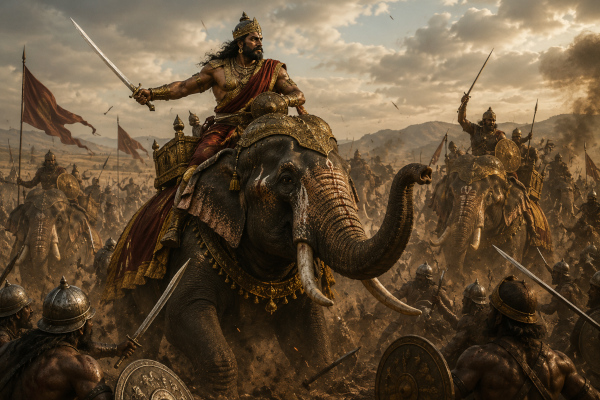
Kanaikkal Irumporai was one of the memorable Chera rulers preserved in Tamil Sangam literary tradition, especially through the fierce world of war poetry, royal pride and conflict among the ancient Tamil powers. He belonged to the Chera line remembered by the name Irumporai, a branch associated in literary memory with the western Tamil region, port towns, elephant armies and rivalry with the Cholas and Pandyas. Unlike later kings whose lives are recorded through inscriptions, temple grants and copper plates, Kanaikkal Irumporai survives mainly through poetry. His exact birth, parentage, queen, children and administrative career are not securely preserved, but his name has endured because Sangam literature gave him something even stronger than a royal genealogy: a dramatic moral image of a king who could accept defeat in war but not humiliation in captivity.
The Cheras were one of the three crowned dynasties of ancient Tamilakam, along with the Cholas and the Pandyas. Their power stretched across the western side of the Tamil cultural world and was connected with inland capitals, hill routes, ports, elephants, pepper, maritime trade and bardic courts. Kanaikkal Irumporai appears within this larger Chera setting as a ruler linked with the Irumporai tradition and with the region around Tondi, an important port-centre in early Tamil political memory. Tondi was not merely a coastal settlement; it represented wealth, movement, trade and military access. A ruler associated with such a centre would have commanded both inland martial resources and coastal prestige.
Kanaikkal Irumporai’s personal family history remains unclear, but his royal identity is firm in literary tradition. The title “Irumporai” itself carried the weight of a Chera lineage known from Sangam poems. In that old Tamil world, dynastic legitimacy was expressed not only through ancestry but also through conduct. A king had to be brave in battle, generous to poets, fierce to enemies and dignified in hardship. Kanaikkal Irumporai’s story fits this ideal perfectly. He is remembered not for palaces, temples or inscriptions, but for war, captivity and a final act of royal self-respect.
One of the harsh episodes associated with him concerns his conflict with a local chieftain or warrior named Muvan. Literary tradition says Kanaikkal Irumporai defeated Muvan and displayed his victory in a severe and public manner. The story claims that Muvan’s teeth were pulled out and fixed on the gate of Tondi as a warning to rivals. This is a brutal image, but it belongs to the violent political atmosphere of the Sangam age, where kingship was inseparable from punishment, revenge and the visible assertion of power. Victory had to be seen. A defeated enemy was not merely overcome; he was made into a message. Through this episode, Kanaikkal Irumporai appears as a ruler who projected authority aggressively and defended his prestige with terrifying force.
His greatest historical memory, however, comes from his conflict with the Chola king Sengannan, also known in tradition as Kochchenganan or Chenkannan. This Chera-Chola conflict became famous because it entered two important streams of Tamil literary memory: Purananuru and Kalavazhi Narpathu. The battleground is remembered in different traditions as Thirupporppuram and Kazhumalam, but the core story remains the same: Kanaikkal Irumporai fought a major war against the Chola power, lost the battle, and was taken prisoner.
The war was remembered as a violent clash of elephant forces and royal armies. In ancient Tamil warfare, elephants were among the greatest symbols of military wealth and battlefield power. A king’s elephant corps was both a weapon and a statement of status. The destruction of such a force meant more than a tactical defeat; it meant the breaking of royal pride. Kalavazhi Narpathu, attributed to the poet Poygaiyar, preserves the atmosphere of this battlefield with images of fallen warriors, broken formations, blood-soaked ground and ruined elephant strength. The poems are not dry historical notes. They are battlefield memory turned into literature, capturing the cost of war in a language of dust, iron, flesh and honour.
Kanaikkal Irumporai’s defeat by Sengannan became the defining moment of his life. Some traditions describe him as fighting fiercely even after his forces suffered heavy losses. He is said to have entered the field with rage and determination, striking back against the Chola side before finally being overcome. After the battle, he was captured and imprisoned, traditionally at Kudavayil fort. For a king of his world, captivity was worse than military loss. On the battlefield, a warrior could die with weapons, drums and honour around him. In prison, he lived at the mercy of his enemy.
The most powerful version of his end is preserved in the tradition around Purananuru 74, a poem attributed to Kanaikkal Irumporai himself. The poem presents him as a captured Chera king who asks his captors for water. The water is delayed, and when it finally arrives, it comes without the respect due to a king. That moment becomes unbearable. In the moral universe of the poem, a ruler born into a warrior lineage cannot live after being reduced to such dependence. The poem recalls the severe pride of martial clans, where even a stillborn child might be touched by the sword so that it would not be denied warrior dignity. Against that background, the humiliation of begging for water from enemies becomes worse than death. Kanaikkal Irumporai refuses to live under dishonour and dies, turning his captivity into one of the most intense statements of royal pride in early Tamil literature.
This death scene is the reason Kanaikkal Irumporai remains unforgettable. He is not remembered as the greatest conqueror among the Cheras. He is remembered as a defeated king who transformed defeat into moral victory. The Chola may have won the battle, but the Chera king seized control of his own memory. By choosing death over humiliation, he became larger than the prison that held him. Sangam poetry often measures kings by the quality of their giving, fighting and dying; in Kanaikkal Irumporai’s case, it is his refusal to live without dignity that gives him lasting stature.
There is also another literary tradition connected with Kalavazhi Narpathu, where the poet Poygaiyar is said to have praised the victorious Chola king and secured the release of the imprisoned Chera ruler. This creates a difference between two memories: one in which Kanaikkal Irumporai dies in prison after refusing dishonour, and another in which poetry becomes powerful enough to soften the victor and free the captive king. Rather than weakening the story, this difference shows how deeply his defeat affected Tamil imagination. One tradition turned him into a martyr of honour; another turned his story into a celebration of poetic diplomacy and the bond between king and bard.
The presence of Poygaiyar in the tradition is important. In the Sangam world, poets were not merely entertainers. They carried reputation across regions and generations. They praised kings, criticised them, mediated between rulers and preserved the moral meaning of political events. If Kanaikkal Irumporai survived in memory, it was because poets gave language to his world. A battlefield without poetry would have vanished into dust; poetry made it permanent.
There is no strong evidence to credit Kanaikkal Irumporai with major architectural works, temples, public buildings or administrative reforms. His legacy belongs to the older heroic age of Tamilakam, where kings were remembered through martial episodes rather than stone inscriptions. This does not make him less important. It places him in a different kind of history — one where literature becomes the archive. Through Purananuru and Kalavazhi Narpathu, he stands as a figure of Chera identity, Chola rivalry, elephant warfare and royal self-respect.
His story also reflects the intense rivalry among the three crowned Tamil powers. The Cheras, Cholas and Pandyas belonged to the same broad Tamil cultural world, shared similar poetic values and honoured the same ideals of generosity and courage, yet they repeatedly fought each other for territory, tribute and supremacy. Kanaikkal Irumporai’s fall to Sengannan is one such episode where Tamil martial greatness turned inward. It produced magnificent poetry, but behind that poetry stood real destruction: dead soldiers, broken elephant corps, captured rulers and grieving courts.
Kanaikkal Irumporai remains one of the most tragic Chera figures because his fame is built not on triumph but on the way he faced ruin. He shows that ancient Tamil kingship was not merely about conquest. It was about reputation, honour and the ability to preserve dignity even when power had been stripped away. In his life, the glory of the Cheras, the violence of war, the authority of poetry and the severity of warrior ethics all come together.
In the end, Kanaikkal Irumporai belongs to that rare class of rulers whose defeat made them immortal. His kingdom may not be mapped with certainty, his palace has not survived, and his family details are lost to time, but his final image remains sharp: a Chera king in enemy captivity, thirsty but proud, refusing water that came without honour. That is why his name still carries force. He lost the battlefield, but in the memory of Tamil literature, he did not lose himself.
You may also like
-
Kapisa: The Ancient Kingdom North of Kabul at the Gateway of the Hindu Kush
-
Lampaka: The Mountain Kingdom of Laghman on the Kabul River Frontier
-
Navaratri and Ayurveda: The Nine Divine Medicinal Plants Associated with Navadurga
-
Bahlika: The Ancient Bactrian Realm of Balkh in the Mahabharata
-
Kamboja: The Horse-Breeding Frontier Kingdom of the Hindu Kush in the Mahabharata
